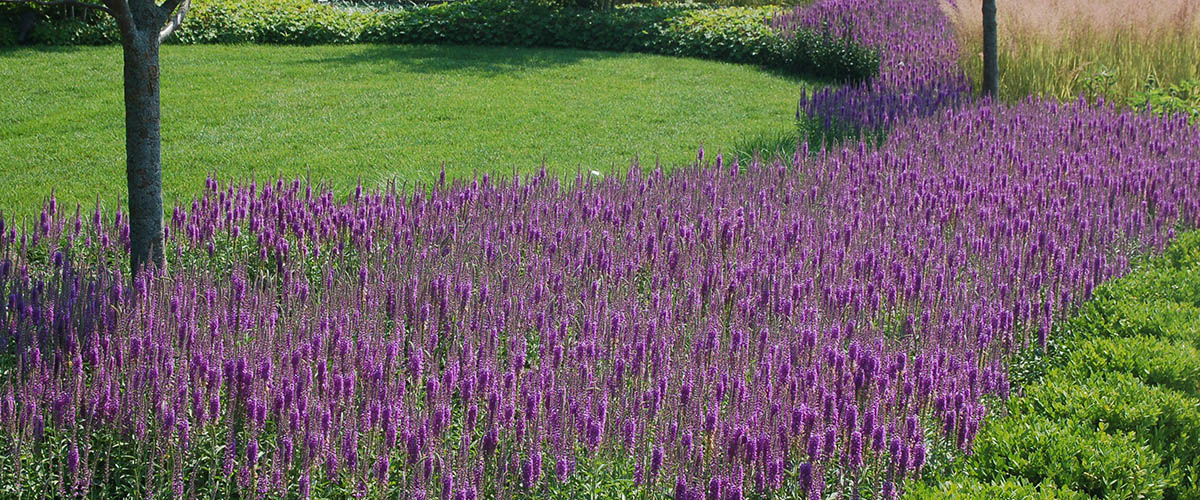
Evaluating Perennials for Chicagoland Gardens
Perennials in Focus is a plant evaluation program that examines new and underused plants for Chicagoland, the third largest metropolitan area in the country. A group of horticultural experts trials and evaluates plants at numerous locations across the region. Results help consumers, public gardens, growers, landscape designers, breeders, and other industry professionals make informed plant choices.
How to design a perennial border with year-round appeal
A perennial border should have something to offer after the last flowers fade. In the Chicagoland region, that means planning for spring emergence, summer bloom, autumn color, and winter structure while choosing plants that can tolerate changing temperatures, snow, moisture, and periods of drought.
Flowers naturally attract attention, but they are only one part of a successful planting. Leaf shape, foliage color, plant form, seed heads, stems, and the way neighboring plants fill space determine whether a border feels intentional throughout the growing season.
The most reliable designs begin with observation. Regional trial results, botanical gardens, and established local plantings can reveal which perennials maintain strong habits rather than collapsing after bloom. The regional plant snapshots from Perennials in Focus offer useful examples of how individual plants perform across seasons and gardens.
Start with structure instead of bloom time
Build the border around a framework of dependable forms. Upright plants create vertical accents, mounded perennials soften edges, and spreading or arching plants connect separate groups. Repeat these forms throughout the bed so the composition remains recognizable when individual flowers disappear.
Evergreen or semi-evergreen foliage can anchor the foreground, while sturdy stems and persistent seed heads provide interest farther back. Plants such as ornamental grasses, baptisia, sedums, ornamental alliums, and coneflowers can hold their shape well into autumn and winter, depending on the cultivar and site.
Avoid relying on a single row of plants that all reach the same height. A flat arrangement may look acceptable during peak bloom, then expose gaps and bare stems later. Instead, create overlapping layers with a clear rhythm from the front edge to the tallest background plants.
Treat foliage as the main design material
Leaves often remain visible for much longer than flowers, so compare foliage with the same care given to bloom color. Broad, rounded leaves contrast with narrow grass blades, while finely divided foliage can lighten dense plantings. Silver, blue, burgundy, chartreuse, and deep green leaves create color relationships even on cloudy days.
Texture also affects how a border looks from a distance. Bold leaves make a planting feel substantial and can disguise declining stems nearby. Fine textures add movement and allow views through the border. Combining both prevents the bed from becoming visually heavy or monotonous.
Place plants with attractive foliage where they can be seen regularly. A low mound of clean leaves near a walkway may contribute more to the garden’s appearance than a short-lived flower hidden behind taller plants. When evaluating candidates, note how long the foliage stays healthy, whether it flops, and whether it becomes ragged after flowering.
Use layers for seasonal continuity
Plan the bed in vertical layers: low edging plants, middle-height masses, tall accents, and occasional transparent plants that rise above the main canopy. This arrangement supports visual interest at different distances and gives each plant enough room to display its habit.
Early-season bulbs and emerging perennials can occupy spaces that later become shaded by larger plants. Spring ephemerals, low sedums, and compact heucheras help cover bare soil before summer growth fills the border. In the middle layer, choose reliable clumps that remain attractive after bloom, such as catmint, cranesbill, yarrow, or selected ornamental grasses.
Tall plants should be distributed rather than concentrated in one block. Repeating them in loose groups creates movement and prevents the border from looking like a solid wall. Leave some breathing room between major groups so individual silhouettes remain visible.
| Design role | Useful characteristics | Seasonal contribution |
|---|---|---|
| Front-edge plants | Compact habit, clean foliage, tolerance for occasional trimming | Defines the border and covers soil |
| Middle-layer perennials | Dense clumps, long-lasting leaves, moderate height | Carries the display between bloom periods |
| Tall structural plants | Strong stems, upright or vase-shaped form | Adds height in summer, autumn, and winter |
| Transparent accents | Airy stems, fine foliage, open branching | Creates movement without blocking views |
| Winter-interest plants | Persistent seed heads or sturdy stems | Extends structure after frost |
Repeat plants to create visual rhythm
Repetition is one of the simplest ways to make a mixed border feel cohesive. Rather than selecting one specimen of every appealing plant, use several plants in connected groups. Repeated foliage colors and forms guide the eye across the bed and make seasonal changes feel deliberate.
Groups do not need to be perfectly symmetrical. Odd-numbered clusters can look natural in informal gardens, while broad drifts suit larger landscapes. Repeat a plant at intervals instead of placing every member of a group together, especially when the border is viewed from several directions.
Use contrast selectively. A bright golden grass may be effective as a recurring accent, but too much high-contrast foliage can make the border restless. Balance vivid plants with greens, muted blues, and textural forms that support the composition between flowering peaks.
Match plants to Chicagoland conditions
A plant that looks excellent in a catalog may perform differently in a residential border. Soil compaction, reflected heat, winter moisture, salt exposure, shade from buildings, and competition from tree roots all influence long-term appearance. Select plants according to the actual conditions rather than designing around a preferred color palette.
Drainage is especially important in regions with freeze-thaw cycles. Plants that tolerate cold may still fail in wet winter soil, while drought-tolerant plants can struggle in heavy clay that stays saturated. Improve soil only when appropriate for the site, and group plants with similar moisture needs to avoid uneven watering.
Regional evaluation is valuable because it captures traits that a single garden visit may miss. Look for information about mature height and spread, bloom duration, disease resistance, winter persistence, and habit after weather events. These details help distinguish a perennial that performs for a short display from one that supports the border for many months.
Plan for the period after flowering
Once a perennial finishes blooming, decide what should happen next. Some plants can be left in place because their seed heads feed birds and catch frost. Others may need selective cutting if their foliage turns unattractive or if they block shorter companions. Avoid treating the entire border as one maintenance zone.
Deadheading can encourage a tidier appearance or additional flowering, but it should not remove every source of winter structure. Leave sturdy stems on plants that remain upright and attractive. Their silhouettes can provide valuable contrast against snow, while their seed heads add movement and habitat.
Design access into the bed from the beginning. Narrow paths, stepping stones, or reachable edges make it easier to divide crowded clumps, remove weeds, and cut back selected plants without damaging neighbors. A border that can be maintained comfortably is more likely to retain its intended shape over time.
Practical choices for a durable border
- Choose at least three foliage textures and repeat each one in more than one location.
- Combine early, midseason, and late-season plants instead of concentrating bloom in one month.
- Reserve space for mature spread so neighboring perennials do not form a tangled mass.
- Keep several plants with persistent stems, seed heads, or evergreen foliage for autumn and winter.
- Review the border from windows, paths, and seating areas before finalizing plant placement.
A perennial border becomes more resilient when its beauty does not depend on perfect bloom timing. By combining strong plant architecture, varied foliage, repeated forms, and regionally proven selections, gardeners can create a planting that changes through the year without losing its identity.
Explore evaluated perennials with your site conditions and design goals in mind, then build a border that rewards observation in every season. Use regional performance information from Perennials in Focus to refine your plant list and make each addition work harder in the landscape.
In the Garden
Evaluator gardens are located across the Chicagoland area, representing a range of growing conditions. Visit our retail and wholesale partners to find trialled perennials for your own garden.
Retail & Wholesale: Hinsdale Nurseries (Willowbrook, IL), Mariani Nurseries (Kenosha, WI & Garden Prairie, IL), Northwind Perennials (Burlington, WI), The Growing Place (Aurora, IL).
Wholesale Only: Hinsdale Nurseries (Plano, IL), Intrinsic Perennial Gardens (Hebron, IL).
Our Evaluation Program
The 2017–2020 evaluation cycle included Agastache 'Blue Boa', Allium senescens 'Blue Eddy', Amsonia ciliata var. filifolia 'Georgia Pancake', Astilbe 'Chocolate Shogun', Boltonia astroides 'James Crocket', Brunnera 'Alexander's Great', and Geranium cinereum 'Jolly Jewel Purple'. Completed evaluations include Amsonia 'Blue Ice' (2004–07).
On April 10, 2020, the program published snapshot profiles for Vernonia lettermanii 'Iron Butterfly', Stokesia laevis 'Elf', Stachys officinalis 'Pink Cotton Candy', Lobelia 'Monet Moment', Helleborus 'Winter Thrillers', Geum 'Mai Tai', Geranium soboliferum 'Butterfly Kisses', Gentiana x intermedia 'True Blue', Eurybia divaricata, Asparagus 'Purple Passion', and Agastache 'Bolero'.
Browse the full collection of snapshots organized alphabetically — from A–D, E–H, I–Q, and R–Z — to find detailed performance data on perennials trialled across Chicagoland.