Evaluating Perennials for Chicagoland Gardens
Perennials in Focus is a plant evaluation program that examines new and underused plants for Chicagoland, the third largest metropolitan area in the country. A group of horticultural experts trials and evaluates plants at numerous locations across the region. Results help consumers, public gardens, growers, landscape designers, breeders, and other industry professionals make informed plant choices.
Combining annuals and perennials for season-long color
Combining annuals with perennials for color all season gives a Chicagoland garden both reliability and flexibility. Perennials provide the framework: returning clumps, established foliage, and dependable seasonal milestones. Annuals fill the pauses with fresh color, extended bloom, and opportunities to adjust the planting each year.
This approach works especially well in a region where spring can arrive suddenly, summer heat can be intense, and autumn weather may stretch into October. A garden that looks finished in June may lose energy by August unless plants are selected for succession, foliage interest, and changing conditions.
The strongest combinations are based on more than flower color. Height, spread, bloom period, light exposure, moisture needs, and winter hardiness all affect whether annuals and perennials will grow together gracefully. Regional trial information, such as the findings published by Perennials in Focus, can help gardeners choose plants with demonstrated performance rather than relying on appearance alone.
Start with a dependable perennial framework
Begin by choosing several perennial anchors that suit the site. These may include ornamental grasses, coneflowers, catmint, daylilies, garden phlox, sedums, hardy geraniums, or other plants proven in local conditions. Place them first according to mature size, allowing enough room for each clump to develop without constant division or crowding.
Think of the perennial layer as the garden’s permanent structure. Early-season plants can establish the first color, while summer and late-season varieties carry the display forward. Plants with attractive foliage, seedheads, or strong form remain useful after flowering, giving annuals a supporting role rather than requiring them to carry the entire design.
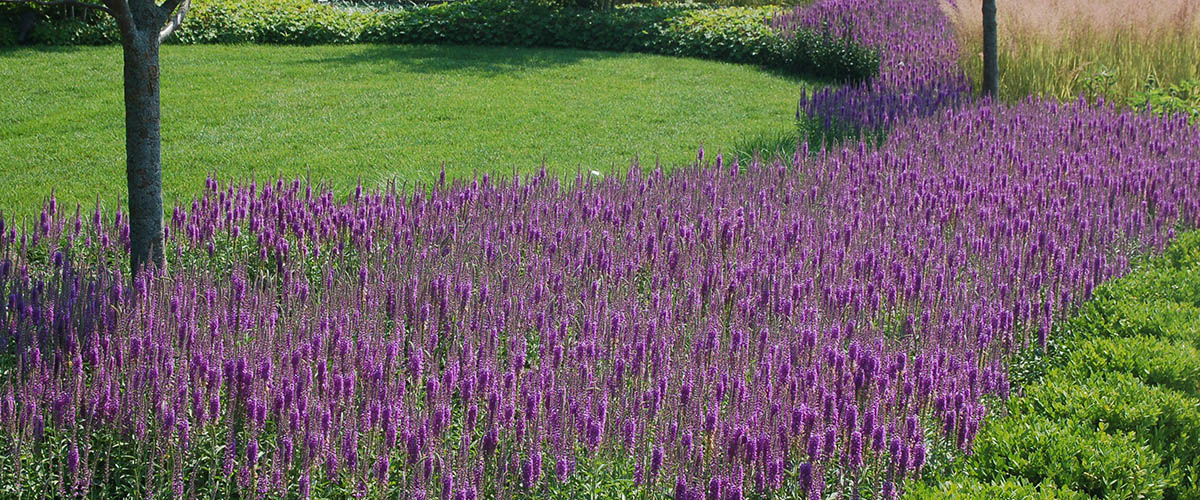
Repeat key perennials throughout the bed instead of planting each variety in isolated pockets. Repetition creates rhythm and makes later annual additions easier to coordinate. A recurring drift of purple salvia, for example, can connect several planting areas while annuals change from year to year.
Match plants to Chicagoland conditions
Sun exposure is the first practical filter. A full-sun bed generally receives at least six hours of direct light, while part-shade areas may need plants that tolerate reflected light, afternoon shade, or competition from trees. Annuals can be useful in difficult spaces, but they still need suitable soil, drainage, and moisture to perform well.
Gardeners seeking a reliable purple flowering accent for bright locations can review the full-sun salvia trials conducted through the regional evaluation program. Salvia nemorosa can contribute upright flower spikes, pollinator value, and a repeated color note when cut back after its first flush.
Soil preparation should be moderate rather than excessive. Incorporate compost where needed, but avoid creating a rich pocket that encourages soft, floppy growth. Group plants with similar watering requirements, especially when pairing thirsty annuals with drought-tolerant perennials. Mulch helps moderate soil temperature and moisture, though it should remain clear of crowns and stems.
Design in layers of height and texture
Use tall perennials and annuals toward the back or center of a border, medium plants through the middle, and low growers along paths and edges. This layered arrangement allows flowers to remain visible while creating depth. A tall perennial grass can provide movement behind compact annuals, while trailing plants soften a retaining wall or container edge.
Color is easier to manage when it follows a limited palette. Choose two or three dominant hues, then add a small amount of contrast. Lavender, blue, and white create a cool and cohesive scheme; orange, red, and gold produce a warmer effect. Green, silver, bronze, and burgundy foliage can connect flowers that do not share an exact color.
Texture keeps the display interesting between bloom periods. Pair rounded perennial leaves with fine grasses, broad annual foliage with airy flower clusters, or upright spikes with mounding plants. The result feels full even when individual flowers are temporarily between flushes.
| Plant role | Best contribution | Useful placement | Seasonal value |
|---|---|---|---|
| Structural perennial | Reliable form and recurring foliage | Background or central mass | Establishes the garden each year |
| Long-blooming perennial | Repeat flowers with limited replanting | Middle layer or repeated drifts | Carries the display through summer |
| Bedding annual | Immediate, saturated color | Gaps and open edges | Fills spaces during the first season |
| Trailing annual | Softens borders and containers | Front edge or raised locations | Adds movement and spillover |
| Ornamental grass | Texture, height, and motion | Back or center of a bed | Extends interest into autumn |
| Foliage annual | Color without dependence on flowers | Repeated throughout the design | Maintains impact during bloom pauses |
Use annuals to bridge bloom gaps
Annuals are especially valuable during transition periods. Cool-season types can provide color before heat-loving perennials reach their peak, while warm-season annuals take over after spring displays fade. In Chicagoland, pansies, sweet alyssum, and calendula may contribute early color, followed by zinnias, angelonia, marigolds, cleome, or annual salvias once the soil warms.
Planting annuals around established perennials requires attention to root competition. Set them into open spaces near, rather than directly against, perennial crowns. Small plugs or young plants are often easier to position than large specimens, and they can settle in before the perennial foliage becomes dense.
Deadheading can extend the display, especially for annuals that respond with new buds. Some perennials also benefit from being trimmed after their first flowering period. This can produce fresh foliage or a second bloom, while removing tired flower stems creates visual space for annual companions.
Choose combinations that support pollinators
A season-long display should provide food for insects across several months. Include flowers with different shapes, such as flat clusters, tubular blooms, daisy forms, and dense spikes. This broadens access for bees, butterflies, hummingbirds, and other beneficial visitors.
Avoid making every plant a double-flowered cultivar, since extra petals can reduce access to pollen and nectar. Fragrant herbs, seed-producing perennials, and plants with sturdy stems also add ecological value. Leaving selected seedheads standing into autumn can feed birds and provide winter texture.
Annuals can supply important late-season resources when some perennials have finished. Zinnias, tithonia, cosmos, Mexican sunflower, and certain salvias often continue flowering until frost when regularly harvested or deadheaded. Their contribution is especially useful in a border where early perennials have already gone dormant.
Keep maintenance and succession in balance
A mixed planting succeeds when its care requirements are realistic. Avoid combining an annual that needs daily irrigation with a perennial selected for dry soil. Likewise, do not place vigorous spreaders beside delicate annuals that will quickly be shaded or crowded.
Use annuals strategically instead of scattering them everywhere. Concentrate them in visible gaps, near entrances, or in small repeated groups. This reduces planting time while giving the garden a designed appearance. Containers can hold tender or experimental annuals, allowing the main perennial bed to remain stable.
- Select perennials for mature size, winter hardiness, and regional performance.
- Add annuals where early, midseason, or late color needs reinforcement.
- Repeat a few colors and forms to connect separate planting areas.
- Group plants by sunlight, soil moisture, and irrigation needs.
- Leave room for airflow, access, and the mature spread of every plant.
Photograph the garden throughout the season and note which combinations flower together, which plants flop, and where bare spaces appear. These observations make next year’s annual choices more precise. They also reveal whether a perennial is truly suited to the location or simply benefited from unusually favorable weather.
Refresh the display without losing its identity
The best annual-perennial gardens change gradually rather than starting over each spring. Keep the strongest perennial masses, then rotate annual colors, textures, or heights around them. A dependable framework makes experimentation less risky and helps the garden mature with each season.
Regional evaluations are useful when deciding which underused plants deserve a place in that framework. Look for information on flowering duration, height, spread, habit, and performance across multiple sites. Those details help translate a beautiful plant combination into a garden that remains attractive through real Chicagoland weather.
Plan the season in stages: early color near emerging perennials, a strong midsummer combination once the canopy fills out, and late-season flowers that remain visible after many spring performers decline. With thoughtful spacing and a restrained palette, annuals can extend the show while perennials provide continuity.
Use this season to map your light conditions, identify bloom gaps, and select a few annual companions for established perennial groups. Explore regional trial findings, visit local demonstration gardens, and record what performs in your own soil so next year’s planting becomes more colorful, durable, and confidently chosen.
In the Garden
Evaluator gardens are located across the Chicagoland area, representing a range of growing conditions. Visit our retail and wholesale partners to find trialled perennials for your own garden.
Retail & Wholesale: Hinsdale Nurseries (Willowbrook, IL), Mariani Nurseries (Kenosha, WI & Garden Prairie, IL), Northwind Perennials (Burlington, WI), The Growing Place (Aurora, IL).
Wholesale Only: Hinsdale Nurseries (Plano, IL), Intrinsic Perennial Gardens (Hebron, IL).
Our Evaluation Program
The 2017–2020 evaluation cycle included Agastache 'Blue Boa', Allium senescens 'Blue Eddy', Amsonia ciliata var. filifolia 'Georgia Pancake', Astilbe 'Chocolate Shogun', Boltonia astroides 'James Crocket', Brunnera 'Alexander's Great', and Geranium cinereum 'Jolly Jewel Purple'. Completed evaluations include Amsonia 'Blue Ice' (2004–07).
On April 10, 2020, the program published snapshot profiles for Vernonia lettermanii 'Iron Butterfly', Stokesia laevis 'Elf', Stachys officinalis 'Pink Cotton Candy', Lobelia 'Monet Moment', Helleborus 'Winter Thrillers', Geum 'Mai Tai', Geranium soboliferum 'Butterfly Kisses', Gentiana x intermedia 'True Blue', Eurybia divaricata, Asparagus 'Purple Passion', and Agastache 'Bolero'.
Browse the full collection of snapshots organized alphabetically — from A–D, E–H, I–Q, and R–Z — to find detailed performance data on perennials trialled across Chicagoland.