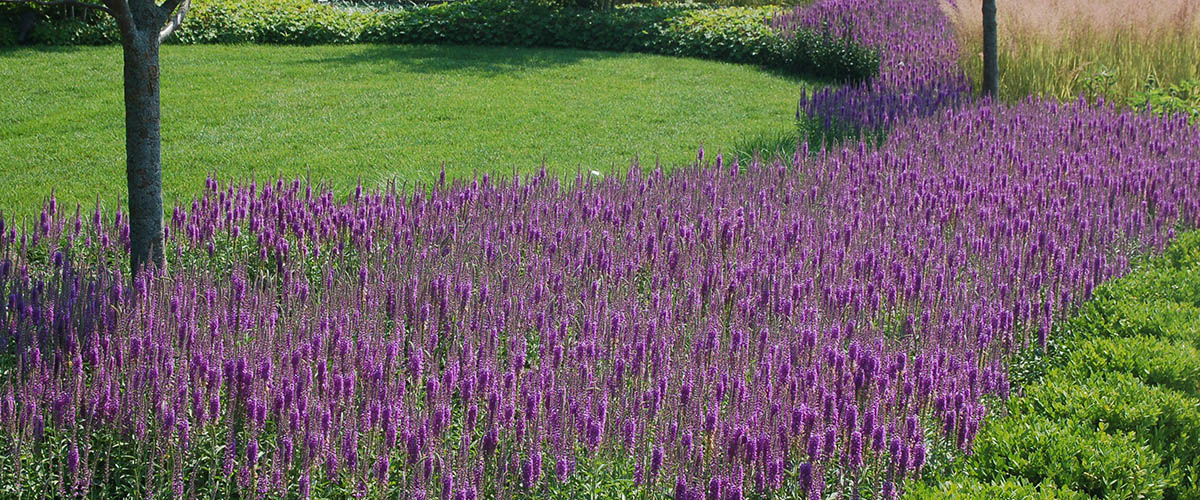
Evaluating Perennials for Chicagoland Gardens
Perennials in Focus is a plant evaluation program that examines new and underused plants for Chicagoland, the third largest metropolitan area in the country. A group of horticultural experts trials and evaluates plants at numerous locations across the region. Results help consumers, public gardens, growers, landscape designers, breeders, and other industry professionals make informed plant choices.
How to amend soil for acid-loving perennials in alkaline Chicago
Chicago-area gardeners often work with soil that is alkaline, compacted, or heavily influenced by construction fill. Many native and adapted perennials tolerate these conditions, but acid-loving plants such as rhododendrons, azaleas, blueberries, heathers, and certain woodland species may show yellow leaves, weak growth, or poor flowering when the root zone stays too alkaline.
Successful soil preparation depends on more than adding a single product. The goal is to create a root environment with a suitable pH, reliable drainage, steady organic matter, and enough moisture for the plant’s needs. In a region with cold winters, humid summers, and variable soil types, amendments should be selected and applied with restraint.
A soil test provides the most useful starting point. Once the existing pH and texture are known, gardeners can adjust the planting area without overcorrecting or creating nutrient imbalances. The same careful approach also supports better plant selection and long-term perennial performance.
Understand alkaline conditions in Chicago soils
Soil pH measures how acidic or alkaline the root environment is. A pH below 7 is acidic, while readings above 7 are alkaline. Many acid-loving perennials perform best between approximately 5.0 and 6.5, although the ideal range varies by species. In alkaline soil, iron, manganese, and other nutrients may become less available even when they are present in the ground.
A common symptom is interveinal chlorosis: new leaves turn pale or yellow while the veins remain green. Stunted growth, small leaves, reduced flowering, and premature leaf drop can follow. These symptoms may also result from poor drainage, drought stress, compacted soil, or root damage, so pH should be tested rather than assumed.
Chicago’s native soils frequently contain significant calcium carbonate, especially where glacial deposits or limestone-based fill are present. Organic matter can improve structure and nutrient availability, but compost alone may not lower pH enough to support a strongly acid-dependent plant.
Test the planting area before adding amendments
Collect soil from several spots in the intended bed, taking samples from the upper 6 to 8 inches. Remove mulch, roots, and surface debris before combining the samples. A laboratory test is more dependable than inexpensive color-strip kits because it can report pH, organic matter, phosphorus, potassium, and sometimes buffer pH.
Buffer pH is particularly useful when applying garden sulfur. It indicates how strongly the soil resists a pH change, which is often more important than the current pH alone. Clay-rich or calcareous soil may require much more sulfur than a sandy soil with the same initial reading.
| Amendment or practice | Main benefit | Best use in alkaline Chicago soil | Important caution |
|---|---|---|---|
| Elemental sulfur | Gradually lowers pH | Prepares beds before planting or corrects modest alkalinity | Requires soil microbes, moisture, and time |
| Pine bark fines | Improves structure and adds organic material | Blended into planting beds for woody or woodland perennials | Does not reliably acidify soil by itself |
| Peat moss | Adds acidity and moisture retention | Limited use in small specialty beds or containers | Can become hydrophobic and is not a complete solution |
| Compost | Improves structure and biological activity | Supports nearly any perennial planting | Mature compost may be neutral rather than acidic |
| Acid-forming fertilizer | Supplies nutrients while gradually acidifying | Maintenance feeding for established acid-loving plants | Overuse can damage roots or increase salt levels |
| Leaf mold | Adds stable organic matter | Woodland-style beds and moisture-retentive areas | Usually changes pH only slightly |
Apply sulfur according to the soil test and product instructions. Mixing it through the future root zone is more effective than scattering it on the surface. Because microbial conversion takes time, amend several months before planting whenever possible.
Build a well-drained, organic-rich root zone
Acid-loving plants often need moisture, but very few tolerate stagnant water. In heavy clay or compacted fill, improve drainage by loosening the entire bed rather than digging a small amended hole. A narrow pocket of rich soil can act like a container, holding water around the roots after rain.
Incorporate 2 to 4 inches of finished compost, leaf mold, or finely aged pine bark across the bed and blend it into the upper soil. Avoid creating sharp layers between amended and native soil. For plants that require especially free drainage, a slightly raised bed is often more effective than adding large amounts of sand, which can produce a dense concrete-like mixture in clay.
Pine bark fines are useful for improving aeration and creating a more woodland-like texture. They should be partially aged and mixed into the bed rather than used as a thick, fresh layer around roots. Coarse bark can temporarily draw nitrogen from the soil as it decomposes, while very fine material may reduce air exchange.
Match plants to realistic soil conditions
Some perennials are genuinely dependent on acidic conditions, while others merely tolerate a mildly low pH. Blueberries, cranberries, mountain laurel, azaleas, and rhododendrons generally need a consistently acidic root zone. Certain ferns, epimediums, heucheras, and woodland perennials may adapt to moderately alkaline soil if drainage, organic matter, and moisture are favorable.
Plant trials are especially valuable in a region where winter cold, summer heat, clay soil, and fluctuating moisture can affect performance as much as pH. Reviewing regional plant snapshots can help gardeners compare mature height, spread, flowering period, and observed garden behavior before committing to a difficult-to-amend site.
Choose plants with the whole bed in mind. A shaded, moisture-retentive location may suit woodland species, while a sunny raised bed with sharp drainage can support a different group of acid-tolerant perennials. Plants that are only marginally suited to the site may require repeated correction and still perform inconsistently.
Maintain acidity without damaging the soil
Changing pH is a gradual process, and the effect of sulfur or acid-forming fertilizer can fade as alkaline irrigation water, native soil, and decomposing materials influence the bed. Retest every one to three years, or sooner if foliage symptoms return. Avoid routine applications based solely on a plant label or calendar.
Use mulch to moderate soil temperature, reduce evaporation, and protect shallow roots through Chicago winters. Pine needles are suitable as a surface mulch, but they do not dramatically acidify established soil as they decompose. Keep all mulch a few inches away from crowns and woody stems to reduce rot and pest problems.
Fertilize according to plant needs and soil-test results. Acid-loving plants may benefit from products formulated for rhododendrons, azaleas, or blueberries, but excess nitrogen can produce soft growth, reduce winter hardiness, and increase nutrient runoff. Water deeply during dry periods, especially in the first two growing seasons, while allowing the bed to drain between irrigation events.
Use a measured amendment routine
A practical soil-management plan should prioritize testing, gradual change, and observation rather than aggressive correction. The following sequence works well for many Chicago gardens:
- Test the soil before planting and record pH, texture, and nutrient levels.
- Apply elemental sulfur only at the rate recommended for the soil’s buffer pH.
- Add finished compost, leaf mold, or aged pine bark to improve structure and biological activity.
- Raise beds or improve drainage where compacted soil remains wet after rainfall.
- Retest periodically and adjust fertilizer or sulfur applications based on current results.
New beds should be prepared well before acid-loving perennials arrive. If planting must happen immediately, choose species that tolerate the existing conditions and make moderate improvements rather than attempting a rapid pH shift. Containers and raised beds can provide more precise control for plants that cannot tolerate alkaline native soil.
Perennial gardens also benefit from thoughtful propagation and renovation. Dividing established plants at the proper season helps maintain vigorous clumps and provides an opportunity to inspect roots, refresh soil, and correct drainage problems. A regional division guide can support that process for common garden perennials.
Evaluate the bed across multiple seasons. Watch new growth, flower production, leaf color, winter survival, and moisture levels rather than judging success from a single flush of spring growth. Healthy roots and consistent performance are stronger indicators than a temporarily corrected pH reading.
Create a small test bed before converting an entire landscape. Record the amendment rates, planting dates, weather conditions, and plant responses, then use those observations to refine future beds. With soil testing, controlled amendments, and regionally proven plant choices, even alkaline Chicago soil can support a diverse and durable perennial garden.
In the Garden
Evaluator gardens are located across the Chicagoland area, representing a range of growing conditions. Visit our retail and wholesale partners to find trialled perennials for your own garden.
Retail & Wholesale: Hinsdale Nurseries (Willowbrook, IL), Mariani Nurseries (Kenosha, WI & Garden Prairie, IL), Northwind Perennials (Burlington, WI), The Growing Place (Aurora, IL).
Wholesale Only: Hinsdale Nurseries (Plano, IL), Intrinsic Perennial Gardens (Hebron, IL).
Our Evaluation Program
The 2017–2020 evaluation cycle included Agastache 'Blue Boa', Allium senescens 'Blue Eddy', Amsonia ciliata var. filifolia 'Georgia Pancake', Astilbe 'Chocolate Shogun', Boltonia astroides 'James Crocket', Brunnera 'Alexander's Great', and Geranium cinereum 'Jolly Jewel Purple'. Completed evaluations include Amsonia 'Blue Ice' (2004–07).
On April 10, 2020, the program published snapshot profiles for Vernonia lettermanii 'Iron Butterfly', Stokesia laevis 'Elf', Stachys officinalis 'Pink Cotton Candy', Lobelia 'Monet Moment', Helleborus 'Winter Thrillers', Geum 'Mai Tai', Geranium soboliferum 'Butterfly Kisses', Gentiana x intermedia 'True Blue', Eurybia divaricata, Asparagus 'Purple Passion', and Agastache 'Bolero'.
Browse the full collection of snapshots organized alphabetically — from A–D, E–H, I–Q, and R–Z — to find detailed performance data on perennials trialled across Chicagoland.