Evaluating Perennials for Chicagoland Gardens
Perennials in Focus is a plant evaluation program that examines new and underused plants for Chicagoland, the third largest metropolitan area in the country. A group of horticultural experts trials and evaluates plants at numerous locations across the region. Results help consumers, public gardens, growers, landscape designers, breeders, and other industry professionals make informed plant choices.
Verbena hastata and stem strength in windy prairie strips
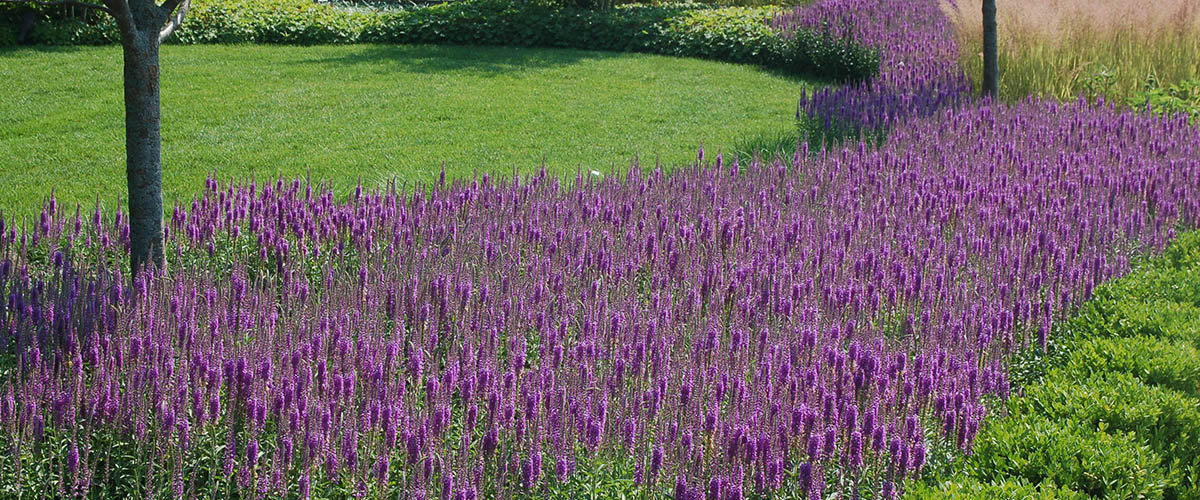
Verbena hastata, an upright perennial verbena with branching, square stems and candelabra-like flower spikes, can look relaxed in still conditions yet architectural in wind. Evaluating its stem strength in windy prairie strips asks a practical question: does the plant remain upright through repeated gusts, heavy rain and seasonal growth, or does its upper mass pull it out of alignment?
Perennials in Focus trials provide a regional starting point, but Chicago results need careful interpretation in Australia, where heat, drought, humidity and wind arrive in different combinations. A sound assessment combines recorded bloom period, height and spread with direct observations of deflection, lodging, recovery and winter survival in the intended planting site.
Why wind changes the trial
Wind does not merely push a stem sideways; it creates leverage. The taller the flowering spike and the wider the branching crown, the more force reaches the base. A plant that appears loose after a calm morning may lean permanently once its upper stems become heavy with buds, especially when rain increases the weight of the flower spikes.
Stem strength should therefore be assessed as a whole-plant characteristic rather than a single measurement. Observers need to note the angle of displacement, whether the base shifts in the soil, whether damaged stems recover and whether neighbouring plants provide useful shelter. The program’s regional snapshots offer useful baseline information on regional performance, while local observations determine how that performance translates to a particular garden.
Reading height, spread and bloom
For Verbena hastata, mature height is commonly recorded between roughly 60 centimetres and 1.5 metres, although growing conditions and named selections can alter the result. Height should be measured from the soil to the highest flower tip, while spread describes the width of the branching crown. Together, these dimensions reveal whether a plant is likely to need a middle or rear position in a prairie-style composition.
Flower colour and timing matter alongside structural observations. Lilac-purple flowers usually appear from midsummer into autumn in the northern hemisphere, but Australian flowering may shift with local heat and frost. In-garden evidence from garden trial observations can help separate a genuine regional trait from a result of favourable weather, irrigation or placement.
Designing a windy prairie strip
A useful test strip should expose the verbena to realistic wind while allowing repeated visits to measure its movement. Plants can sit in the centre or rear of the bed, with lower grasses in front and a windbreak behind. This arrangement reflects how the plant will be viewed while still testing the amount of shelter it receives in a working landscape.
The visual appeal of narrow upright forms is also central to contemporary design. A reference such as contemporary interior design illustrates how repeated vertical lines can energise a narrow composition; outdoors, the equivalent effect comes from real stems moving against grasses and sky. In Australia, Adelaide’s hot, dry northerlies and Melbourne’s cool, gusty conditions create especially useful opportunities to compare flexibility with lasting stability.
Comparing Verbena for exposure
Different verbenas respond differently to the same exposed position. The species most closely associated with tall, airy flower spires is not automatically the most secure choice, and compact plants are not necessarily less useful merely because they require a different position in the planting.
| Plant | Typical stature | Stem and wind behaviour | Best prairie-strip role |
|---|---|---|---|
| Verbena hastata | 60–150 cm | Branching, upright stems; tall flowering mass can gain leverage | Middle or rear position with light shelter |
| Verbena bonariensis | 60–120 cm | Narrower, less branched habit; often delicate in exposed sites | Open drifts, containers or protected edges |
| Verbena rigida | 30–60 cm | Shorter, denser growth with less wind exposure | Front edge, borders and smaller gardens |
Australian nursery labels can group several unrelated plants simply as verbena, so buyers should check the botanical name and expected mature size. Garden centres and specialist online nurseries may offer different forms under the same common name, making a written description of height, spread and flowering habit especially valuable before ordering.
Measuring stem strength
A simple field method is to mark several representative stems before a forecast wind or heavy rain. Record their original angle, then reassess them from the same fixed point after the weather event. Useful measurements include basal movement, the greatest lateral displacement and the angle of the main flowering stems. Photographs taken from one position make seasonal comparisons more reliable.
Each plant can then receive a practical rating based on stability, recovery and appearance. “Stable” means little permanent movement, “flexible” means visible bending followed by a return to the original position, and “lodged” indicates that stems remain bent or broken. Repeated observations across several events are more informative than a single gale, because soil moisture and accumulated growth also affect stability.
Building a prairie strip in Australia
Preparation can reduce wind damage before the plant is even installed. Verbena hastata prefers well-drained soil, and a position that becomes waterlogged in winter is unsuitable. Incorporating organic matter into compacted ground, maintaining an open surface around the crown and applying a moderate mulch layer can support anchorage without hiding emerging shoots.
Australian conditions require flexible planting decisions. Canberra’s frost can weaken winter growth, while Perth’s dry summer makes establishment irrigation especially important. In frost-free districts, Verbena hastata may behave as a short-lived perennial and may need replacing from nursery stock. Where winters are cold but reliable snow cover occurs, the crown may retreat naturally and re-emerge as conditions improve.
Planting for long-term performance
Choose vigorous, well-rooted stock and plant it at the same depth as it grew in its pot. Space plants according to their recorded spread rather than their current nursery size, since crowding can restrict airflow and conceal early movement. Avoid immediate staking if the objective is a fair strength trial, although discreet support is reasonable in a permanent display garden.
Record the plant’s identity, position, soil conditions, irrigation and every significant wind event through the flowering period. Share the results with the supplying nursery, local garden groups or public-garden colleagues, because practical evidence from Australian gardens is needed alongside the Chicagoland findings. Plant a healthy Verbena hastata in a well-drained, realistically exposed position this season, observe how its stems respond to the weather, and contribute a clear record of its stability, flowering and survival.
In the Garden
Evaluator gardens are located across the Chicagoland area, representing a range of growing conditions. Visit our retail and wholesale partners to find trialled perennials for your own garden.
Retail & Wholesale: Hinsdale Nurseries (Willowbrook, IL), Mariani Nurseries (Kenosha, WI & Garden Prairie, IL), Northwind Perennials (Burlington, WI), The Growing Place (Aurora, IL).
Wholesale Only: Hinsdale Nurseries (Plano, IL), Intrinsic Perennial Gardens (Hebron, IL).
Our Evaluation Program
The 2017–2020 evaluation cycle included Agastache 'Blue Boa', Allium senescens 'Blue Eddy', Amsonia ciliata var. filifolia 'Georgia Pancake', Astilbe 'Chocolate Shogun', Boltonia astroides 'James Crocket', Brunnera 'Alexander's Great', and Geranium cinereum 'Jolly Jewel Purple'. Completed evaluations include Amsonia 'Blue Ice' (2004–07).
On April 10, 2020, the program published snapshot profiles for Vernonia lettermanii 'Iron Butterfly', Stokesia laevis 'Elf', Stachys officinalis 'Pink Cotton Candy', Lobelia 'Monet Moment', Helleborus 'Winter Thrillers', Geum 'Mai Tai', Geranium soboliferum 'Butterfly Kisses', Gentiana x intermedia 'True Blue', Eurybia divaricata, Asparagus 'Purple Passion', and Agastache 'Bolero'.
Browse the full collection of snapshots organized alphabetically — from A–D, E–H, I–Q, and R–Z — to find detailed performance data on perennials trialled across Chicagoland.