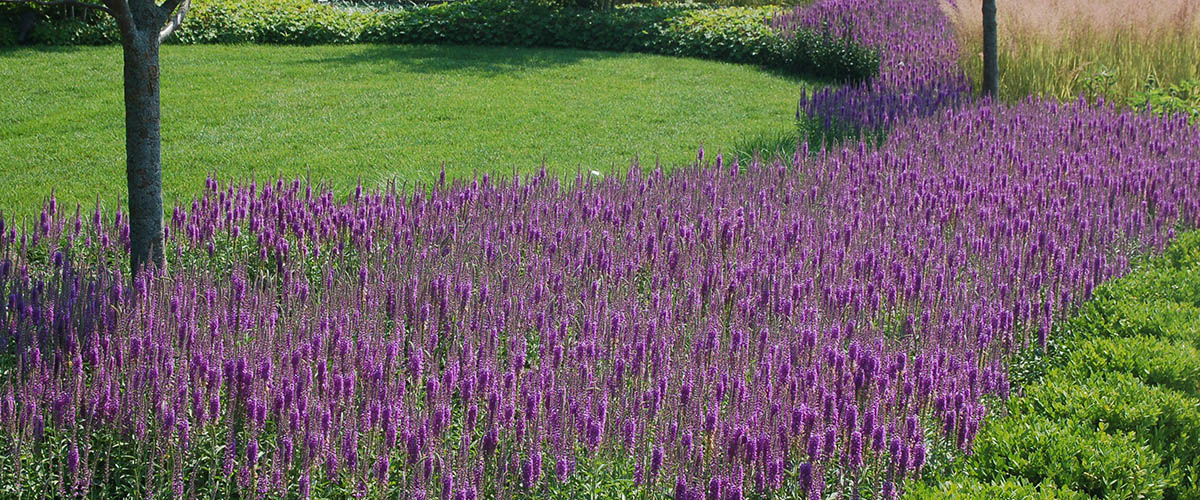
Evaluating Perennials for Chicagoland Gardens
Perennials in Focus is a plant evaluation program that examines new and underused plants for Chicagoland, the third largest metropolitan area in the country. A group of horticultural experts trials and evaluates plants at numerous locations across the region. Results help consumers, public gardens, growers, landscape designers, breeders, and other industry professionals make informed plant choices.
Evaluating Verbena Bonariensis In Chicagoland Gardens
Verbena bonariensis brings an airy, vertical presence to perennial borders. Its tall, branching stems rise above lower plants, carrying clusters of small purple flowers from summer into fall. In Chicagoland gardens, however, its performance involves more than bloom quality. Gardeners also need to understand how readily it produces volunteer seedlings and whether those seedlings remain welcome in the planting.
Self-seeding can be a valuable trait when it fills gaps, extends seasonal interest, and creates a naturalistic effect. It can become inconvenient when seedlings appear in paths, between prized cultivars, or in areas where a controlled design matters. Regional observation helps distinguish dependable behavior from assumptions based on warmer climates.
A useful evaluation considers the entire growing cycle: first-year establishment, flowering, seed formation, winter survival, and the location and number of volunteer plants the following year. These details give gardeners a clearer basis for deciding whether Verbena bonariensis belongs in a formal border, prairie-style planting, container combination, or wildlife garden.
Why self-seeding matters in the region
Verbena bonariensis is often grown as a tender perennial or annual in northern gardens. Some plants may survive a mild winter in a protected location, while others return primarily through seed. This distinction matters because a plant that appears perennial in one Chicagoland garden may behave as a reseeding annual in another.
Seedlings are most likely to appear where mature flower heads are allowed to remain through fall and where bare soil provides a suitable germination site. Open, well-drained areas may produce more volunteers than thickly mulched beds. Wind can also move the small seeds beyond the original planting, although the densest group usually develops close to the parent plant.
The resulting pattern is rarely uniform. One season may produce a few strategically placed seedlings, while a favorable combination of late warmth, exposed soil, and moderate moisture can lead to many more. Recording that variation is essential when evaluating the plant for regional use.
What to observe during a garden trial
A trial should begin with consistent notes on planting date, sun exposure, soil texture, drainage, mulch depth, and neighboring vegetation. These conditions help explain differences between sites. A plant in a hot, open border may flower and set seed differently from one growing in a lightly shaded, irrigated bed.
During summer, evaluators can record stem height, branching, flowering time, flower color, lodging, and pollinator activity. The plant’s upright form is one of its strongest ornamental qualities, but stems may lean if crowded, exposed to strong wind, or carrying heavy late-season growth. Flowering often continues after many shorter perennials have faded.
After frost, the most important observations concern seed production and management. Note whether seed heads remain intact, whether birds or weather remove them, and how easily unwanted stems can be cut back. In spring, map volunteer locations rather than simply counting seedlings. Distribution shows whether the plant is staying within its intended area.
Reading volunteer patterns across sites
The following categories can help organize observations from multiple Chicagoland gardens. They are practical evaluation ranges rather than fixed ratings, since winter severity, soil exposure, and maintenance have a strong influence on results.
| Garden condition | Likely volunteer pattern | Management implication |
|---|---|---|
| Open, sunny bed with bare soil | Several seedlings near the parent plant | Easy to encourage, but monitor density |
| Dense perennial border with mulch | Fewer visible seedlings | Volunteers may be limited or delayed |
| Sheltered south-facing site | Greater chance of mature plants returning | Watch for both overwintering crowns and seedlings |
| Exposed site with heavy winter moisture | Lower survival of established plants | Reseeding may be more important than winter survival |
| Naturalistic or prairie-style planting | Volunteers may blend into the design | Allow selected seedlings to develop |
| Formal border or mixed display | Stray plants are more noticeable | Remove seedlings while young |
A strong regional evaluation should compare several gardens rather than rely on a single planting. Repeated observations across seasons reveal whether self-seeding is consistent, occasional, or highly site-dependent. They also show whether volunteer plants retain the desired height and flower color.
It is useful to distinguish seedlings from overwintered plants. A returning crown may flower earlier and grow more vigorously, while a seedling may take longer to reach bloom. Marking plants in fall or early spring can clarify which pathway is responsible for the next season’s display.
Balancing natural spread with design control
For gardeners seeking a relaxed, meadow-like appearance, self-seeding may be a major advantage. Verbena bonariensis can weave through ornamental grasses, sedums, rudbeckias, and other late-season perennials without creating a heavy visual mass. Its transparent stems allow nearby plants to remain visible, which makes scattered volunteers easier to incorporate.
In a tightly composed border, the same behavior requires more attention. Seedlings can be removed when they are small and the soil is moist. Cutting flower heads before mature seed drops is another effective option, although it reduces late-season texture and may remove food or shelter used by garden wildlife.
Deadheading does not need to be an all-or-nothing practice. A gardener might leave several stems for seed and winter structure while removing the rest. This selective approach preserves some natural regeneration and limits the number of plants appearing beyond the preferred planting zone.
Site design can also influence control. A thick layer of organic mulch may reduce germination, while companion plants that occupy the soil surface can make volunteer establishment less likely. These methods work best when combined with observation rather than applied uniformly across every garden.
Comparing it with other dependable perennials
Verbena bonariensis fills a particular design role: tall, light-textured, late-blooming, and potentially self-renewing. It should therefore be compared with plants that provide a similar seasonal effect, rather than judged only against compact mound-forming perennials. The most suitable choice depends on whether the priority is height, pollinator value, winter persistence, or predictable placement.
Its seed behavior may appeal to gardeners who value movement and spontaneity. Those who need consistent color and form through difficult winters may prefer strongly persistent perennials with less variable regeneration. Regional plant evaluations often reveal that winter survival and self-seeding are separate traits, and a plant can score well in one category without excelling in the other.
For example, gardeners researching reliable foliage and seasonal color can also review winter color trials when building a more controlled planting palette. Heuchera and Verbena bonariensis serve different visual purposes, but comparing their regional reliability helps clarify which plants should anchor a design and which should provide flexible seasonal accents.
A balanced border may use persistent structural plants as its foundation, then include Verbena bonariensis where a few self-sown stems will be useful. This arrangement reduces dependence on the plant for overall coverage while allowing its distinctive flowering habit to contribute character.
Recommendations for evaluating and managing volunteers
A practical assessment should document both the plant’s ornamental value and the work required to keep it in bounds. The following practices create useful information for home gardeners, growers, landscape professionals, and public gardens:
- Map the original plants and spring seedlings separately to distinguish reseeding from winter survival.
- Record volunteer numbers at a consistent time each spring, before thinning or weeding.
- Note soil exposure, mulch depth, moisture, and nearby plant density at each volunteer location.
- Leave a representative sample of seedlings to evaluate height, bloom timing, and flower color.
- Remove excess seedlings early, while retaining selected plants in areas where natural spread is desirable.
These records can be simple. A garden map, dated photographs, and short notes on weather and maintenance may reveal patterns that casual observation misses. Over several seasons, the information can show whether the plant is a restrained accent or a persistent colonizer under local conditions.
Evaluators should also record negative observations. Few volunteers may reflect dense groundcover rather than low seed production, while abundant seedlings may result from an unusually mild winter. Capturing the context around each result makes regional findings more valuable than a single label such as “easy” or “aggressive.”
Using the findings in Chicagoland gardens
The best placement for Verbena bonariensis depends on the gardener’s tolerance for variation. It is well suited to sunny, well-drained spaces where a few surprise plants enhance the composition. It can also perform in mixed borders, provided that volunteers are inspected in spring and flower heads are managed according to the desired level of spread.
In public gardens and commercial landscapes, maintenance schedules should be considered alongside visual performance. A plant that looks excellent in late summer but requires frequent removal from adjacent paths may be less suitable than one with a tidier habit. Conversely, a naturalistic installation may benefit from reduced intervention and a broader tolerance for seedlings.
Regional trial data can help define those differences clearly. By tracking bloom period, height, spread, winter response, and seedling distribution across multiple sites, evaluators can give Verbena bonariensis a more useful profile than a generic hardiness description. The result is practical guidance based on how the plant behaves in real Chicagoland gardens.
Grow the plant where its vertical flowers and pollinator appeal can be appreciated, then observe what it does beyond the original planting. With careful records and timely management, self-seeding becomes a measurable garden characteristic rather than an unexpected problem. Share repeated observations from local sites so future plant choices reflect the conditions and priorities of the region.
In the Garden
Evaluator gardens are located across the Chicagoland area, representing a range of growing conditions. Visit our retail and wholesale partners to find trialled perennials for your own garden.
Retail & Wholesale: Hinsdale Nurseries (Willowbrook, IL), Mariani Nurseries (Kenosha, WI & Garden Prairie, IL), Northwind Perennials (Burlington, WI), The Growing Place (Aurora, IL).
Wholesale Only: Hinsdale Nurseries (Plano, IL), Intrinsic Perennial Gardens (Hebron, IL).
Our Evaluation Program
The 2017–2020 evaluation cycle included Agastache 'Blue Boa', Allium senescens 'Blue Eddy', Amsonia ciliata var. filifolia 'Georgia Pancake', Astilbe 'Chocolate Shogun', Boltonia astroides 'James Crocket', Brunnera 'Alexander's Great', and Geranium cinereum 'Jolly Jewel Purple'. Completed evaluations include Amsonia 'Blue Ice' (2004–07).
On April 10, 2020, the program published snapshot profiles for Vernonia lettermanii 'Iron Butterfly', Stokesia laevis 'Elf', Stachys officinalis 'Pink Cotton Candy', Lobelia 'Monet Moment', Helleborus 'Winter Thrillers', Geum 'Mai Tai', Geranium soboliferum 'Butterfly Kisses', Gentiana x intermedia 'True Blue', Eurybia divaricata, Asparagus 'Purple Passion', and Agastache 'Bolero'.
Browse the full collection of snapshots organized alphabetically — from A–D, E–H, I–Q, and R–Z — to find detailed performance data on perennials trialled across Chicagoland.