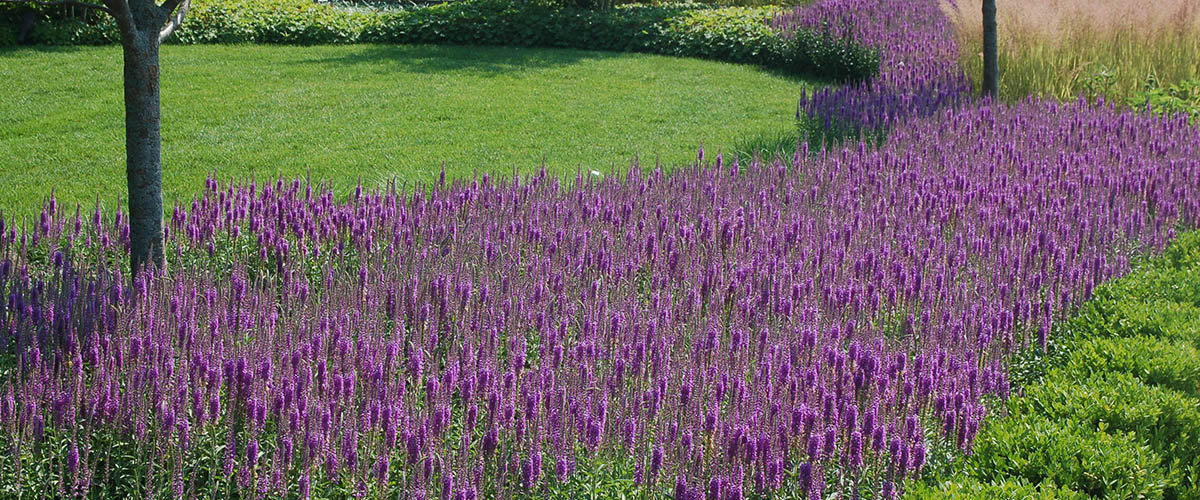
Evaluating Perennials for Chicagoland Gardens
Perennials in Focus is a plant evaluation program that examines new and underused plants for Chicagoland, the third largest metropolitan area in the country. A group of horticultural experts trials and evaluates plants at numerous locations across the region. Results help consumers, public gardens, growers, landscape designers, breeders, and other industry professionals make informed plant choices.
Evaluating Ceanothus americanus in high-traffic areas
Compacted ground can decide whether urban shrubs establish, flower or survive. Evaluating the compaction tolerance of Ceanothus americanus in high-traffic areas asks more than whether plants live through a season. It tests root development, drainage, recovery from damage and performance under repeated pressure.
Ceanothus americanus, commonly called New Jersey tea, is a deciduous shrub native to eastern North America. It has blue-grey foliage and masses of small white flowers in late spring and early summer, usually reaching about 1–2 m. The species tolerates heat and drought once established, making it a credible candidate, although drought tolerance alone does not prove tolerance of compaction.
Australian growers face a different environment from Chicagoland, where winters are severe and summers can be dry. Behaviour, traffic loads, soils and irrigation differ, so regional findings should guide local trials rather than replace them. Side-by-side evaluation can reveal whether this deciduous Ceanothus has a useful place in busy Australian landscapes.
Why compaction changes plant performance
Repeated footfall, service vehicles and bicycle traffic compress soil into a dense layer with fewer pores. Water enters slowly, root penetration becomes difficult and oxygen around fine roots declines. Compaction can also reduce water-holding capacity, leaving shrubs vulnerable to drought stress even after useful rain.
Traffic tolerance has two parts: coping with impaired soil and avoiding abrasion, breakage or trampling. A plant may survive compacted ground yet fail where people continually brush past it. Protecting the root zone while routing movement around the crown can matter as much as inherent tolerance.
Use this evaluation framework to compare conditions rather than assuming the outcome:
| Assessment | Low-disturbance reference | Compacted, high-traffic planting |
|---|---|---|
| Soil structure | Friable root zone with visible pore space | Dense layer, slow infiltration and restricted aeration |
| Establishment | Baseline rooting and incremental shoot growth | Delayed rooting and reduced shoot expansion |
| Visible condition | Intact stems and full canopy | Scraped stems, thin canopy or wilting during dry periods |
| Long-term value | Height, spread, bloom density and resilience | Survival, recovery, flowering and maintenance needs |
Designing a replicated traffic trial
Use several existing sites with similar soil and exposure but different use. Pair a protected, low-traffic reference planting with a pedestrian edge, service crossing or frequent route, using at least three plants per treatment. Document actual movement rather than creating unsafe traffic, and match nursery stock, planting date and initial size.
Measure conditions before planting. A fixed-depth soil core or calibrated penetrometer can establish compaction, while an infiltration test shows how quickly water enters. Record canopy width, stem count, shoot length and root-zone moisture at fixed intervals. Photograph plants from consistent angles so abrasion and dieback are not confused with seasonal leaf loss.
Continue through at least three growing seasons, including wet and dry periods. A structured plan can draw on regional trial observations for consistent recording, then add traffic counts and maintenance records. Separate poor drainage from direct physical injury, because each requires a different correction.
Reading Ceanothus growth and flowering
New Jersey tea’s drought tolerance may appear only after roots establish. In compacted, poorly drained soil, early growth can remain weak, while excessive winter moisture creates another risk. Judge the species on second- and third-year growth, not survival after the first summer or dry spell.
Flowering and structure remain essential quality measures. The collaborative Perennials in Focus programme records bloom period, flower colour, height and spread across multiple locations. For C. americanus, record flowering start and finish, bloom density, mature width and the proportion of healthy stems after traffic exposure.
Treat every site separately. Some hold more moisture, receive reflected heat or experience different mowing regimes. Report survival alongside incremental growth, canopy recovery, stem injury and repeat flowering. These measures show whether the shrub is merely persisting or delivering the ornamental contribution expected in a public or commercial setting.
Translating results for Australian cities
Melbourne’s wet winters, dry summers and busy park entrances provide a useful test around pedestrian routes and tram stops. Sydney adds humid summers, coastal rainfall and constrained tree pits with little root volume. A plant proven in either city still needs local observation because soil depth, irrigation and traffic vary between sites.
Adelaide tests prolonged heat, reflected pavement and compacted roadside soils. Water restrictions can make establishment irrigation less predictable, so record both irrigation received and plant response. Mulch conserves moisture but cannot correct a dense soil layer or improve oxygen at root depth.
In the Australian market, C. americanus is an uncommon deciduous exotic rather than a mainstream native shrub. Landscape buyers are more likely to find it through specialist wholesalers than everyday retail nurseries. Australian labels should clarify its botanical identity, deciduous habit and eventual size, and buyers ordering overseas liners must check current biosecurity requirements.
Matching the plant to site conditions
Compaction tolerance cannot rescue an unsuitable root zone. Where loads can be reduced, use continuous soil cells, structural soil beneath paths or a decompacted strip connected to larger soil volumes. Keep the bed permeable, provide drainage and use guards to shield stems. A route crossed regularly by vehicles is rarely suitable for any shrub.
Planting technique affects early performance. Set plants at nursery depth in a broad hole, loosen the sides and base, remove circling roots and backfill without creating a perched layer. Water deeply during establishment, mulch over the root zone and avoid heavy feeding. Staking should prevent movement, not replace a stable site.
Place the shrub where its mature spread remains clear of pinch points, signs and windows. Expect seasonal foliage loss in cooler Australian regions, and contrast that feature with the white spring and summer display. If a site has constant vehicle loading, pedestrian movement or scraping, choose another species rather than treating C. americanus as a decorative traffic barrier.
Turning field evidence into action
Set targets before planting: acceptable survival, meaningful annual growth, stable stems, repeat flowering and maintenance consistent with the intended use. Include a reference planting so poor soil or an unusual season is not credited as traffic tolerance. A clear pass, conditional pass or fail decision is more useful than a general impression of health.
Gardeners, growers, retailers, breeders, councils and public gardens can contribute compatible observations. Keep records consistent, include photographs and weather notes, and publish failures alongside successes. Shared evidence prevents untested shrubs being repeated across Australia merely because they are unfamiliar or fashionable.
Start a protected reference planting beside a measured high-traffic planting, using matched C. americanus plants across more than one site. Record soil conditions, traffic, flowering and recovery through wet and dry seasons, then use the results to guide the next planting. This repeatable approach will establish whether New Jersey tea belongs in our busiest landscapes or should remain a specialist garden subject.
In the Garden
Evaluator gardens are located across the Chicagoland area, representing a range of growing conditions. Visit our retail and wholesale partners to find trialled perennials for your own garden.
Retail & Wholesale: Hinsdale Nurseries (Willowbrook, IL), Mariani Nurseries (Kenosha, WI & Garden Prairie, IL), Northwind Perennials (Burlington, WI), The Growing Place (Aurora, IL).
Wholesale Only: Hinsdale Nurseries (Plano, IL), Intrinsic Perennial Gardens (Hebron, IL).
Our Evaluation Program
The 2017–2020 evaluation cycle included Agastache 'Blue Boa', Allium senescens 'Blue Eddy', Amsonia ciliata var. filifolia 'Georgia Pancake', Astilbe 'Chocolate Shogun', Boltonia astroides 'James Crocket', Brunnera 'Alexander's Great', and Geranium cinereum 'Jolly Jewel Purple'. Completed evaluations include Amsonia 'Blue Ice' (2004–07).
On April 10, 2020, the program published snapshot profiles for Vernonia lettermanii 'Iron Butterfly', Stokesia laevis 'Elf', Stachys officinalis 'Pink Cotton Candy', Lobelia 'Monet Moment', Helleborus 'Winter Thrillers', Geum 'Mai Tai', Geranium soboliferum 'Butterfly Kisses', Gentiana x intermedia 'True Blue', Eurybia divaricata, Asparagus 'Purple Passion', and Agastache 'Bolero'.
Browse the full collection of snapshots organized alphabetically — from A–D, E–H, I–Q, and R–Z — to find detailed performance data on perennials trialled across Chicagoland.