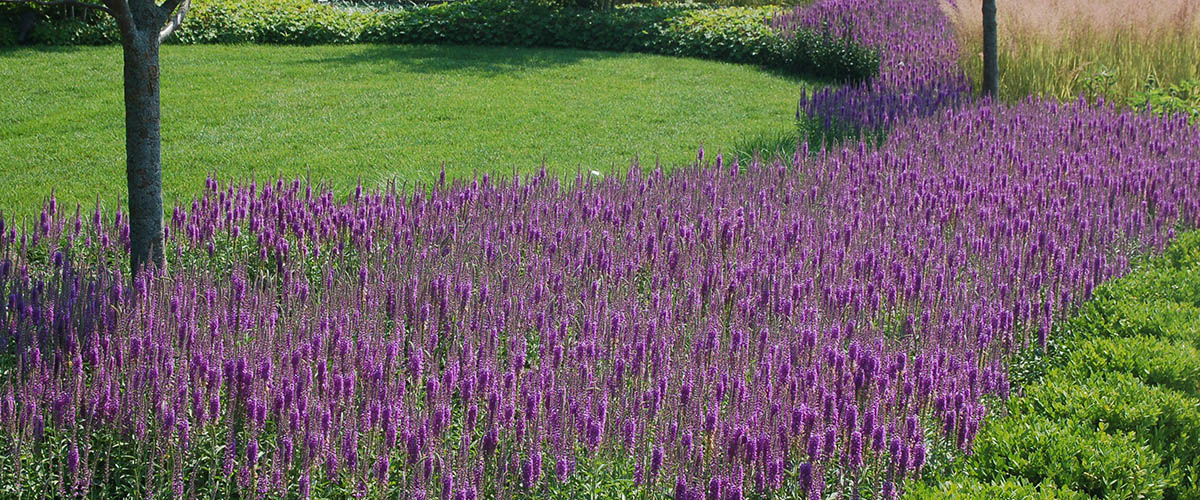
Evaluating Perennials for Chicagoland Gardens
Perennials in Focus is a plant evaluation program that examines new and underused plants for Chicagoland, the third largest metropolitan area in the country. A group of horticultural experts trials and evaluates plants at numerous locations across the region. Results help consumers, public gardens, growers, landscape designers, breeders, and other industry professionals make informed plant choices.
Coreopsis Verticillata Reseeding Performance In Unmulched Beds
Coreopsis verticillata is valued for its fine foliage, long flowering season and cheerful daisy-like blooms. It can bring useful movement to a perennial border, yet its performance is shaped by more than flower colour or plant height. Seed production, germination and seedling survival determine whether it creates a gentle drift of plants or remains a tidy, clump-forming feature.
Evaluating the Ability of Coreopsis Verticillata to Reseed in Unmulched Beds requires several seasons of observation. An unmulched bed exposes seed to natural moisture changes, surface temperatures, competing weeds and disturbance from birds or gardeners. These conditions reveal whether self-sown seedlings can establish without the protected environment of a nursery tray.
Findings from a Chicagoland trial can guide Australian growers, although the climates are different. A result recorded in Illinois should be treated as evidence about the plant’s potential, rather than a guarantee for gardens in Melbourne, Sydney, Brisbane or Adelaide. Local rainfall, irrigation practices, soil types and summer heat all influence the outcome.
Why Natural Reseeding Matters
Self-sowing can help a perennial planting renew itself without regular division or the purchase of replacement plants. In a mixed border, scattered seedlings may fill small gaps, soften hard edges and produce a more natural distribution than plants installed at equal intervals. This quality is especially useful in low-input gardens where gardeners want reliable colour with less replanting.
Coreopsis verticillata generally produces small, dry seeds after flowering. The quantity of viable seed depends on pollination, the length of the flowering period and whether spent blooms are removed. A plant that flowers heavily but is deadheaded frequently may contribute little seed to the bed, while a lightly managed planting may produce enough seedlings to become noticeable the following season.
Reseeding is not automatically a sign of invasive behaviour. The useful distinction is between modest, manageable recruitment and persistent spread into places where the plant is difficult to remove. A trial should therefore record both the number of seedlings and their location, vigour and ease of control.
Separating Cultivar Traits From Species Behaviour
Different forms sold under the Coreopsis verticillata name can vary in height, flower colour, branching and seed production. Named cultivars may have reduced fertility, altered flower structure or a growth habit selected for visual uniformity. Plants grown from seed may also show variation, so seedlings do not always reproduce the parent’s exact appearance.
A fair assessment begins with accurate plant identification and consistent labelling. Record the cultivar or accession, supplier, planting date and number of original plants. Photographs of flowers and foliage help identify unexpected differences later, particularly when several threadleaf coreopsis selections are being assessed in the same garden.
The trial snapshots published by Perennials in Focus provide a useful model for documenting characteristics such as bloom timing, height and spread. For Australian readers, those observations can be paired with local records rather than copied as fixed expectations.
Designing An Unmulched Bed
An unmulched trial bed should be clearly separated from mulched borders, lawns and areas where compost is regularly spread. Mark a defined observation zone around the parent plants so that seedlings can be counted consistently. The soil should be prepared evenly, with good drainage and enough fertility to support establishment without creating unusually soft, weed-free conditions.
Avoid adding a fresh mulch layer after flowering if the purpose is to measure natural recruitment. Mulch can improve moisture retention and suppress competing seedlings, but it also changes the seed-to-soil contact that is central to the trial. In Australian gardens, this distinction matters because mulch is widely used to reduce evaporation during hot weather, particularly in water-conscious suburbs of Adelaide, Perth and Melbourne.
Irrigation should be recorded rather than left unexplained. A bed receiving regular supplementary watering in a Brisbane summer is experiencing a different establishment environment from a bed relying on winter and spring rainfall in Melbourne. Note rainfall, irrigation frequency, soil texture, slope and nearby vegetation so that poor recruitment is not wrongly attributed to genetics.
Recording Germination And Survival
Count seedlings at consistent intervals, such as early spring, midsummer and early autumn. A single spring count can overstate success because young plants may succumb to heat, drought, slugs, mowing or competition before they flower. Tracking survival gives a more practical picture of whether self-sowing contributes mature plants to the border.
Use simple categories: newly emerged, established with several true leaves, flowering juvenile and mature flowering plant. Record approximate distance from the parent and whether the seedling is growing in bare soil, grass, leaf litter or among other perennials. These details show which microsites support recruitment.
Flowering time should also be noted. A seedling that survives but flowers much later than the established plants may have limited value for maintaining a continuous display. Record flower colour, plant height and spread as well, especially if the trial is intended to inform retail descriptions or landscape specifications.
Interpreting Results In Australian Gardens
Seasonal timing will differ across Australia. In Melbourne, cool winters and dry summers may create a narrow window in which seedlings can establish. Sydney gardens may experience warmer conditions and episodic heavy rain, while Brisbane’s humidity and summer rainfall can increase competition from vigorous weeds. Adelaide’s dry climate may favour seedlings only where winter moisture and open soil coincide.
Everyday gardening habits also affect the result. Many Australian households water early in the morning, use drip irrigation and apply mulch around established plants. These practices are sensible for conserving water, but they can either assist or suppress self-sown coreopsis depending on where water falls and how deeply the surface is covered. A trial should distinguish plant performance from the effects of routine garden care.
Local nursery demand is another consideration. Retailers may prefer uniform, non-spreading cultivars for small urban gardens, while ecological or cottage-style plantings may value moderate self-sowing. A plant that performs well in a public garden may need different marketing advice for a suburban courtyard, balcony planter or commercial streetscape.
Managing Seedlings Responsibly
Allowing a plant to reseed does not mean abandoning maintenance. Remove seedlings that appear in paths, drainage areas or beside more valuable plants. Thin crowded groups so that the strongest individuals have room to develop, and record how many were removed. Ease of control is an important performance trait alongside germination rate.
Biosecurity requirements should also be considered before collecting or exchanging seed. Australia’s state and territory rules differ, and plants regarded as acceptable in one region may be restricted in another. Check relevant government weed and biosecurity databases before moving seed between properties, especially across state borders or into environmentally sensitive areas.
Garden access deserves practical attention during repeated monitoring. Keep tools, hoses and paths organised around the trial, and address hazards before inspecting beds; guidance on garage door spring safety illustrates the wider principle that stored energy and access hazards should never be treated casually around working properties.
Turning Observations Into A Planting Decision
A useful assessment combines recruitment, survival and management effort. High seedling numbers are valuable only when the seedlings survive, resemble the desired plant and remain within acceptable boundaries. Conversely, sparse recruitment may be perfectly satisfactory for a formal border where the original clumps provide the intended display.
Use several parent plants and repeat observations across at least two growing seasons. Weather can distort a single year: an unusually wet winter may produce abundant germination, while a hot spring may eliminate seedlings before they are counted. Comparing sites gives stronger evidence than relying on one garden or one planting date.
| Performance Measure | Strong Result | Caution For Australian Gardens |
|---|---|---|
| Seed production | Many mature flower heads retain viable-looking seed | Deadheading or sterile cultivars may reduce recruitment |
| Germination | Seedlings appear in open soil near parent plants | Heavy mulch, crusted soil or dense weeds can hide the true result |
| Survival | Seedlings persist through summer or the local dry period | Supplementary irrigation may make results less transferable |
| Flowering | New plants flower within the expected seasonal window | Late flowering may limit their value in short or cool seasons |
| Manageability | Unwanted seedlings are easy to identify and remove | Check state biosecurity and weed regulations before moving seed |
For home gardeners and professionals, the final recommendation should describe the plant’s behaviour plainly: occasional self-sowing, dependable naturalisation, or little observed recruitment. Include the site conditions and maintenance regime, so readers can judge whether the result applies to their own garden rather than treating reseeding as a fixed attribute.
Trial Coreopsis verticillata in a clearly marked, unmulched section, keep seasonal records and allow seedlings to show what they can do before making a broader planting. Share observations with local growers, retailers and public gardens so regional evidence becomes more useful over time, while removing unwanted plants and following Australian biosecurity requirements.
In the Garden
Evaluator gardens are located across the Chicagoland area, representing a range of growing conditions. Visit our retail and wholesale partners to find trialled perennials for your own garden.
Retail & Wholesale: Hinsdale Nurseries (Willowbrook, IL), Mariani Nurseries (Kenosha, WI & Garden Prairie, IL), Northwind Perennials (Burlington, WI), The Growing Place (Aurora, IL).
Wholesale Only: Hinsdale Nurseries (Plano, IL), Intrinsic Perennial Gardens (Hebron, IL).
Our Evaluation Program
The 2017–2020 evaluation cycle included Agastache 'Blue Boa', Allium senescens 'Blue Eddy', Amsonia ciliata var. filifolia 'Georgia Pancake', Astilbe 'Chocolate Shogun', Boltonia astroides 'James Crocket', Brunnera 'Alexander's Great', and Geranium cinereum 'Jolly Jewel Purple'. Completed evaluations include Amsonia 'Blue Ice' (2004–07).
On April 10, 2020, the program published snapshot profiles for Vernonia lettermanii 'Iron Butterfly', Stokesia laevis 'Elf', Stachys officinalis 'Pink Cotton Candy', Lobelia 'Monet Moment', Helleborus 'Winter Thrillers', Geum 'Mai Tai', Geranium soboliferum 'Butterfly Kisses', Gentiana x intermedia 'True Blue', Eurybia divaricata, Asparagus 'Purple Passion', and Agastache 'Bolero'.
Browse the full collection of snapshots organized alphabetically — from A–D, E–H, I–Q, and R–Z — to find detailed performance data on perennials trialled across Chicagoland.