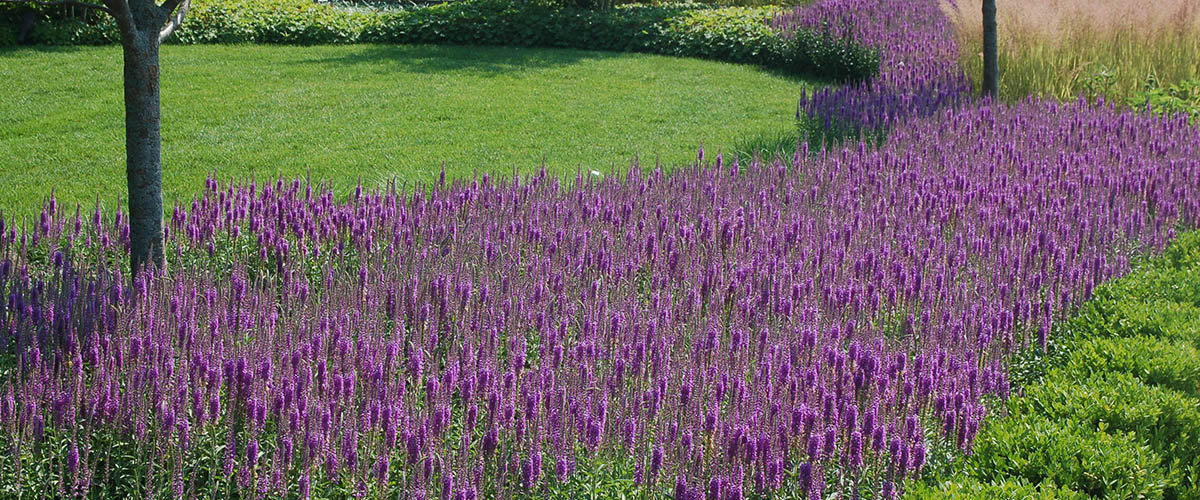
Evaluating Perennials for Chicagoland Gardens
Perennials in Focus is a plant evaluation program that examines new and underused plants for Chicagoland, the third largest metropolitan area in the country. A group of horticultural experts trials and evaluates plants at numerous locations across the region. Results help consumers, public gardens, growers, landscape designers, breeders, and other industry professionals make informed plant choices.
Spring emergence: Aconitum napellus versus A. carmichaelii
Perennials in Focus has made the timing difference between two familiar monkshoods easy to assess. In its Chicagoland record, A. carmichaelii generally shows visible shoots first, often with a sturdier, upright start. A. napellus commonly follows, although the gap ranges from days to several weeks as soil, weather and establishment vary.
Australian gardeners should treat this as a relative result, not a calendar to transplant. The seasons run in the opposite direction, and a crown in a Victorian garden behaves differently from one in frosty Canberra or mild Sydney. The useful lesson is that A. carmichaelii tends to wake more assertively, while A. napellus can still lead where cold is severe and the ground stays frozen longer.
What spring emergence actually measures
Here, emergence means the first shoot visibly breaking the soil, not bud colour, unfurled leaves or a flower. That distinction matters because the two monkshoods can emerge in the same week yet behave differently later: A. napellus often has a more compact start, while A. carmichaelii usually lengthens quickly into an upright plant.
The difference reflects stored reserves and crown vigour as much as warmth. A. carmichaelii generally develops more substantial shoots, whereas A. napellus commonly forms tighter clusters from established crowns. Newly divided plants may reverse that pattern because their roots have not yet rebuilt reserves.
Emergence dates are valuable because they identify when to mulch carefully, protect tender growth from slugs and see whether a perennial has settled into its position. They do not predict exact flowering dates, final height or long-term suitability.
Reading the Chicagoland pattern
Chicagoland includes gardens with different soils, snow cover and urban heat, so its trial record reveals tendencies rather than one fixed date. A sheltered courtyard crown may wake while a nursery bed remains frozen. The regional trial context helps explain why observations from several sites are more dependable than a single backyard note.
The earlier start of A. carmichaelii is most convincing where the crown receives mild winter sun and stable moisture. A. napellus closes the gap in colder, heavier ground, especially after a slow thaw. A warm spell may advance both, but a cold snap can pause them and make the recorded gap look larger.
Keep the original date with the location and weather conditions. “Emerged” on a mild, sunny day is not the same as emergence under an average spring. The programme’s multi-site approach is valuable because it separates a dependable species tendency from the quirks of one patch of soil.
Side-by-side garden behaviour
The central comparison becomes clearer when emergence, flowering and mature size are kept separate. Chicago dates cannot be shifted directly onto an Australian calendar, but the relative sequence can be compared with local records.
| Character | Aconitum napellus | Aconitum carmichaelii |
|---|---|---|
| Typical Chicagoland emergence | Usually appears after A. carmichaelii | Often appears first, with vigorous shoots |
| Early growth habit | Compact, clustered growth | Taller, upright and often more forceful |
| Typical flowering window | Often late spring to early summer | Often midsummer into late summer |
| Approximate mature height | Commonly 60–90 cm | Commonly 90–120 cm |
| Approximate mature spread | Often 30–45 cm | Often 45–60 cm |
| Main timing influence | Cold soil can delay or briefly halt growth | Soil warmth can favour an early start, but establishment still matters |
This pattern explains why A. carmichaelii may be visible before A. napellus even though its main flowering display arrives later. Early emergence is a growth trait, not a promise of early flowers. It also means the more vigorous species can need more room and, in exposed sites, staking.
For planning, record the first visible shoot, then note full leaf expansion and opening of the first flower separately. Those dates reveal whether a plant merely started early or carried that advantage through the whole season.
Translating the pattern into Australian conditions
In Australia, spring generally occupies the period from August to November, but “spring” for a dormant crown may begin during a cold June or July in southern regions. Melbourne’s changeable, often wet spring, Canberra’s hard frosts and Sydney’s milder winter can place the same species in very different local windows. Tasmania adds a longer, colder dormant period.
For most cool-climate Australian gardens, the practical planting period is autumn, especially March and April. Garden centres and specialist perennial nurseries commonly stock container-grown crowns or divisions for this cool-season window. Check local labels for the expected mature size and confirm the supplier has the correct species, since trade names can blur the distinction.
Choose a site with reliable moisture but free drainage, then irrigate during a dry autumn so roots establish before winter. In Sydney, summer rain may supply that moisture while winter growth remains slower; inland Queensland gardeners face the opposite challenge. Local conditions, not a Chicago date, should guide the planting calendar.
Planning around the first shoots
Early shoots of A. napellus are compact and suited to the middle or rear of a border, while the taller A. carmichaelii earns space nearer the back of a cottage-garden-style planting. Both suit the layered look familiar to many Aussie gardeners, particularly with ferns, hostas and hardy geraniums, provided the site is not crowded by thirsty roots.
Keep mulch away from emerging crowns so it does not trap rot or hide snail damage. Check the area from late winter onward, particularly around A. napellus, whose shorter shoots can be overlooked. The more upright A. carmichaelii may need support in windy coastal gardens or where late frost has produced soft growth.
Companions can add berries for birds, but vigorous plants need checking before inclusion. The programme’s bird-friendly berry notes offer practical guidance on selecting food plants without inviting unwanted spread. Wear gloves when handling monkshood crowns, as both species contain toxic alkaloids that can irritate skin and should never be ingested.
Trialing the difference close to home
A small Australian trial gives a clearer answer than a general label. Use three or more healthy crowns of each species, dividing them between two positions if possible: one cool and protected, the other brighter but still shaded from intense afternoon sun. Water them consistently and avoid moving the crowns after growth begins.
Label each plant with the species, planting date and site. Once weekly, note visible emergence, leaf expansion, first flower, height and spread. Record frost, heavy rain and any slug damage as well, since these events explain departures from the expected sequence.
After one full growing year, compare median emergence dates rather than the fastest single shoot. Share the observations with a local garden group, trial coordinator or regional nursery. Such records complement the Chicagoland findings with Australian conditions, giving growers and gardeners evidence they can use when the plants reach local retail shelves.
Choose one labelled crown of each monkshood this autumn and plant them side by side. Photograph the first shoots on the same day, record the weather and keep observing through flowering. That simple routine turns a regional comparison into a reliable result for your own garden.
In the Garden
Evaluator gardens are located across the Chicagoland area, representing a range of growing conditions. Visit our retail and wholesale partners to find trialled perennials for your own garden.
Retail & Wholesale: Hinsdale Nurseries (Willowbrook, IL), Mariani Nurseries (Kenosha, WI & Garden Prairie, IL), Northwind Perennials (Burlington, WI), The Growing Place (Aurora, IL).
Wholesale Only: Hinsdale Nurseries (Plano, IL), Intrinsic Perennial Gardens (Hebron, IL).
Our Evaluation Program
The 2017–2020 evaluation cycle included Agastache 'Blue Boa', Allium senescens 'Blue Eddy', Amsonia ciliata var. filifolia 'Georgia Pancake', Astilbe 'Chocolate Shogun', Boltonia astroides 'James Crocket', Brunnera 'Alexander's Great', and Geranium cinereum 'Jolly Jewel Purple'. Completed evaluations include Amsonia 'Blue Ice' (2004–07).
On April 10, 2020, the program published snapshot profiles for Vernonia lettermanii 'Iron Butterfly', Stokesia laevis 'Elf', Stachys officinalis 'Pink Cotton Candy', Lobelia 'Monet Moment', Helleborus 'Winter Thrillers', Geum 'Mai Tai', Geranium soboliferum 'Butterfly Kisses', Gentiana x intermedia 'True Blue', Eurybia divaricata, Asparagus 'Purple Passion', and Agastache 'Bolero'.
Browse the full collection of snapshots organized alphabetically — from A–D, E–H, I–Q, and R–Z — to find detailed performance data on perennials trialled across Chicagoland.