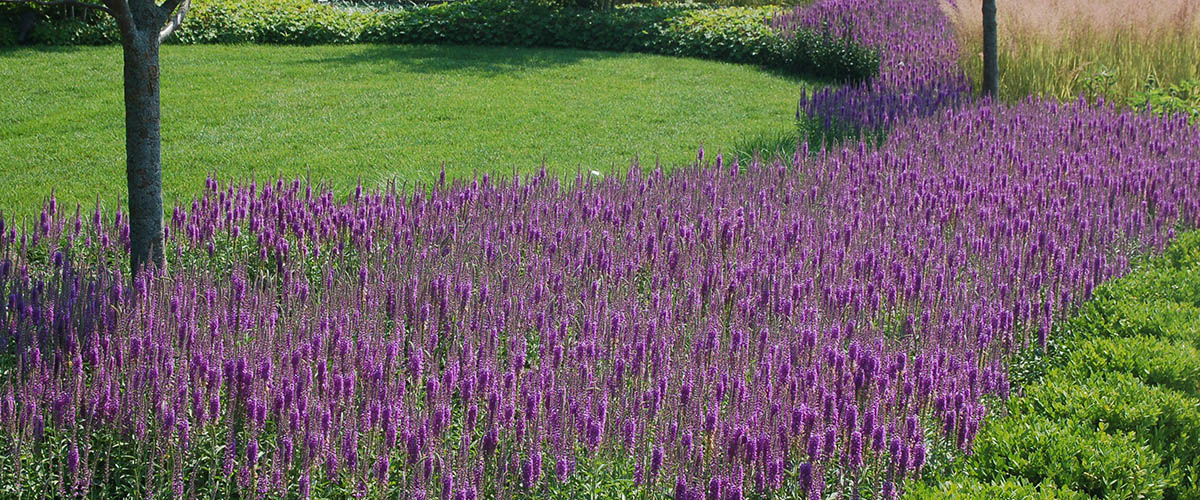
Evaluating Perennials for Chicagoland Gardens
Perennials in Focus is a plant evaluation program that examines new and underused plants for Chicagoland, the third largest metropolitan area in the country. A group of horticultural experts trials and evaluates plants at numerous locations across the region. Results help consumers, public gardens, growers, landscape designers, breeders, and other industry professionals make informed plant choices.
Veronicastrum Rust Resistance Across Species And Climates
Rust can turn an otherwise reliable perennial into a disappointing purchase, particularly when dense foliage stays damp overnight. For gardeners comparing Veronicastrum virginicum and Veronicastrum sibiricum, the important question is not simply which species is “rust-proof”. Resistance depends on genetics, cultivar, weather, plant spacing, nutrition and the specific rust pathogen present in a garden.
Trials from the Chicagoland region offer valuable evidence because plants are observed across several seasons rather than judged from a single nursery display. Australian gardeners can use those findings as a guide, while allowing for different conditions in Melbourne, Sydney, Adelaide, Perth and Brisbane.
| Feature | Veronicastrum virginicum | Veronicastrum sibiricum |
|---|---|---|
| General habit | Tall, upright, often strongly architectural | Usually more compact, though height varies by selection |
| Typical garden role | Back-of-border plant, meadow planting or bold mass | Mixed border, smaller perennial scheme or naturalistic planting |
| Rust expectation | Can show rust under prolonged leaf wetness; cultivar differences matter | Rust response is less consistently documented and should be assessed from local stock |
| Climate relevance | Often performs best where summers are warm but not persistently humid | May suit cooler or moderate sites, depending on provenance and selection |
| Best comparison method | Inspect the exact cultivar over a full growing season | Treat nursery claims cautiously and seek regional performance records |
What Rust Resistance Really Means
Rust is a fungal disease group that produces yellow, orange, brown or cinnamon-coloured pustules, commonly on the undersides of leaves. On Veronicastrum, symptoms may begin as small flecks before becoming more obvious patches, with infected foliage sometimes yellowing or dropping early. Heavy infection can reduce visual quality and weaken the plant before flowering.
A plant described as resistant may still develop a few spots in a favourable disease year. In horticultural trials, resistance usually means lower disease severity, slower spread or better retention of healthy foliage compared with other entries. It rarely means complete immunity. A clean plant in a dry season has not necessarily demonstrated durable genetic resistance.
Comparing The Two Species
Veronicastrum virginicum is the better-known species in ornamental horticulture and has a broader range of named selections. Its tall flower spikes and whorled foliage make it popular for prairie-style borders and pollinator plantings. That wider use also means gardeners are more likely to encounter reports of rust, simply because more plants are being grown and compared.
Veronicastrum sibiricum is less familiar in many retail markets, and published disease comparisons are consequently less common. Its more restrained habit can improve air movement within a border, but compact growth should not automatically be interpreted as superior disease resistance. A susceptible plant in a humid, crowded position can still become heavily marked.
The most defensible comparison is therefore selection against selection. A vigorous V. virginicum cultivar with open foliage may outperform a dense V. sibiricum clone, while another pairing could produce the reverse result. Plant identity, propagation source and growing conditions should be recorded before drawing conclusions.
How Australian Weather Changes The Risk
Rust generally benefits from moisture on leaf surfaces, moderate temperatures and limited air movement. In Melbourne and Hobart, cool nights and autumn dew can extend the period when leaves remain wet. In Sydney and Brisbane, warm humidity and summer rainfall may create repeated infection opportunities, especially in irrigated gardens with dense planting.
Adelaide and inland districts may experience lower natural humidity, yet overhead watering or poorly timed irrigation can still create a disease-friendly microclimate. Perth gardeners should consider winter rainfall and sheltered courtyards, where air circulation is often weaker than in an open garden. Across Australia, watering at soil level in the morning is preferable to wetting the foliage late in the day.
Climate also affects plant vigour. A perennial under heat stress, drought stress or waterlogged roots may produce thinner foliage and fewer flowers, making disease symptoms more noticeable. Australian gardeners should avoid assuming that a result from a cool, humid Chicagoland summer will translate directly to a hot, dry Adelaide site or a subtropical Brisbane border.
Reading Regional Trial Evidence
A useful trial record should identify the plant, planting site, observation period and disease rating method. Notes such as “minor spotting in late summer” are helpful, but they are less informative than repeated observations showing when symptoms appeared and how much foliage was affected. Flowering time, plant height and canopy density can also help explain the disease result.
Perennials in Focus evaluates plants across multiple gardens and seasons, which is more informative than a single demonstration bed. Its evaluation committee brings professional horticultural experience to the process, helping distinguish temporary cosmetic damage from a consistent weakness.
For Australian buyers, the strongest evidence combines regional trial information with local observation. Ask whether plants sold by a nursery came from a named cultivar, whether they were propagated from clean stock and whether the grower has seen rust in the same batch. A plant label that lists only the species gives less confidence than a traceable cultivar name.
Placement And Airflow Matter
Position both species where morning sun can dry foliage and where mature plants will not be pressed against walls, fences or dense shrubs. A spacing decision that looks generous at planting can become inadequate after two or three growing seasons. Tall Veronicastrum should have enough room for air to pass around the lower stems and leaves.
Avoid routine overhead irrigation, especially in gardens with evening watering restrictions or automated systems that run after dark. Drip lines, porous hoses and hand watering directed at the soil reduce leaf wetness. Remove badly affected fallen foliage at the end of the season and avoid composting diseased material unless the compost system reaches reliably high temperatures.
Fertiliser balance also matters. Excess nitrogen can encourage soft, lush growth that forms a dense canopy and may be more vulnerable to fungal disease. A moderately fertile soil, consistent moisture and mulch kept slightly away from the crown generally support stronger plants than alternating drought and heavy feeding.
Choosing Cultivars And Nursery Stock
When rust resistance is a priority, compare named cultivars rather than relying on species-level reputation. Look for selections with an open habit, sturdy stems and foliage that remains healthy late into the growing season. These traits do not guarantee resistance, but they can reduce the damp, congested conditions that allow rust to spread quickly.
Australian availability may be uneven. Specialist perennial nurseries, mail-order growers and plant fairs may carry a wider range than large garden centres, while mainstream retail outlets often stock only the most familiar forms. In local markets, plants labelled “speedwell” or “Veronica” should be checked carefully because Veronicastrum is a separate genus with different mature dimensions and cultural needs.
Inspect leaves before purchase, particularly on plants held under dense shade or frequent misting. Avoid specimens with active orange-brown pustules, widespread yellowing or premature leaf drop. Clean stock is not proof of inherited resistance, but it gives the plant a better start and reduces the chance of introducing disease to an established collection.
Making A Practical Choice
For a large border in a cool-temperate Australian garden, V. virginicum may offer the stronger range of tested ornamental forms and more readily available performance information. Its rust response should still be judged by cultivar, spacing and seasonal weather. It is a good candidate where height, vertical flower spikes and wildlife value are more important than a compact footprint.
V. sibiricum deserves consideration where a gardener wants a less imposing plant or is trialling less common perennials. Its comparative rust advantage cannot be assumed from the species name or geographic origin, because disease records are less extensive and nursery material may vary. Start with a small group rather than planting an entire border before observing it through a full wet season.
The fairest verdict is that neither species can be declared universally superior for rust resistance. V. virginicum has more visible horticultural evidence and cultivar choice, while V. sibiricum may offer useful differences in habit and local performance. In both cases, a healthy source, open planting, careful watering and several seasons of observation provide more dependable guidance than a simple species comparison.
Gardeners and professionals can strengthen the evidence by recording cultivar names, flowering dates, disease symptoms, rainfall patterns and plant spacing. Share those observations with regional trial programs and specialist growers, then use the results to refine future purchases. A small, well-documented trial in an Australian garden can reveal which Veronicastrum remains clean when local conditions are at their most demanding.
In the Garden
Evaluator gardens are located across the Chicagoland area, representing a range of growing conditions. Visit our retail and wholesale partners to find trialled perennials for your own garden.
Retail & Wholesale: Hinsdale Nurseries (Willowbrook, IL), Mariani Nurseries (Kenosha, WI & Garden Prairie, IL), Northwind Perennials (Burlington, WI), The Growing Place (Aurora, IL).
Wholesale Only: Hinsdale Nurseries (Plano, IL), Intrinsic Perennial Gardens (Hebron, IL).
Our Evaluation Program
The 2017–2020 evaluation cycle included Agastache 'Blue Boa', Allium senescens 'Blue Eddy', Amsonia ciliata var. filifolia 'Georgia Pancake', Astilbe 'Chocolate Shogun', Boltonia astroides 'James Crocket', Brunnera 'Alexander's Great', and Geranium cinereum 'Jolly Jewel Purple'. Completed evaluations include Amsonia 'Blue Ice' (2004–07).
On April 10, 2020, the program published snapshot profiles for Vernonia lettermanii 'Iron Butterfly', Stokesia laevis 'Elf', Stachys officinalis 'Pink Cotton Candy', Lobelia 'Monet Moment', Helleborus 'Winter Thrillers', Geum 'Mai Tai', Geranium soboliferum 'Butterfly Kisses', Gentiana x intermedia 'True Blue', Eurybia divaricata, Asparagus 'Purple Passion', and Agastache 'Bolero'.
Browse the full collection of snapshots organized alphabetically — from A–D, E–H, I–Q, and R–Z — to find detailed performance data on perennials trialled across Chicagoland.