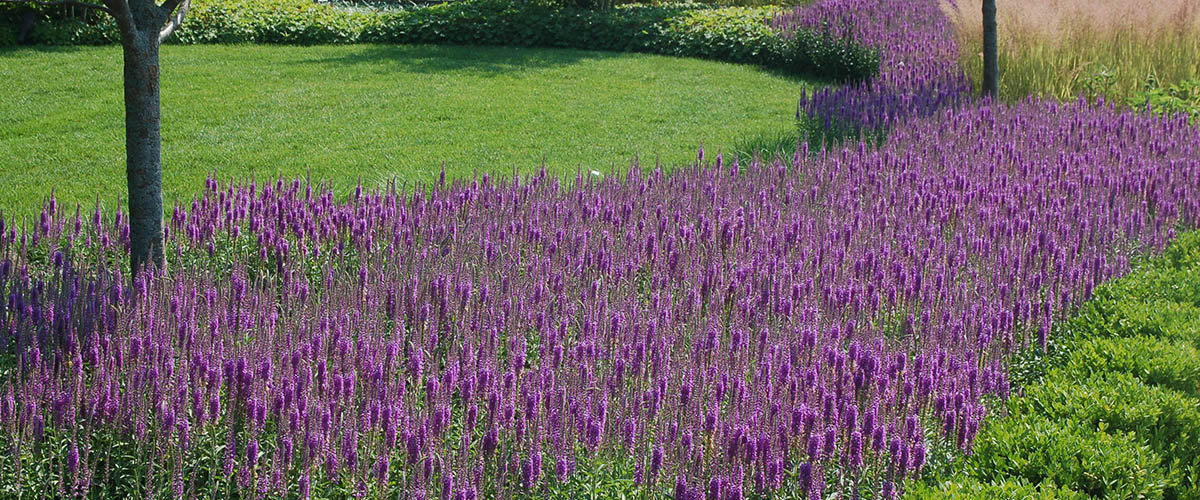
Evaluating Perennials for Chicagoland Gardens
Perennials in Focus is a plant evaluation program that examines new and underused plants for Chicagoland, the third largest metropolitan area in the country. A group of horticultural experts trials and evaluates plants at numerous locations across the region. Results help consumers, public gardens, growers, landscape designers, breeders, and other industry professionals make informed plant choices.
Pollinator diversity: Vernonia versus Eutrochium
Choosing between these two North American perennials is less about naming a universal winner and more about matching floral architecture, bloom timing and garden conditions to the insects a site can support. Vernonia fasciculata, commonly called ironweed or prairie ironweed, and Eutrochium maculatum, often sold as spotted Joe-Pye weed or queen of the prairie, both bring late-season colour to sunny perennial borders.
Chicagoland evaluations can reveal how the plants perform across sites and seasons, recording bloom period, flower colour, height, spread and pollinator activity. Australian gardeners should treat those findings as a baseline, because heat, drought, humidity, rainfall and native insect communities can change how the same species performs.
Plant identity and garden character
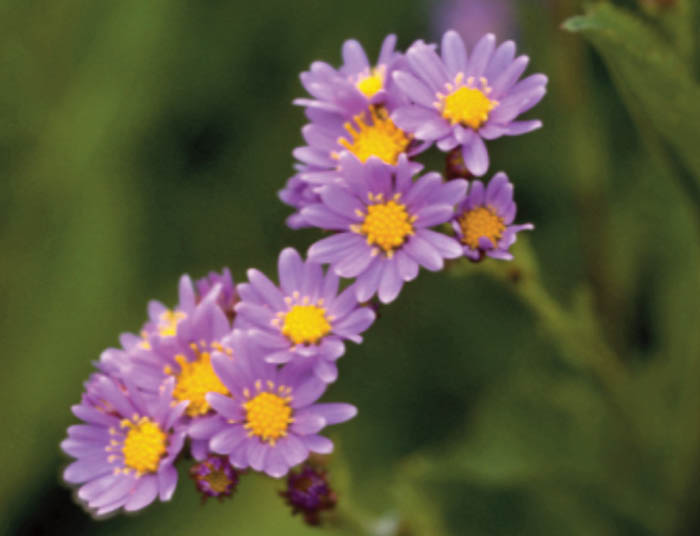
Vernonia fasciculata forms an upright, branching clump, usually around 1–1.5 metres tall, with narrow leaves and dense terminal clusters of deep magenta-purple flower heads. Its open, fine-textured habit works as a vertical accent among grasses and smaller perennials, particularly in a sunny border with reasonably fertile, well-drained soil.
Eutrochium maculatum develops taller, heavier stems, often 1.8–2.4 metres, and broad foliage beneath domed clusters of dusty pink-purple flowers. It has greater visual mass and prefers moist ground, so it suits a spacious damp border, rain garden or large container more effectively than a narrow mixed bed.
Bloom timing and floral resources
Ironweed generally flowers from late summer into autumn, with many small composite heads opening in succession. Each head contains accessible florets that can supply nectar and pollen to honey bees, native bees, hoverflies, beetles and butterflies. The display often gains intensity as shorter summer flowers decline.
Joe-Pye weed carries large, crowded flower clusters through midsummer and autumn. Its tubular florets favour long-tongued bees and strong-bodied butterflies, while smaller insects may forage around the cluster. For Australian plantings, the value of that abundance depends on which native blue-banded and carpenter bees, hoverflies and butterflies are active locally rather than on North American insect names alone.
Pollinator diversity and plant performance
Comparing pollinator diversity on Vernonia fasciculata versus Eutrochium maculatum involves more than a bee count: species number, visitor abundance and the range of flower shapes and foraging times all matter. Eutrochium may record more visits because each plant offers a conspicuous nectar-rich display, yet heavy use by a few species can still produce lower diversity than visits spread across several insect groups.
Ironweed offers smaller, open flowers within a branched display, potentially allowing short- and medium-tongued bees, hoverflies and beetles to forage alongside butterflies. This makes it a useful complement rather than a substitute. Counts made at different times, in sunny and windy weather and across several plants reveal more than a single spectacular flowering photograph.
What Chicagoland trials can show
The E-H trial snapshots offer a regional lens on perennial performance and can help readers interpret flowering sequence, habit and resilience. Multi-garden observation is especially useful for separating a plant’s reliable character from unusually favourable conditions at one site.
A sound comparison tracks both plants on the same dates, notes soil moisture and light, and records insect groups rather than simply counting bees. Chicagoland’s humid summers and winter cold provide useful contrasts, but Australian results should be checked against local climate zones and the flowering calendar of nearby native plants.
Translating the comparison for Australia
Melbourne’s cool, variable summers can delay flowering and shorten displays, while Sydney and Brisbane generally offer longer frost-free seasons. Perth and Adelaide have dry summers, making moisture retention crucial for Eutrochium and giving Vernonia an advantage where irrigation is limited. Flowering calendars also shift, as a Chicago late-summer display can coincide with late spring in Melbourne.
Neither species is native to Australia. Australian garden-centre and online nursery catalogues may offer them under common names, so check state weed databases, Australian Customs and biosecurity requirements, and interstate rules before ordering or moving seed. Reputable Australian specialist growers are safer sources than unlabelled bargain seed, particularly because both plants can reproduce from seed.
Australian native alternatives deserve equal consideration. Region-appropriate native Grevillea, Eremophila, Pimelea and daisy-flowered shrubs can provide nectar or pollen across a broader local season, reducing the ecological risk of relying on exotics. An experienced local nursery can help match plants to Brisbane, Melbourne, Perth or Adelaide conditions without importing records.
Design choices and practical trade-offs
Designers selecting coffee table material consider colour, texture and scale, much as gardeners must consider these qualities when balancing airy ironweed and massive Joe-Pye weed. Use Vernonia where a vertical purple accent is needed without a large footprint; reserve Eutrochium for a damp focal area where its scale can be appreciated.
Both reward repeated grouping, and both offer useful cut flowers, but their maintenance differs. Ironweed usually needs less water once established and benefits from division as clumps age. Joe-Pye weed may need regular moisture, staking in exposed sites and removal before seed spread near sensitive bushland. Select plants for the site, then verify that their mature size leaves room for air and pollinator access.
A direct comparison clarifies the choices:
| Feature | Vernonia fasciculata | Eutrochium maculatum | Pollinator significance |
|---|---|---|---|
| Typical habit | Upright, branched, 1–1.5 m | Broad, domed, 1.8–2.4 m | Contrasting scale suits different garden roles |
| Main bloom | Late summer to autumn | Midsummer to autumn | Can extend nectar and pollen availability |
| Flower form | Numerous small composite heads | Large clusters of tubular florets | Supports different insect sizes and tongue lengths |
| Preferred soil | Fertile, well-drained; moisture during establishment | Consistently moist to damp | Affects reliable flowering and longevity |
| Australian caution | Monitor seed spread and local weeds | Control seed and avoid damp bushland fringes | Both are non-native exotics |
Grow a season of pollinator value
Choose the plant whose flowering window fills a gap in your local garden, using the comparison as a starting point rather than a guarantee. A mixed planting can combine ironweed’s open late flowers with Joe-Pye weed’s concentrated display, then add Australian natives that bloom before, between and after both. Keep flowers untreated, provide shallow water and avoid pesticide drift.
Make the next decision at your local nursery: ask for current stock, confirm mature size and flowering time, and check that the grower follows Australian biosecurity requirements. Plant a suitable perennial this season, record its bloom dates and insect visitors, and share those observations with your local garden group or trial programme to build better regional evidence.
In the Garden
Evaluator gardens are located across the Chicagoland area, representing a range of growing conditions. Visit our retail and wholesale partners to find trialled perennials for your own garden.
Retail & Wholesale: Hinsdale Nurseries (Willowbrook, IL), Mariani Nurseries (Kenosha, WI & Garden Prairie, IL), Northwind Perennials (Burlington, WI), The Growing Place (Aurora, IL).
Wholesale Only: Hinsdale Nurseries (Plano, IL), Intrinsic Perennial Gardens (Hebron, IL).
Our Evaluation Program
The 2017–2020 evaluation cycle included Agastache 'Blue Boa', Allium senescens 'Blue Eddy', Amsonia ciliata var. filifolia 'Georgia Pancake', Astilbe 'Chocolate Shogun', Boltonia astroides 'James Crocket', Brunnera 'Alexander's Great', and Geranium cinereum 'Jolly Jewel Purple'. Completed evaluations include Amsonia 'Blue Ice' (2004–07).
On April 10, 2020, the program published snapshot profiles for Vernonia lettermanii 'Iron Butterfly', Stokesia laevis 'Elf', Stachys officinalis 'Pink Cotton Candy', Lobelia 'Monet Moment', Helleborus 'Winter Thrillers', Geum 'Mai Tai', Geranium soboliferum 'Butterfly Kisses', Gentiana x intermedia 'True Blue', Eurybia divaricata, Asparagus 'Purple Passion', and Agastache 'Bolero'.
Browse the full collection of snapshots organized alphabetically — from A–D, E–H, I–Q, and R–Z — to find detailed performance data on perennials trialled across Chicagoland.