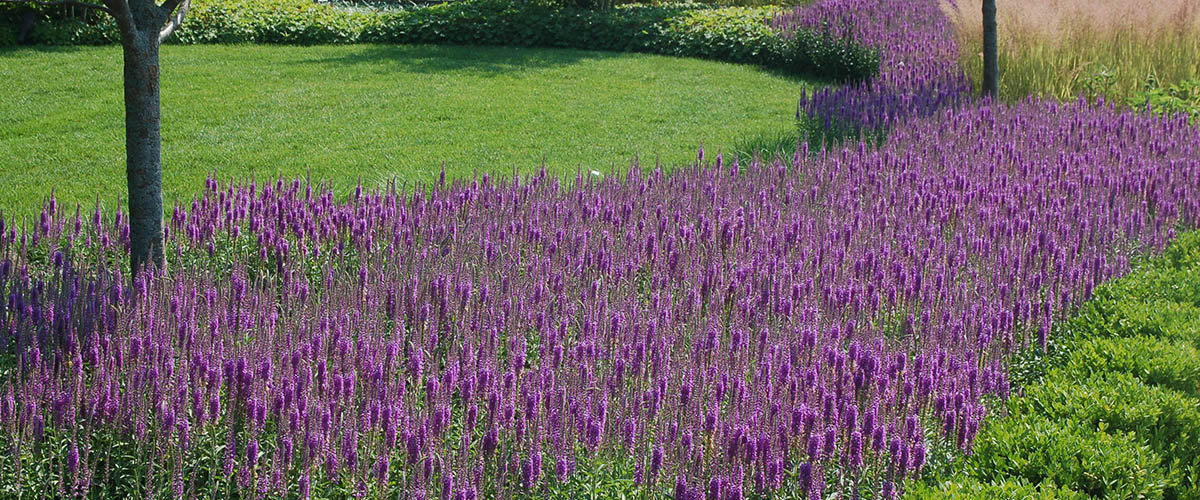
Evaluating Perennials for Chicagoland Gardens
Perennials in Focus is a plant evaluation program that examines new and underused plants for Chicagoland, the third largest metropolitan area in the country. A group of horticultural experts trials and evaluates plants at numerous locations across the region. Results help consumers, public gardens, growers, landscape designers, breeders, and other industry professionals make informed plant choices.
Pollen load efficiency: Silphium versus Helianthus
Comparing the pollen load efficiency of Silphium perfoliatum and Helianthus grosseserratus is not as simple as declaring the plant with the biggest flowers the best pollinator plant. Pollen load efficiency describes how readily pollen can be collected, retained and delivered between flowers. For these two North American prairie perennials, the result depends on flower-head size, floret accessibility, bloom duration and the behaviour of visiting bees.
Both species offer strong pollinator value, but they contribute at different scales and times. Silphium perfoliatum, commonly called cup plant, produces numerous smaller yellow heads over an extended period. Helianthus grosseserratus, the giant sunflower, concentrates a dramatic display into fewer, much larger heads. Those differences make the plants useful alternatives when the aim is continuous pollen supply, concentrated late-season forage, or a combination of both.
Pollen load efficiency in practice
Pollen load efficiency can be divided into three connected processes: pollen pickup from the anthers, retention on the bee’s body and delivery to a receptive flower. A flower may produce abundant pollen yet perform poorly if bees cannot reach it easily or remove the grains. Conversely, a modest-looking patch can provide a steady supply when many small flowers are available over many weeks.
Size alone therefore gives an unreliable ranking. A large sunflower head contains hundreds of individual florets, but a bee works only a few at a time. A cup plant head is smaller, yet the plant commonly carries several heads at different heights, creating numerous separate foraging stations. The relevant measure is how much usable pollen a visitor acquires during a normal foraging trip, followed by how often that pollen reaches another flower.
Flower structure and seasonal supply
Silphium perfoliatum generally reaches 1.2–2.4 metres and bears upright stems with paired, stem-clasping leaves. Its yellow flower heads have accessible ray and disk florets that usually open progressively. This extended sequence favours repeated visits from honey bees, bumblebees and smaller solitary bees. It also allows the plant to supply pollen before and after the heaviest displays of taller summer flowers.
Helianthus grosseserratus commonly grows 1.8–3 metres tall, with coarse foliage and large terminal flower heads. Its dark central disks contain a substantial late-season pollen reservoir, while the yellow rays make it conspicuous to bees. The larger heads particularly favour robust bees capable of moving across the broad flower face. Flowering is more concentrated, however, and the weight of the heads can make exposed plants vulnerable to lodging after wind or heavy rain.
On balance, cup plant offers the better efficiency for regular pickup, delivery and continuity across numerous visits. Giant sunflower has greater potential pollen volume in each display and can provide a valuable late-season resource for larger bees. Its showy head does not automatically translate into a larger pollen load per bee, especially when abundant nectar attracts bees primarily for nectar collection.
Lessons from Chicagoland trial gardens
Perennials in Focus evaluates selected perennials across several Chicagoland gardens rather than relying on a single site. Its records track practical characteristics including flowering period, flower colour, mature height, spread and seasonal performance. These observations are particularly useful because the region experiences humid summers, periodic drought, wet autumns and sharply cold winters, all of which affect plant establishment and the duration of bloom.
For readers seeking the basis of this regional assessment, the regional evaluation team explains how plants are observed across participating sites. Multi-site records can reveal whether a plant flowers consistently, whether its habit changes between wet and dry conditions, and whether its appearance holds up from early summer into autumn. They also help separate genuine regional strengths from unusually favourable conditions at one garden.
Trial results should not be presented as a controlled pollen-counting experiment unless pollen has actually been sampled and quantified. Bloom duration and pollinator activity offer useful evidence, while visible pollen on bees provides another practical indicator. For Australian growers, Chicagoland performance is best treated as a strong baseline that requires local checking. Flowering dates shift with latitude, winter temperatures, moisture and the southern-hemisphere season.
Australian conditions and garden markets
Australian conditions vary sharply across the continent. Melbourne’s cool, wet winters and changeable summers can encourage strong spring growth but cause tall stems to lodge. Adelaide and Perth often provide intense sun and dry summers, making establishment irrigation important, particularly for cup plant. Sydney has milder winters but humid storms that may damage large flower heads. In Brisbane and other subtropical regions, mild conditions can shift flowering outside the familiar temperate pattern, so perennial performance should be recorded locally.
Local nurseries and garden centres commonly market plants under labels such as “full sun”, “pollinator friendly”, “cut flower” or “long flowering”. Those labels help buyers compare Silphium and Helianthus, but they can obscure differences in mature size and useful bloom period. Wholesale growers may offer plugs or seed while public gardens and specialist pollinator plantings can provide valuable local performance records. Seed imported from overseas must also meet Australian Customs and biosecurity requirements, including any required phytosanitary certification.
| Characteristic | Silphium perfoliatum | Helianthus grosseserratus |
|---|---|---|
| Typical stature | About 1.2–2.4 m tall with an upright, branching habit | About 1.8–3 m tall with fewer, larger flower heads |
| Indicative spread | Roughly 0.6–1.2 m | Roughly 0.9–1.5 m |
| Chicagoland bloom period | Usually June into September | Usually August into October |
| Pollen pattern | Numerous smaller heads opening progressively | Larger pollen-rich displays concentrated later |
| Foraging advantage | Regular pickup and delivery across a long flowering window | Bulk forage for robust bees in late summer |
| Main growing consideration | Regular moisture and protection from severe wind | Heat tolerance once established, but large heads may lodge |
| Landscape use | Long-lasting bee forage and natural-looking screening | Dramatic height, late-season flowers and potential cut-flower use |
| Best efficiency | Consistent, mixed-bee pollen collection | Concentrated late-season pollen availability |
Choosing, planting and monitoring
Choose cup plant when continuous pollen supply is the priority, especially for a sunny border where smaller bees can work among numerous modest-sized flowers. Choose giant sunflower when visual impact, substantial late-season forage and a strong cut-flower character matter more. Growing both can extend overlap and provide complementary resources, provided there is room for plants of this stature.
Buy from an Australian nursery with clearly labelled perennial status and documented provenance, then plant in full sun with dependable drainage during establishment. Keep a simple garden record showing the first and last flowering dates, weather conditions and the kinds of bees observed. Note whether visitors collect visible pollen and whether they move between separate heads. Repeating those observations over several seasons will reveal which plant delivers the most useful pollen load in the local climate, while records shared with growers and regional trial networks can strengthen future plant evaluations.
In the Garden
Evaluator gardens are located across the Chicagoland area, representing a range of growing conditions. Visit our retail and wholesale partners to find trialled perennials for your own garden.
Retail & Wholesale: Hinsdale Nurseries (Willowbrook, IL), Mariani Nurseries (Kenosha, WI & Garden Prairie, IL), Northwind Perennials (Burlington, WI), The Growing Place (Aurora, IL).
Wholesale Only: Hinsdale Nurseries (Plano, IL), Intrinsic Perennial Gardens (Hebron, IL).
Our Evaluation Program
The 2017–2020 evaluation cycle included Agastache 'Blue Boa', Allium senescens 'Blue Eddy', Amsonia ciliata var. filifolia 'Georgia Pancake', Astilbe 'Chocolate Shogun', Boltonia astroides 'James Crocket', Brunnera 'Alexander's Great', and Geranium cinereum 'Jolly Jewel Purple'. Completed evaluations include Amsonia 'Blue Ice' (2004–07).
On April 10, 2020, the program published snapshot profiles for Vernonia lettermanii 'Iron Butterfly', Stokesia laevis 'Elf', Stachys officinalis 'Pink Cotton Candy', Lobelia 'Monet Moment', Helleborus 'Winter Thrillers', Geum 'Mai Tai', Geranium soboliferum 'Butterfly Kisses', Gentiana x intermedia 'True Blue', Eurybia divaricata, Asparagus 'Purple Passion', and Agastache 'Bolero'.
Browse the full collection of snapshots organized alphabetically — from A–D, E–H, I–Q, and R–Z — to find detailed performance data on perennials trialled across Chicagoland.