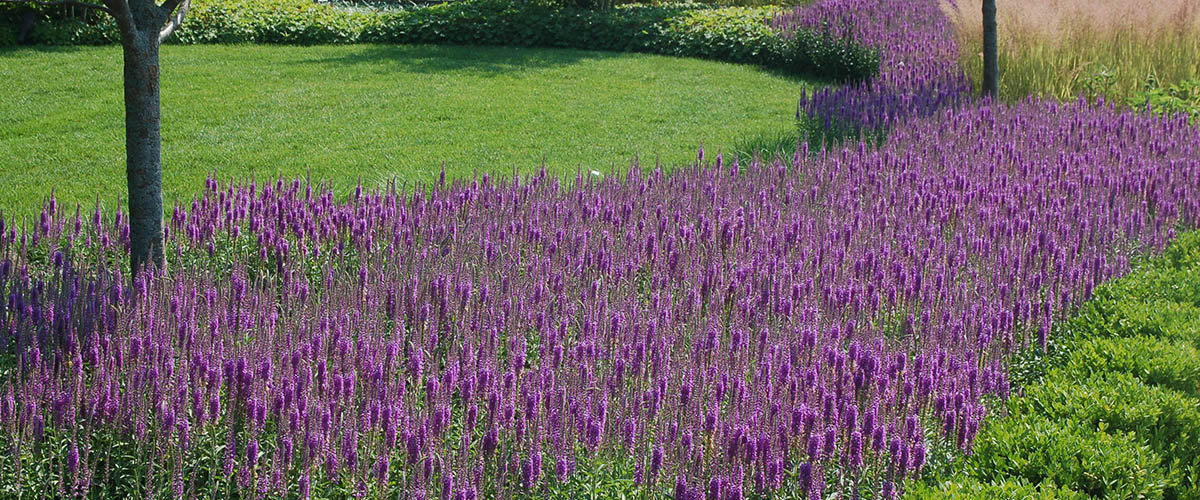
Evaluating Perennials for Chicagoland Gardens
Perennials in Focus is a plant evaluation program that examines new and underused plants for Chicagoland, the third largest metropolitan area in the country. A group of horticultural experts trials and evaluates plants at numerous locations across the region. Results help consumers, public gardens, growers, landscape designers, breeders, and other industry professionals make informed plant choices.
Comparing foliage texture: Brunnera macrophylla and Pulmonaria
Foliage brings a garden to life before flowers open, yet two widely grown shade perennials create very different surfaces. Brunnera macrophylla, commonly called Siberian bugloss, usually forms a low mat of broad, heart-shaped leaves with a smooth or lightly quilted face. Pulmonaria, or lungwort, carries narrower leaves with raised veins, silver spotting and a distinctly hairy, corrugated surface. Comparing their foliage texture reveals differences in touch, visual weight and the way each plant occupies shaded ground.
For Australian gardeners, that distinction matters in compact courtyards, beneath evergreen shrubs and on partially shaded balconies. A plant that looks soft and broad in a temperate display may behave differently in Melbourne’s dry summers, Sydney’s humidity or Brisbane’s warmer winters. Texture also changes with water, light and leaf age, so plant form and local growing conditions deserve equal attention when choosing a perennial for a long-term planting.
A close look at leaf surfaces
Brunnera leaves are generally thin, heart- or kidney-shaped and softly reflective, with cultivars such as ‘Jack Frost’ showing broad silver areas between green veins. Young leaves may look especially smooth, while older foliage can develop gentle puckering along the margins. The result is a calm, almost polished texture that reads as larger and calmer than surrounding leaves, particularly when a clump is viewed from a path or balcony.
Pulmonaria offers a more intricate texture. The leaves of common lungwort, Pulmonaria officinalis, are elongated, with a puckered blade, prominent branching veins and fine hairs that make the surface feel rough rather than silky. Many cultivars add silver spots or nearly continuous silvering. Held on short stems above the soil, these patterned leaves create a busier, more upright texture than Brunnera’s spreading, ground-hugging foliage.
Descriptions can blur the distinction between visual and tactile texture, so it helps to examine both sides of a leaf and compare mature growth rather than a new nursery pot. Hairiness, moisture and reflected light all affect perception; research into leaf texture provides useful background on the characteristics used to describe foliage. Brunnera generally feels smoother and looks broader, while Pulmonaria feels coarser and looks more finely patterned.
Conditions that shape foliage texture
Both plants prefer cool, moisture-retentive soil and filtered or dappled light. They suit woodland edges, the north side of shrubs and shaded borders where roots are not repeatedly disturbed. Brunnera usually tolerates a brighter position if moisture remains steady, although hot Australian sun can scorch its broad blades. Pulmonaria is equally comfortable in shelter, where the hairy leaf surface remains useful as a rich textural accent.
Evidence gathered across multiple Chicagoland gardens by the Perennials in Focus program gives useful data on bloom period, stature and spread. It is not a substitute for Australian experience: the southern growing season and summer heat invert parts of the northern climate pattern. In Melbourne and Adelaide, winter moisture supports spring growth before dry conditions arrive; in Sydney and Brisbane, humidity and warmer nights can encourage softer growth and greater slug pressure.
Water management can alter the foliage as much as climate does. A Brunnera leaf that wilts in a dry container loses its smooth, taut appearance, while drought-stressed Pulmonaria can become curled and coarse. Deep watering followed by mulch and an organic surface helps both plants in garden beds, though it must not create a wet, stagnant root zone. Drip systems and early-morning container watering fit Australian garden habits and help respect local water restrictions.
Brunnera and Pulmonaria side by side
At comparable viewing distance, the plants separate clearly by scale as well as surface. The following comparison focuses on forms most often sold in Australian nurseries, while recognising that species and named cultivars can vary.
| Plant feature | Brunnera macrophylla | Pulmonaria |
|---|---|---|
| Common name | Siberian bugloss | Lungwort |
| Typical habit | Low, spreading mound | Compact clump with more upright leaves |
| Leaf outline | Broad heart- or kidney-shaped | Narrow oval, lance-shaped or spoon-shaped |
| Surface | Smooth to lightly quilted, soft sheen | Hairy, pubescent and strongly puckered |
| Pattern | Green, silver-mottled or silver-veined | Green, silver-spotted or largely silvered |
| Visual effect | Calm, broad, luminous masses | Detailed, speckled, tactile-looking foliage |
| Flowering | Small blue flowers on fine stems | Tubular pink, purple, blue or white flowers |
| Best role | Groundcover, border edging and containers | Close-up borders, troughs and mixed shade planting |
Flowering strengthens the contrast without changing the basic foliage character. Brunnera produces airy sprays of tiny blue flowers that hover above the leaves; Pulmonaria carries clustered tubular flowers, often in pink, violet or blue, closer to the crown. In Australia these usually appear in spring, and the leaves may remain attractive longer in mild, sheltered districts than at sites exposed to summer heat.
Both plants benefit from air movement, and slugs and snails can damage new foliage, especially in damp, shaded gardens. Dense growth also needs room between crowns. Brunnera can seed freely into damp soil, while Pulmonaria tends to expand as a clump; remove unwanted seedlings and divide mature crowns when crowded. Checking leaf undersides for pests helps both plants stay presentable without mistaking seasonal dieback for a lack of suitability.
Using contrasting foliage in Australian gardens
In a small Australian courtyard, Brunnera can create a broad silver-green plane beneath a tree or wall, giving a simple space a cool visual rhythm. Pulmonaria works well near the front of a border, where its spotted leaves can be seen at close range from a path. Pairing the two is effective when the smoother leaves provide a background for the more textured, speckled foliage.
Australian buying habits influence what is available as much as the climate does. Garden centres and online nurseries commonly offer these plants in small pots for autumn or winter planting, and specialist growers may carry several Pulmonaria cultivars. Labels can be inconsistent: ‘lungwort’ may identify more than one species, while some Brunnera selections are sold under the macrophylla name. Check the full botanical name and expected mature spread before combining either plant.
Plant purchasing also sits within Australian biosecurity law. The Commonwealth Biosecurity Act 2015 can apply to imported plant material, while state quarantine controls govern movement between jurisdictions. Buying from a reputable Australian nursery and keeping the plant label reduces uncertainty and avoids introducing pests. Before moving a clump interstate, check the destination state’s current plant quarantine requirements, as controls can change with pest risks.
Make a texture-led choice
Choose according to the texture you want to live with. Brunnera is the stronger option for broad, smooth-looking foliage, generous silver patterning and a low, flowing edge. Pulmonaria suits gardeners who value tactile leaves, visible hairs and small-scale mottling. Both work in pots, but Pulmonaria’s upright clump and Brunnera’s spreading habit need slightly different spacing and placement.
Before ordering, compare the site in morning and afternoon light, note how quickly it dries and check drainage beneath existing shrubs. Select a nursery-grown plant with active growth, firm leaves and a clear label, then prepare the soil with compost before transplanting. Cooler autumn and winter planting gives roots time to establish in much of southern Australia; in subtropical districts, afternoon shade remains important through the warmer months.
Start with one healthy pot of each from a local specialist nursery, place them in separate corners of the same shaded bed, and compare their foliage through a full year. Then choose the plant whose texture, habit and care routine suit your garden, and use its contrasting leaf shape to give the space a deliberate, year-round character.
In the Garden
Evaluator gardens are located across the Chicagoland area, representing a range of growing conditions. Visit our retail and wholesale partners to find trialled perennials for your own garden.
Retail & Wholesale: Hinsdale Nurseries (Willowbrook, IL), Mariani Nurseries (Kenosha, WI & Garden Prairie, IL), Northwind Perennials (Burlington, WI), The Growing Place (Aurora, IL).
Wholesale Only: Hinsdale Nurseries (Plano, IL), Intrinsic Perennial Gardens (Hebron, IL).
Our Evaluation Program
The 2017–2020 evaluation cycle included Agastache 'Blue Boa', Allium senescens 'Blue Eddy', Amsonia ciliata var. filifolia 'Georgia Pancake', Astilbe 'Chocolate Shogun', Boltonia astroides 'James Crocket', Brunnera 'Alexander's Great', and Geranium cinereum 'Jolly Jewel Purple'. Completed evaluations include Amsonia 'Blue Ice' (2004–07).
On April 10, 2020, the program published snapshot profiles for Vernonia lettermanii 'Iron Butterfly', Stokesia laevis 'Elf', Stachys officinalis 'Pink Cotton Candy', Lobelia 'Monet Moment', Helleborus 'Winter Thrillers', Geum 'Mai Tai', Geranium soboliferum 'Butterfly Kisses', Gentiana x intermedia 'True Blue', Eurybia divaricata, Asparagus 'Purple Passion', and Agastache 'Bolero'.
Browse the full collection of snapshots organized alphabetically — from A–D, E–H, I–Q, and R–Z — to find detailed performance data on perennials trialled across Chicagoland.