Evaluating Perennials for Chicagoland Gardens
Perennials in Focus is a plant evaluation program that examines new and underused plants for Chicagoland, the third largest metropolitan area in the country. A group of horticultural experts trials and evaluates plants at numerous locations across the region. Results help consumers, public gardens, growers, landscape designers, breeders, and other industry professionals make informed plant choices.
Early Spring Foliage: Epimedium and Helleborus Hybrids
Early spring in Chicagoland can make a perennial garden look dormant one day and surprisingly animated the next. As snow recedes and soil temperatures rise, the first foliage becomes an important part of the garden’s visual rhythm. Two especially valuable shade plants, Epimedium and Helleborus hybrids, emerge with distinct textures, colors, and habits.
Comparing the Early Spring Foliage of Epimedium and Helleborus Hybrids requires looking beyond simple plant height or bloom time. The first leaves can differ greatly from the mature summer canopy, and their appearance may change according to cultivar, winter temperatures, exposure, and the age of the planting.
For home gardeners and landscape professionals, these early details help determine where each perennial belongs. One may provide a delicate, expanding carpet beneath trees, while the other creates a substantial evergreen or semi-evergreen mound near a path or entry garden.
What appears first in Chicagoland gardens
Helleborus hybrids often make the earliest visual statement. In many protected gardens, their leathery leaves remain through winter, though they may be flattened, weathered, or browned at the edges. New foliage then rises from the crown as flower stems develop, giving the plant renewed density before many neighboring perennials have stirred.
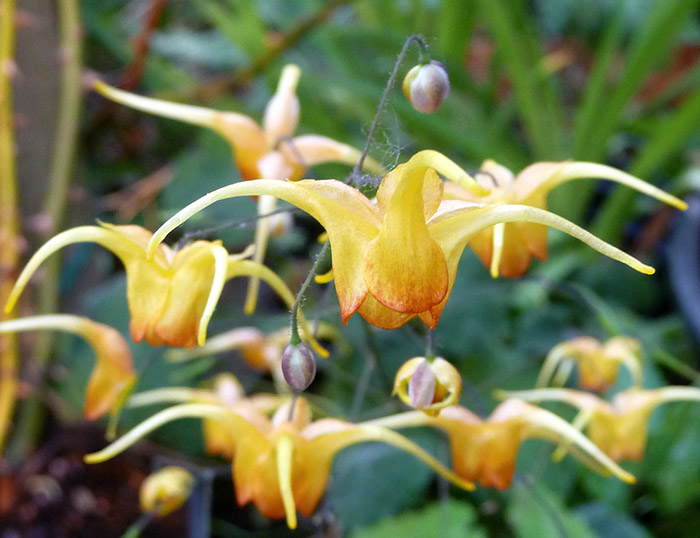
Epimedium usually begins with a more animated flush. Depending on the selection, young leaves can emerge bronze, copper, red, or plum before shifting toward green. The stems are slender, and the unfurling leaves create a light, layered effect rather than a single solid mass. In a cold spring, emergence may be delayed until the soil has warmed consistently.
Microclimate plays a major role in the comparison. A sheltered bed beside a foundation may show new growth weeks before an exposed woodland edge. Late freezes can also damage tender Epimedium leaves, while Helleborus foliage generally looks tougher, even when flower stems or older leaves show winter injury.
Reading epimedium foliage
The appeal of Epimedium lies in its combination of fine structure and seasonal color. New leaves are often heart-shaped, with thin blades held on wiry petioles. Some cultivars have red margins, mottled surfaces, or a distinct flush of burgundy across the entire leaf. These tones are especially visible when plants are grown against mulch or pale stone.
As the season advances, the foliage typically expands into a low, spreading cover. Mature height varies, but many selections remain useful beneath shrubs, deciduous trees, and taller woodland perennials. The leaves rarely dominate a composition; instead, they soften edges and fill spaces between larger forms.
Epimedium foliage is also valuable after flowering. Some plants retain a fresh green appearance into summer, while others develop a slightly blue-green or yellow-green cast. In dry shade, established clumps are often dependable once their roots are developed, although new plantings benefit from regular moisture during their first seasons.
How helleborus foliage holds its shape
Helleborus hybrids offer a bolder leaf presence. Their palmate leaves are divided into substantial, pointed segments and often form a rounded mound. Dark green foliage can provide a strong backdrop for nodding flowers in white, pink, purple, slate, or near-black shades.
Many hybrid hellebores are evergreen or semi-evergreen in the region, but that description should not be treated as a promise of perfect winter foliage. Wind, ice, snow cover, and sudden temperature changes can leave older leaves tattered. Removing damaged leaves in late winter or early spring exposes the new growth and improves air circulation around the crown.
Fresh Helleborus leaves tend to look thicker and more substantial than Epimedium leaves. They contribute structure in a sparse spring border and continue to anchor the planting after the flowers fade. This persistence makes hellebores useful near walkways, patios, and front-entry beds where a reliable mound is desirable.
Comparing foliage traits in the landscape
The strongest contrast is one of visual weight. Epimedium offers movement, fine texture, and often a colorful spring flush. Helleborus hybrids contribute permanence, dark mass, and a more formal presence. Combining them can create a layered shade planting, with Epimedium spreading beneath or beside the larger hellebore clumps.
Performance still depends on the individual plant. Some Epimedium selections spread gradually by rhizomes, while others form tight clumps. Helleborus hybrids can vary in leaf gloss, leaflet width, winter retention, and crown size. Trial observations are therefore more useful than relying on a species name alone.
| Foliage characteristic | Epimedium | Helleborus hybrids |
|---|---|---|
| First spring impression | Light, unfolding, often bronze or red | Dense, substantial, frequently supported by overwintered leaves |
| Leaf texture | Thin to medium, delicate-looking | Thick, leathery, strongly divided |
| Typical habit | Low mound or spreading ground cover | Rounded clump with a stronger vertical presence |
| Seasonal color | Spring flush may fade to green or blue-green | Usually dark green, sometimes glossy or subtly marbled |
| Winter behavior | Often deciduous or semi-evergreen, depending on selection | Frequently evergreen or semi-evergreen |
| Best design role | Fine-textured carpet and transitional layer | Structural accent and long-lasting anchor |
Garden conditions can change the apparent winner. Under high tree canopies with competition from roots, a tough Epimedium may provide more dependable coverage once established. In a well-drained bed with morning light, Helleborus hybrids can maintain a handsome mound and reward close viewing during the dormant season.
Matching each perennial to its site
Epimedium is particularly useful in dry or average-moisture shade, though newly planted divisions or container-grown specimens should not be allowed to dry out. A leaf mulch or compost layer helps moderate soil temperature and supports gradual establishment. Avoid burying the crown under a heavy layer of organic material.
Helleborus hybrids prefer fertile, well-drained soil and usually appreciate consistent moisture during active growth. They tolerate shade well, but some morning or filtered light can improve flowering and keep the foliage from becoming overly open. Poor drainage is a greater concern than ordinary winter cold, especially in heavy soils that remain saturated.
Spacing also affects the foliage display. Close planting creates a fuller composition sooner, while wider spacing allows each plant’s form to be read clearly. In a mixed border, place hellebores where their dark leaves can contrast with lighter Epimedium growth, sedges, ferns, or spring bulbs.
Using seasonal observations to choose plants
Local trial information helps reveal characteristics that catalog descriptions may compress into a few words. Notes recorded across several seasons can show whether a plant emerges early, recovers quickly after frost, retains attractive leaves through winter, or develops a useful spread under regional conditions. Perennials in Focus shares practical garden observations that can support more informed plant selection.
When comparing trial results, pay attention to the planting location as well as the plant name. A Helleborus hybrid in open winter wind may behave differently from the same selection in a protected courtyard. An Epimedium beneath mature trees may face root competition that is absent in a prepared garden bed.
The most useful evaluation considers appearance over time. Early foliage, flowering, summer persistence, and late-season condition all contribute to a perennial’s value. A plant that looks modest in April may become an excellent ground-covering layer by July, while a showy spring mound may need occasional cleanup to remain attractive.
Practical selection points for spring foliage
A short checklist can make nursery visits and garden planning more productive:
- Choose Epimedium for fine texture, colored new growth, and gradual ground-covering ability in shade.
- Choose Helleborus hybrids for substantial evergreen or semi-evergreen structure and early-season presence.
- Inspect the mature spread, not just the container size, before deciding on spacing.
- Favor well-drained soil for hellebores and consistent establishment moisture for both genera.
- Compare cultivar-specific trial notes when winter foliage, leaf color, or emergence timing matters.
It is also worth photographing plants in early spring rather than evaluating them only during peak bloom. Images taken as leaves emerge can reveal differences in crown density, stem strength, and recovery after cold weather. Those details are especially helpful when planning a layered woodland border or a highly visible foundation planting.
A thoughtful pairing may include hellebores as anchored focal clumps and Epimedium as a lower, more fluid layer around them. The result changes steadily from late winter through summer without relying on a single flowering moment.
Visit the garden in early spring, record which foliage textures hold your attention, and use regional trial findings to select cultivars that fit both the site and the season. Thoughtful observation at planting time can turn two excellent shade perennials into a more durable and visually connected composition.
In the Garden
Evaluator gardens are located across the Chicagoland area, representing a range of growing conditions. Visit our retail and wholesale partners to find trialled perennials for your own garden.
Retail & Wholesale: Hinsdale Nurseries (Willowbrook, IL), Mariani Nurseries (Kenosha, WI & Garden Prairie, IL), Northwind Perennials (Burlington, WI), The Growing Place (Aurora, IL).
Wholesale Only: Hinsdale Nurseries (Plano, IL), Intrinsic Perennial Gardens (Hebron, IL).
Our Evaluation Program
The 2017–2020 evaluation cycle included Agastache 'Blue Boa', Allium senescens 'Blue Eddy', Amsonia ciliata var. filifolia 'Georgia Pancake', Astilbe 'Chocolate Shogun', Boltonia astroides 'James Crocket', Brunnera 'Alexander's Great', and Geranium cinereum 'Jolly Jewel Purple'. Completed evaluations include Amsonia 'Blue Ice' (2004–07).
On April 10, 2020, the program published snapshot profiles for Vernonia lettermanii 'Iron Butterfly', Stokesia laevis 'Elf', Stachys officinalis 'Pink Cotton Candy', Lobelia 'Monet Moment', Helleborus 'Winter Thrillers', Geum 'Mai Tai', Geranium soboliferum 'Butterfly Kisses', Gentiana x intermedia 'True Blue', Eurybia divaricata, Asparagus 'Purple Passion', and Agastache 'Bolero'.
Browse the full collection of snapshots organized alphabetically — from A–D, E–H, I–Q, and R–Z — to find detailed performance data on perennials trialled across Chicagoland.