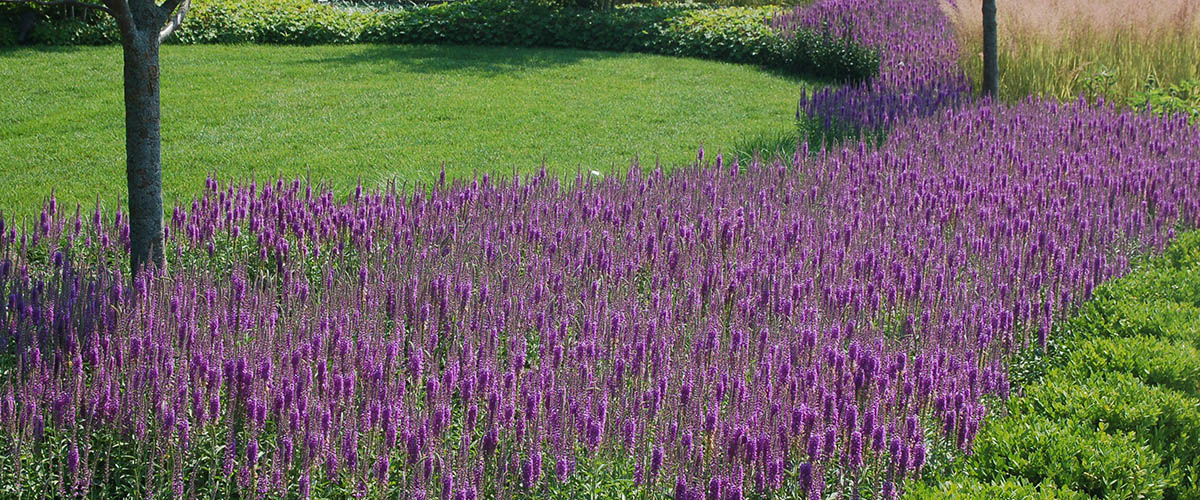
Evaluating Perennials for Chicagoland Gardens
Perennials in Focus is a plant evaluation program that examines new and underused plants for Chicagoland, the third largest metropolitan area in the country. A group of horticultural experts trials and evaluates plants at numerous locations across the region. Results help consumers, public gardens, growers, landscape designers, breeders, and other industry professionals make informed plant choices.
Sedum sieboldii and Sedum pachyphyllum in dry gardens
Sedums are often grouped together as drought-tolerant succulents, but their performance can differ greatly by species, climate, and growing conditions. Sedum sieboldii and Sedum pachyphyllum both store water in fleshy leaves, yet they respond very differently to a Chicagoland winter and to the seasonal rhythm of a Midwestern garden.
For gardeners comparing these plants, the key question is not simply which sedum tolerates the least water. It is which plant can survive the full combination of summer heat, humidity, heavy rain, poor drainage, freezing temperatures, and changing winter moisture. A species that excels in an arid container may be a poor choice for an unprotected perennial bed.
This comparison considers drought resistance, cold hardiness, soil requirements, ornamental value, and practical landscape use. It also separates true garden performance from short-term tolerance observed in pots or highly controlled sites.
How the two sedums grow
Sedum sieboldii, often called October daphne, forms low, rounded growth from slender stems. Its blue-green, spoon-shaped leaves are arranged in whorls, frequently edged or flushed with pink. The plant is commonly treated as a hardy perennial in suitable climates, although its aboveground growth dies back in winter. It returns from the crown when spring conditions become favorable.
Sedum pachyphyllum, sometimes known as jelly beans or many fingers, has a more upright, branching habit. Its cylindrical leaves range from blue-green to yellow-green and may develop red tips in strong light or during dry conditions. Unlike S. sieboldii, it is generally grown as a tender succulent in the Chicago region, where freezing temperatures can kill exposed plants.
Both species use crassulacean acid metabolism, a water-saving process that allows them to open leaf pores primarily at night. This reduces moisture loss during hot, sunny weather. Their succulent tissues provide a reserve, but that reserve does not eliminate the need for suitable roots, airflow, and drainage.
Drought tolerance is shaped by the root zone
In a well-drained outdoor bed, S. sieboldii can handle periods of summer dryness after it has established. Its low habit helps protect the soil surface, while its fleshy leaves carry the plant through short intervals without irrigation. It is best described as drought tolerant rather than drought proof. Extended heat combined with shallow soil can still cause leaf drop, weak growth, or premature dormancy.
S. pachyphyllum is more specialized for prolonged dryness. Its thick leaves hold substantial water, and the plant can remain attractive through long periods without watering when grown in a porous mineral mix. In a container, it may need less frequent irrigation than S. sieboldii, especially when placed in bright light with good air circulation.
That advantage comes with a major limitation. A plant that tolerates severe drought in a pot may fail outdoors in Chicago because cold, saturated soil damages its roots. Water management includes removing excess moisture as well as supplying it. For local landscapes, winter survival is part of the drought-tolerance calculation.
Chicagoland conditions change the comparison
Chicagoland gardens experience hot summers, variable rainfall, humid spells, freeze-thaw cycles, and winter precipitation that can linger around plant crowns. These conditions reward plants that combine water storage with dependable seasonal adaptation. S. sieboldii is better aligned with that cycle because it can grow during the warm season, enter winter dormancy, and return when planted in an appropriate site.
S. pachyphyllum should usually be treated as a container specimen, seasonal accent, or protected collection plant in this region. It can spend summer outdoors, where sunlight intensifies leaf color and compact growth, but it needs shelter before frost. A bright indoor location or frost-free greenhouse is more realistic than permanent placement in a perennial border.
This distinction matters for landscape planning. Gardeners developing formal rose garden ideas can use hardy, low-growing sedums as textural edging where soil drains freely. A tender jelly bean sedum is better reserved for pots that can be moved before cold weather arrives.
Performance comparison
The following summary describes likely behavior in the Chicagoland region rather than performance in a warm, arid climate. Cultivar, planting depth, soil texture, exposure, and winter protection can change the outcome.
| Characteristic | Sedum sieboldii | Sedum pachyphyllum |
|---|---|---|
| Typical habit | Low, spreading to mounded perennial | Upright, branching succulent |
| Leaf structure | Fleshy, rounded, blue-green leaves | Thick, cylindrical “jelly bean” leaves |
| Summer drought tolerance | Moderate to high after establishment | High in a dry, porous container |
| Response to wet soil | Declines in poorly drained sites | Especially vulnerable to root and stem rot |
| Chicagoland winter use | Possible as a hardy perennial with good drainage | Usually grown as a tender seasonal plant |
| Best setting | Rock garden, raised bed, edging, trough | Container, windowsill, conservatory, summer display |
| Main ornamental season | Spring through fall, with late flowers | Summer through frost, depending on protection |
The table also shows why a direct winner can be misleading. S. pachyphyllum has stronger tissue-level adaptation to drought, while S. sieboldii offers more dependable year-round garden value in a cold-winter climate. For an outdoor perennial planting, survival from year to year is often more useful than maximum dry-soil endurance.
Soil, light, and watering practices
Plant S. sieboldii in full sun to light afternoon shade, ideally in a raised, sloping, gravelly, or sandy site. Amendments should improve drainage rather than simply increase fertility. Heavy clay can hold too much winter moisture, so a raised bed or rock garden may be safer than a level border. Water deeply during establishment, then allow the upper soil to dry before irrigating again.
S. pachyphyllum needs bright light and a sharply draining medium composed of materials such as coarse sand, pumice, perlite, or fine gravel. A container with a drainage hole is essential. Water thoroughly when the mix is dry, then let excess water escape completely. During winter indoors, reduce watering substantially because low light and cool conditions slow growth.
Neither sedum benefits from frequent shallow watering. That pattern encourages surface roots and can leave the crown vulnerable to rot. Mulch should be used carefully around S. sieboldii, keeping dense organic material away from the crown. S. pachyphyllum generally performs better with a mineral top dressing than with moisture-retentive mulch.
Choosing a role in the planting design
S. sieboldii is the stronger candidate for a low-water perennial bed, rock garden, green roof-style trough, or sunny edge where a plant must return after winter. Its foliage provides dependable texture before the flowers appear, and its late-season bloom can support insects when incorporated into a diverse planting. It should still be evaluated for spread, bloom timing, and winter losses at the site level.
S. pachyphyllum contributes a different visual effect. Its chunky leaves and warm-colored tips create contrast among fine-textured grasses, darker foliage, and compact annuals. It works well in a container collection or as a movable accent near a patio, where drainage and winter protection can be managed precisely.
For a pollinator-focused planting, neither species should carry the entire design. Pair hardy sedums with a broader range of flowering perennials, especially plants selected for sequential bloom and local site conditions. Resources on pollinator pathway plants can help place sedum among taller, longer-blooming species rather than using it as the sole nectar source.
Practical recommendations for gardeners
Use the following approach when deciding which plant belongs in a Chicagoland garden:
- Choose S. sieboldii for an outdoor perennial bed where winter return is important.
- Grow S. pachyphyllum in a movable container unless a protected, frost-free growing space is available.
- Prioritize drainage, especially in clay soil or locations exposed to winter runoff.
- Water new plantings regularly during establishment, then shift to deep, infrequent irrigation.
- Test both species in small groups and record winter survival, flowering, and drought response before expanding a design.
A local evaluation should include more than leaf appearance during a dry week. Record how quickly each plant recovers after rain, whether stems remain firm during humid weather, how the crown handles winter, and whether growth stays compact under the available light. These observations provide more useful guidance than a generic drought-tolerance label.
For most Chicagoland landscapes, S. sieboldii is the more reliable outdoor choice because it combines succulent foliage with better seasonal suitability. S. pachyphyllum wins for extreme dry-soil adaptation and distinctive form, but its lack of dependable cold hardiness makes it a specialized container plant rather than a permanent garden perennial.
Use these differences to match the plant to the site: trial S. sieboldii in a sharply drained sunny bed, and give S. pachyphyllum the portable protection it needs. Document the results across seasons and share those observations through regional perennial evaluation efforts so future plant choices become more precise.
In the Garden
Evaluator gardens are located across the Chicagoland area, representing a range of growing conditions. Visit our retail and wholesale partners to find trialled perennials for your own garden.
Retail & Wholesale: Hinsdale Nurseries (Willowbrook, IL), Mariani Nurseries (Kenosha, WI & Garden Prairie, IL), Northwind Perennials (Burlington, WI), The Growing Place (Aurora, IL).
Wholesale Only: Hinsdale Nurseries (Plano, IL), Intrinsic Perennial Gardens (Hebron, IL).
Our Evaluation Program
The 2017–2020 evaluation cycle included Agastache 'Blue Boa', Allium senescens 'Blue Eddy', Amsonia ciliata var. filifolia 'Georgia Pancake', Astilbe 'Chocolate Shogun', Boltonia astroides 'James Crocket', Brunnera 'Alexander's Great', and Geranium cinereum 'Jolly Jewel Purple'. Completed evaluations include Amsonia 'Blue Ice' (2004–07).
On April 10, 2020, the program published snapshot profiles for Vernonia lettermanii 'Iron Butterfly', Stokesia laevis 'Elf', Stachys officinalis 'Pink Cotton Candy', Lobelia 'Monet Moment', Helleborus 'Winter Thrillers', Geum 'Mai Tai', Geranium soboliferum 'Butterfly Kisses', Gentiana x intermedia 'True Blue', Eurybia divaricata, Asparagus 'Purple Passion', and Agastache 'Bolero'.
Browse the full collection of snapshots organized alphabetically — from A–D, E–H, I–Q, and R–Z — to find detailed performance data on perennials trialled across Chicagoland.