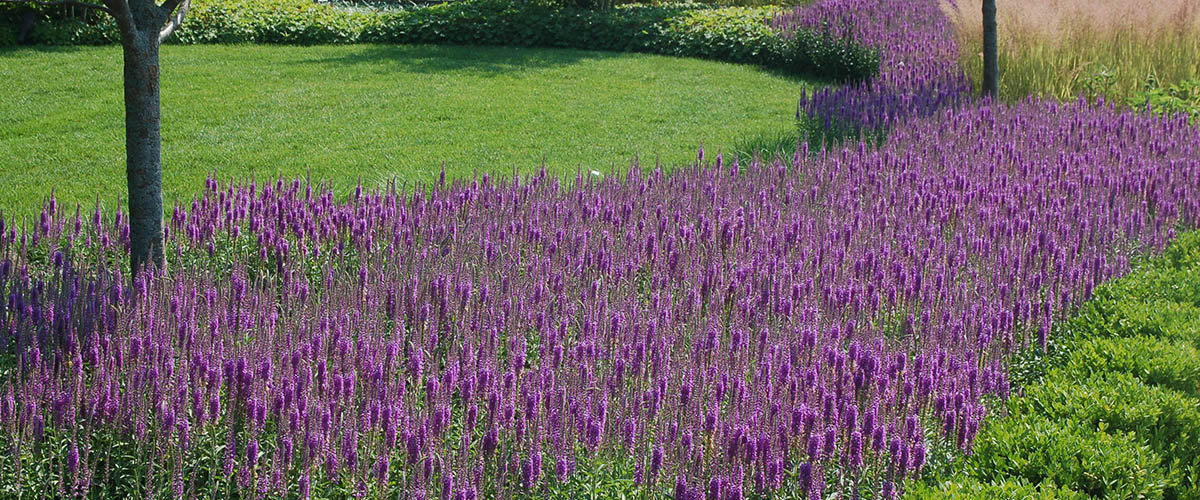
Evaluating Perennials for Chicagoland Gardens
Perennials in Focus is a plant evaluation program that examines new and underused plants for Chicagoland, the third largest metropolitan area in the country. A group of horticultural experts trials and evaluates plants at numerous locations across the region. Results help consumers, public gardens, growers, landscape designers, breeders, and other industry professionals make informed plant choices.
Deer browsing in two bellflowers
Deer browsing can quickly change the character of a perennial bed. It may remove flower buds, strip tender leaves or shorten stems, reducing both the display and the plant’s reserves for the following season. Campanula carpatica, the Carpathian bellflower, and Campanula rotundifolia, often called harebell, respond differently because they have contrasting growth habits. Neither is reliably deer-proof.
Perennials in Focus evaluates plants across multiple Chicagoland gardens, tracking bloom period, flower colour, height and spread over several seasons. Those records help growers make informed choices, but Chicago’s climate and browsing pressure do not perfectly predict performance in Australia. Local climate, wildlife and placement should determine which bellflower is more likely to remain attractive and resilient.
The two plants at a glance
Campanula carpatica develops a compact mound of leafy stems, usually with larger, more conspicuous bells. Campanula rotundifolia produces finer branching stems, smaller flowers and a looser appearance. Their different architecture changes how much of the plant is exposed to browsing.
| Characteristic | Campanula carpatica | Campanula rotundifolia |
|---|---|---|
| Typical growth habit | Compact, dense clump | Looser clump with slender, branching stems |
| Flowers | Larger, broadly bell-shaped blooms | Smaller, narrow bells along delicate stems |
| Most visible browse damage | Missing tips, damaged buds and shortened shoots | Stripped stems, missing flowers and reduced height |
| Recovery after light damage | Often produces fresh basal growth when the crown remains intact | Can reshoot from surviving rhizomes or stems |
| Best suited position | Protected edges, raised beds and pots behind barriers | Protected borders or mixed perennial plantings where stems are less exposed |
| Main limitation | Repeated browsing can still weaken the crown | Browsing can remove much of its flowering framework |
Deer may not necessarily prefer one species over the other. Availability, seasonal growth and individual animals can alter their choice. C. rotundifolia often appears more severely affected because much of its delicate flowering growth sits above the crown and is easy to strip. C. carpatica can conceal more foliage within a dense clump, although a hungry deer will browse its buds and upper growth too.
Browsing changes their performance
Deer are browsers rather than grazing animals, so they commonly target leaves, shoots and flower heads. Light nibbling may act like a controlled prune, especially when the crown remains intact. Repeated damage is more serious: the plant expends stored energy on replacement growth, produces shorter stems and carries fewer flowers into the next season.
With C. carpatica, an occasional snapped stem may be replaced from the base. A compact plant can still look presentable after minor damage, particularly if the central crown is protected. If browsing continues, however, successive flushes become shorter and the mound may become sparse. Container-grown specimens are vulnerable because the soft new growth can be especially attractive.
C. rotundifolia presents more of its biomass on exposed stems. Deer may remove an entire flowering stem rather than merely nibbling a leaf. The plant can regenerate from its spreading rhizomes, but severe or repeated browsing reduces vigour and may also affect its ability to maintain a naturalised colony. Trampling can compound the problem because the thin stems are easily flattened.
What regional trials reveal
Perennials in Focus provides a useful model for separating genuine plant performance from an unusual growing season. Multi-site observations across Chicagoland make it possible to compare bloom timing, colour, stature and spread under several soil and weather conditions. For browse-sensitive plants, however, the records need an additional measure of browsing pressure, such as a percentage of shoots affected or a comparison with protected plants.
The programme’s companion review of winter container plants offers useful context for anyone repeating trials in pots. Drainage, winter protection and losses from failed overwintering can affect the apparent performance of a bellflower just as surely as deer damage. A missing plant caused by rot should not be recorded as a browsing failure.
Chicago’s humid continental conditions also need careful translation. Australian gardeners may face a longer dry summer, warmer soil or reflected heat from masonry. In a warm, dry position, both campanulas may become short-lived without reliable moisture and shade from surrounding plants. Regional trial findings should therefore be treated as a strong starting point, not a replacement for local observation.
Australian conditions matter
Australia reverses the Northern Hemisphere growing calendar. Cooler conditions from March to May are often the best time to establish campanulas in temperate areas, including Melbourne, Canberra and Tasmania. Sydney and Perth gardeners may need more shade, careful irrigation and containers positioned away from hot afternoon sun. Winter growth can be useful in southern Australia, while summer dormancy is likely where plants experience high heat and dry soil.
Deer are not native to Australia, but introduced populations occur around Canberra, parts of eastern Victoria, New South Wales and Tasmania. In many other areas, the animals causing the most damage are kangaroos, wallabies, rabbits or possums. All can affect campanulas, although their feeding patterns differ. Advice based entirely on deer may therefore miss the main wildlife challenge in a particular garden.
Local plant names also need care. Australian gardeners frequently use “bluebell” for native Wahlenbergia species, while “bellflower” generally identifies Campanula. C. rotundifolia may be listed as harebell, bluebell or round-leaved bellflower. A botanical label prevents a purchase mistake at specialist nurseries, garden centres and plant sales. C. carpatica is generally easier to find, while C. rotundifolia may require a specialist source or a plant swap.
Protection that fits local gardens
Physical barriers remain the most dependable option where browsing is persistent. Fine-garden netting can protect flower buds, but it must be held away from foliage and secured at the base. Wire mesh is more suitable where rabbits or wallabies are involved. Local council and wildlife guidance should be checked before installing structures that might entangle animals.
C. carpatica is well suited to a protected edge, a raised bed or a pot placed behind a barrier. C. rotundifolia needs enough room for its stems to develop, but a sheltered position among robust perennials can make them less accessible. Companion planting provides some visual camouflage and reduces the amount of exposed growth. It should complement rather than replace protection where animals repeatedly browse.
Scent-based deterrents and homemade sprays can provide short-lived results, especially after rain, and are unlikely to solve persistent pressure. Watering and feeding also help: a stressed plant offers softer growth and fewer reserves for recovery. Maintaining even moisture and avoiding excessive nitrogen can produce tougher stems, although no cultural treatment makes either species immune to browsing.
Plant, protect and record
A small Australian comparison is easy to run without dedicated trial equipment. Buy matched plants, label them clearly and place some in a protected area while leaving others accessible. Record browsing frequency, stem loss, new growth, flowering and final dimensions. Local garden clubs, plant swaps and neighbourhood groups can share observations, while the Perennials in Focus trial model demonstrates how repeated observations across locations produce more reliable conclusions.
Keeping successful plants and propagating them reduces waste and replacement costs. That recovery-before-discard mindset also appears in projects focused on recovering silver from panels, although its chemistry has no direct effect on bellflowers. The gardening lesson is similar: retain value rather than treating a damaged plant or discarded component as waste without further use.
Choose the planting site this autumn, install the barrier before fresh shoots emerge, and keep a simple record beside each labelled campanula. Share the season’s results with local growers and contribute well-documented observations to regional perennial trials.
In the Garden
Evaluator gardens are located across the Chicagoland area, representing a range of growing conditions. Visit our retail and wholesale partners to find trialled perennials for your own garden.
Retail & Wholesale: Hinsdale Nurseries (Willowbrook, IL), Mariani Nurseries (Kenosha, WI & Garden Prairie, IL), Northwind Perennials (Burlington, WI), The Growing Place (Aurora, IL).
Wholesale Only: Hinsdale Nurseries (Plano, IL), Intrinsic Perennial Gardens (Hebron, IL).
Our Evaluation Program
The 2017–2020 evaluation cycle included Agastache 'Blue Boa', Allium senescens 'Blue Eddy', Amsonia ciliata var. filifolia 'Georgia Pancake', Astilbe 'Chocolate Shogun', Boltonia astroides 'James Crocket', Brunnera 'Alexander's Great', and Geranium cinereum 'Jolly Jewel Purple'. Completed evaluations include Amsonia 'Blue Ice' (2004–07).
On April 10, 2020, the program published snapshot profiles for Vernonia lettermanii 'Iron Butterfly', Stokesia laevis 'Elf', Stachys officinalis 'Pink Cotton Candy', Lobelia 'Monet Moment', Helleborus 'Winter Thrillers', Geum 'Mai Tai', Geranium soboliferum 'Butterfly Kisses', Gentiana x intermedia 'True Blue', Eurybia divaricata, Asparagus 'Purple Passion', and Agastache 'Bolero'.
Browse the full collection of snapshots organized alphabetically — from A–D, E–H, I–Q, and R–Z — to find detailed performance data on perennials trialled across Chicagoland.