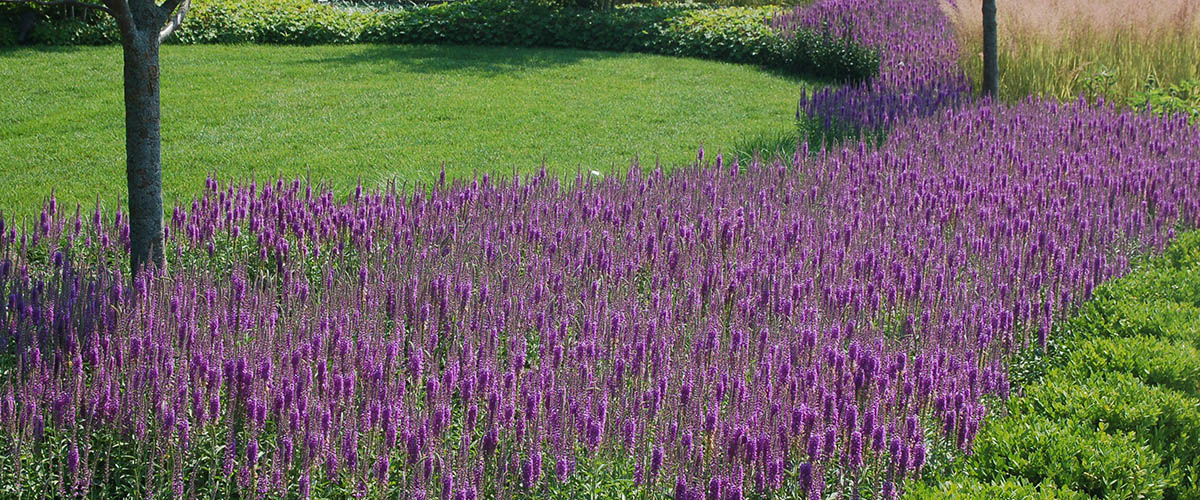
Evaluating Perennials for Chicagoland Gardens
Perennials in Focus is a plant evaluation program that examines new and underused plants for Chicagoland, the third largest metropolitan area in the country. A group of horticultural experts trials and evaluates plants at numerous locations across the region. Results help consumers, public gardens, growers, landscape designers, breeders, and other industry professionals make informed plant choices.
Comparing goldenrod species for monarch butterfly appeal
Goldenrod is one of the most valuable late-season nectar plants for monarch butterflies in the Midwest. When many summer perennials are finishing, Solidago species can provide abundant yellow flower clusters that help adult monarchs refuel during migration. Their bloom period also overlaps with other pollinators, making goldenrod a strong choice for wildlife-focused gardens.
Attractiveness, however, is not identical across every goldenrod. Species vary in flower density, bloom timing, plant height, branching, and tolerance of garden conditions. A plant that performs impressively in a sunny prairie-style border may be less useful in a compact residential bed or a partially shaded Chicagoland garden.
Regional evaluation matters because humid summers, heavy clay soils, winter variability, and changing rainfall can alter both plant performance and nectar availability. Observations from multiple gardens offer a more practical basis for choosing goldenrod than a single nursery description.
Why goldenrod matters during monarch migration
Monarch butterflies need nectar throughout their adult lives, but late summer and early fall are especially important. The migratory generation must accumulate energy for a long journey, and flowering goldenrod often supplies nectar when milkweed has passed its peak. A substantial stand of goldenrod can therefore become a dependable refueling area in the garden.
Goldenrod flowers are made up of many small florets grouped into branching sprays or dense plumes. This architecture gives butterflies repeated access to nectar within a relatively small area. Warm yellow blooms are also highly visible against fading grasses and autumn foliage, which can make a planting easier for pollinators to locate.
Goldenrod should be viewed as part of a sequence rather than an isolated monarch plant. Early and midsummer nectar sources support earlier generations, while asters, late-blooming mountain mint, and other fall perennials extend the forage period. Gardeners interested in seasonal succession can also explore these late-August perennials for companion planting ideas.
What makes one species more attractive
Flower abundance is the most obvious factor, but it is not the only one. Monarchs benefit from a broad, well-branched inflorescence with many open flowers at once. A plant producing a few tall spikes may offer nectar, yet a fuller plant can provide more feeding opportunities and remain useful for a longer stretch of favorable weather.
Bloom timing is equally important. A species that flowers in early August may support resident monarchs, while one that peaks in September may be especially valuable during migration. Weather can shift flowering by several days or weeks, so overlapping species often create a more reliable nectar window than relying on a single goldenrod.
Plant structure affects garden accessibility too. Tall species can rise above surrounding vegetation and attract butterflies from a distance, but they may flop or shade shorter plants. Compact or upright selections are easier to place in borders, although reduced size sometimes comes with fewer total flower heads. Cultivar performance should therefore be judged separately from the traits of the wild species.
Species comparison in the Chicagoland garden
The following comparison describes general tendencies rather than fixed rankings. Soil fertility, moisture, sun exposure, plant genetics, and management can change the appearance and flowering strength of any goldenrod. Monarchs also respond to what is blooming throughout the surrounding landscape, not to a plant in isolation.
| Goldenrod species | Typical garden character | Bloom tendency | Potential value for monarchs | Best placement |
|---|---|---|---|---|
| Canada goldenrod (Solidago canadensis) | Tall, vigorous, spreading | Late summer to early fall | High nectar potential from large flower sprays | Naturalistic borders, meadows, larger gardens |
| Tall goldenrod (Solidago altissima) | Upright, strongly vertical, prairie-forming | Late summer to fall | High where abundant flowers and height are desirable | Back of sunny beds, prairie plantings |
| Stiff goldenrod (Solidago rigida) | Clump-forming, sturdy, broad-headed | Late summer to early fall | Strong late-season resource with durable stems | Dry to average sunny soil |
| Showy goldenrod (Solidago speciosa) | Upright, ornamental, plume-like | Late summer to fall | Good visual signal and nectar supply | Mixed borders and pollinator gardens |
| Wrinkleleaf goldenrod (Solidago rugosa) | Branching, adaptable, often fuller in form | Late summer to fall | High potential from numerous small flower clusters | Moist to average soil, informal plantings |
| Gray goldenrod (Solidago nemoralis) | Shorter, fine-textured, adaptable | Late summer to fall | Useful where height is limited, though total flower mass may be lower | Dry edges, rock gardens, small beds |
Canada and tall goldenrod can be especially productive when space allows them to develop naturally. Their height and vigorous growth may be unsuitable for a tightly managed border, but their large flowering presence can benefit monarchs and many native bees.
Stiff and showy goldenrods often provide a useful balance between ornamental structure and wildlife value. Wrinkleleaf goldenrod can be a strong option for average or slightly moist soil, while gray goldenrod brings late-season flowers to leaner, drier sites. No species should be selected solely for monarch appeal without considering its mature spread and behavior.
How growing conditions change the result
Full sun is generally the most important requirement for abundant goldenrod flowering. Plants grown in insufficient light may become thin, produce fewer flower heads, or bloom later than expected. In the Chicagoland region, morning sun with afternoon shade can be workable for some species, but a bright, open position usually gives monarchs the largest nectar display.
Moisture needs differ among goldenrods. Canada, tall, and wrinkleleaf goldenrods can handle average soil and may appreciate consistent moisture during establishment. Stiff and gray goldenrods are better suited to leaner, well-drained locations. Heavy, wet soil can weaken crowns during winter, while drought stress before flowering may reduce plant size and floral output.
Plant health also influences pollinator value. Good air circulation can reduce problems associated with humid weather, especially in crowded beds. The same regional approach used when assessing other perennials—looking at vigor, disease tolerance, flowering reliability, and winter survival—helps identify goldenrods that perform consistently rather than merely looking impressive in a catalog. For comparison, the challenges of growing delphinium illustrate why local performance can differ sharply from idealized descriptions.
Building a longer monarch forage period
A mixed planting can make goldenrod more useful than a single-species block. Combine a tall goldenrod with asters, which often flower at a similar time, and add earlier nectar plants such as mountain mint, bee balm, blazing star, or butterfly weed. This arrangement supports butterflies before goldenrod opens and keeps food available after individual flower heads fade.
Layering also improves access. Place tall goldenrods toward the rear or center of a bed, medium-sized species in the middle, and shorter plants along paths or edges. Leave enough space for air movement and for each plant to form a substantial flowering canopy. A crowded planting may contain many stems but offer fewer accessible blooms.
Avoid treating neatness as the primary goal. Allowing some spent flower heads and stems to remain through winter provides habitat for insects and seeds for birds. After the main winter season, cut stems back before vigorous spring growth begins. Dividing mature clumps can maintain flowering strength, but excessive division may temporarily reduce the number of blooms available to monarchs.
Practical choices for gardeners and professionals
When comparing goldenrods, record more than the first day of bloom. Note the date when roughly half the flower heads are open, the length of the useful flowering period, stem strength after rain, plant width, and the number of pollinator visits during similar weather. These observations provide a clearer picture of practical value than color or height alone.
For public gardens, retailers, and landscape professionals, regional trial data can help separate dependable performers from plants that need unusually favorable conditions. Home gardeners can use the same principles on a smaller scale:
- Choose at least one goldenrod whose bloom overlaps the local monarch migration period.
- Match species to sun, drainage, soil moisture, and available planting space.
- Combine tall and compact forms to create nectar at several heights.
- Pair goldenrod with asters and other late-season nectar plants.
- Assess cultivars for flower production and plant health rather than relying on name recognition.
The most attractive goldenrod to monarchs is usually the one that produces many accessible flowers at the right time and continues performing through local weather patterns. In a Chicagoland garden, that may be a vigorous native species in a naturalistic planting or a more restrained selection in a residential border. Careful observation makes the choice more precise.
Plant goldenrod as part of a continuous, regionally appropriate nectar garden, then watch which species draw monarchs during the weeks that matter most. Sharing those observations with local horticultural and pollinator networks can strengthen the practical knowledge available to gardeners across the region.
In the Garden
Evaluator gardens are located across the Chicagoland area, representing a range of growing conditions. Visit our retail and wholesale partners to find trialled perennials for your own garden.
Retail & Wholesale: Hinsdale Nurseries (Willowbrook, IL), Mariani Nurseries (Kenosha, WI & Garden Prairie, IL), Northwind Perennials (Burlington, WI), The Growing Place (Aurora, IL).
Wholesale Only: Hinsdale Nurseries (Plano, IL), Intrinsic Perennial Gardens (Hebron, IL).
Our Evaluation Program
The 2017–2020 evaluation cycle included Agastache 'Blue Boa', Allium senescens 'Blue Eddy', Amsonia ciliata var. filifolia 'Georgia Pancake', Astilbe 'Chocolate Shogun', Boltonia astroides 'James Crocket', Brunnera 'Alexander's Great', and Geranium cinereum 'Jolly Jewel Purple'. Completed evaluations include Amsonia 'Blue Ice' (2004–07).
On April 10, 2020, the program published snapshot profiles for Vernonia lettermanii 'Iron Butterfly', Stokesia laevis 'Elf', Stachys officinalis 'Pink Cotton Candy', Lobelia 'Monet Moment', Helleborus 'Winter Thrillers', Geum 'Mai Tai', Geranium soboliferum 'Butterfly Kisses', Gentiana x intermedia 'True Blue', Eurybia divaricata, Asparagus 'Purple Passion', and Agastache 'Bolero'.
Browse the full collection of snapshots organized alphabetically — from A–D, E–H, I–Q, and R–Z — to find detailed performance data on perennials trialled across Chicagoland.