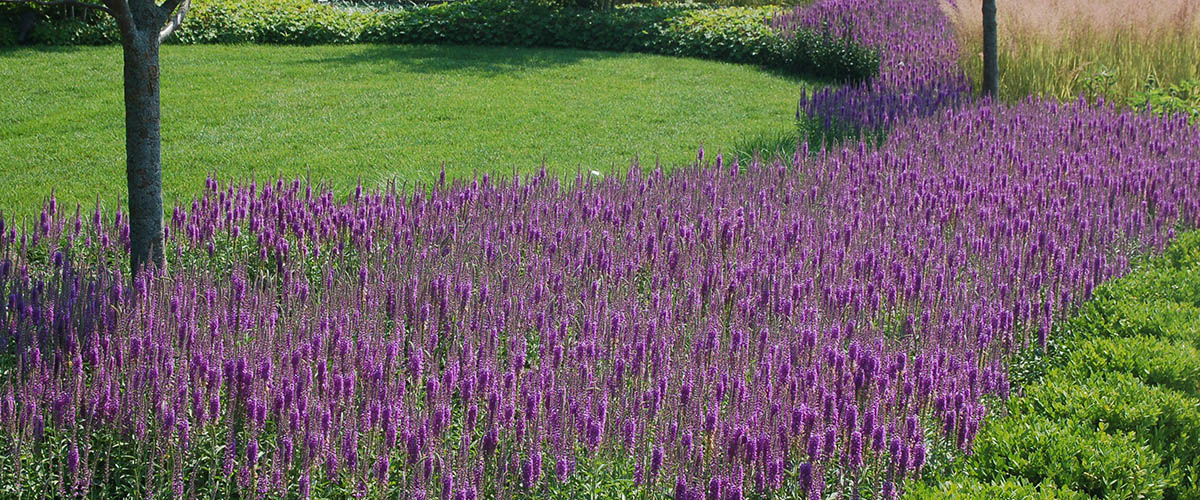
Evaluating Perennials for Chicagoland Gardens
Perennials in Focus is a plant evaluation program that examines new and underused plants for Chicagoland, the third largest metropolitan area in the country. A group of horticultural experts trials and evaluates plants at numerous locations across the region. Results help consumers, public gardens, growers, landscape designers, breeders, and other industry professionals make informed plant choices.
Polemonium Reptans Cultivars for Early Spring Pollinators
When the first bees begin moving through the garden, few herbaceous perennials offer as much charm in such a compact form as creeping Jacob’s ladder, Polemonium reptans. Its blue, bell-shaped flowers rise above fresh foliage in spring, providing useful nectar and pollen when many garden beds are still bare.
For gardeners in Australia, the timing requires careful interpretation. In the cool climates around Melbourne, Canberra and the Blue Mountains, flowering may coincide with early spring activity from native bees and introduced honeybees. In Sydney, Adelaide or Perth, the same plant may flower earlier during late winter or struggle if exposed to hot, dry conditions.
The best selection depends on more than flower colour. Leaf persistence, clump size, drainage, summer dormancy and tolerance of afternoon heat all affect its value. A cultivar that performs beautifully in a Chicagoland evaluation may need a shaded, well-irrigated position in an Australian garden.
Perennials in Focus trials are especially useful because they assess plants over seasons rather than judging them from a single nursery display. Their observations can help Australian gardeners distinguish a genuinely reliable selection from one that is attractive only during its first flush of growth.
Why Creeping Jacob’s Ladder Helps Early Pollinators
Polemonium reptans forms a low mound, commonly around 20 to 35 centimetres high, with divided leaves and branching stems of blue flowers. The open blooms are relatively easy for small bees to reach, making the plant a useful early-season nectar source when flowering choices are limited.
Its greatest ecological value comes from timing and continuity. A patch planted beneath deciduous trees, at the edge of a woodland border or beside a cool retaining wall can flower before summer perennials take over. Combining it with hellebores, native violets, early-flowering salvias suited to the site and spring bulbs creates a longer sequence of forage.
This is a woodland perennial rather than a drought-hardy rockery plant. It prefers humus-rich soil that remains lightly moist in spring, with protection from severe afternoon sun. In water-conscious Melbourne or Adelaide gardens, thick organic mulch and efficient drip irrigation can make the difference between a vigorous clump and a plant that disappears after its first hot spell.
Cultivars Worth Comparing
The straight species remains an excellent benchmark. It generally offers blue flowers, green foliage and dependable ground-level growth, while its genetic variability can produce differences in vigour between nurseries. For pollinator planting, the species is often the most practical choice when ornamental foliage is less important than flower production.
‘Stairway to Heaven’ is the best-known ornamental selection, valued for foliage marked in cream, pink and green. Its blue flowers provide the same basic floral resource as the species, while the leaves add contrast in a shaded border. In hot Australian districts, however, the pale variegation can scorch, particularly when reflected heat comes from paving or masonry.
‘Touch of Class’ is another variegated form frequently considered for compact perennial displays. It is useful where a tidy clump is needed near a path or in a small courtyard bed, although its ornamental foliage should not be mistaken for improved pollinator performance. Flowers, flowering duration and recovery after summer stress deserve greater weight than leaf pattern alone.
‘Album’, with white flowers, can brighten a dark planting scheme and may be attractive to a range of small insects. Blue-flowered forms usually create a stronger visual association with spring pollinator gardens, but colour should not be treated as a measure of nectar quality. Check the plant’s identity carefully, as some nurseries use similar names for other Polemonium species.
Comparing Performance Traits
A useful evaluation considers how quickly plants establish, how many flowering stems they produce, whether flowers remain open through changing weather and how well the crown returns the following season. Spread is also important: a dense, stable clump can support repeated visits, while a weak plant contributes little even if its flowers are attractive.
The following comparison is a practical starting point rather than a universal ranking. Local soil, winter temperatures, irrigation and nursery propagation can alter results, so Australian growers should trial more than one selection whenever possible.
| Selection | Main Feature | Pollinator-Garden Value | Australian Growing Note |
|---|---|---|---|
| Straight species | Green foliage and blue flowers | Strong benchmark for spring bloom and natural form | Best starting point where reliable seasonal moisture is available |
| ‘Stairway to Heaven’ | Cream, pink and green variegated leaves | Adds visual interest around flowering plants | Protect from hot afternoon sun and reflected heat |
| ‘Touch of Class’ | Compact variegated habit | Suitable for small beds and containers with cool roots | Monitor moisture closely during summer |
| ‘Album’ | White flowers and green foliage | Lightens shaded borders and supports spring insect activity | Confirm plant label and assess flowering quantity locally |
For a public garden, nursery display or larger residential project, recording flowering start, peak bloom, plant height, spread and summer survival will produce more useful information than relying on catalogue descriptions. The Perennials in Focus committee model demonstrates the value of comparing plants across multiple gardens and seasons.
Site And Soil Requirements
Plant Polemonium reptans in bright filtered light, morning sun or dappled shade. In southern Australia, it may tolerate more sun during the cool months, but a position shaded from intense afternoon rays is safer. In subtropical areas, summer heat and humidity can shorten its useful life unless drainage and air movement are excellent.
The soil should be moisture-retentive without becoming waterlogged. Incorporate compost before planting, keep the crown at soil level and apply a modest mulch layer around, rather than over, the base. Water deeply while roots establish, then reduce frequency only when the plant has developed a substantial clump.
Container growing is possible, especially for ‘Touch of Class’, but pots heat and dry faster than garden beds. Choose a wide container, use a premium mix with reliable drainage and place it where the pot receives morning light. Gardeners accustomed to weekend nursery visits should resist choosing a plant simply because the foliage looks lush in a heavily irrigated retail display.
Flowering, Maintenance And Propagation
The main flowering period is spring, with timing influenced by winter chill and regional temperatures. In Chicagoland, trials can assess performance after cold winters and spring frosts; in Australia, flowering may shift substantially between Canberra, Melbourne, Sydney and Perth. This makes local records essential when planning pollinator resources.
Remove exhausted flower stems if seed production is not required, but avoid cutting away healthy foliage too early. The leaves help rebuild the crown for the following season. A light division after flowering can rejuvenate crowded plants, although small divisions may need consistent moisture while they re-establish.
Polemonium is usually propagated by division or seed, depending on the selection. Named cultivars should be sourced from reputable Australian nurseries because seed may not reproduce the parent’s foliage or habit. Imported seed and plant material are subject to Australian biosecurity controls under federal and state rules, so do not bring packets home from overseas or exchange material without checking current requirements.
Building A Longer Pollinator Sequence
Creeping Jacob’s ladder works best as one layer in a planting rather than as a solitary feature. Combine it with low-growing plants that flower before or alongside it, then follow with summer perennials that support bees, hoverflies and butterflies after the Polemonium rests. Keep enough open soil or mulch-free edge for insects to land and for the clumps to remain visible.
Avoid treating an ornamental cultivar as a substitute for habitat. Flowering diversity, shelter from wind, shallow water and the absence of broad-spectrum insecticides generally matter more than selecting the most unusual foliage. In a suburban Australian garden, even a narrow shaded strip beside a fence can become a valuable seasonal link between larger planting areas.
Record what happens in your own conditions. Note the first flower, the length of the display, insect visits, heat damage and whether the plant returns strongly after summer. The method used for assessing reblooming garden plants can be adapted to Polemonium by replacing rebloom counts with flowering duration and seasonal recovery.
Choose a straight species plant as a baseline, add one named cultivar for comparison and place both in similar conditions. Share clear observations with local growers, community gardens and horticultural groups so that dependable early-season perennials become easier to find across Australian regions. A small, well-recorded trial can lead to better plant choices for your own garden and stronger pollinator support for the wider neighbourhood.
In the Garden
Evaluator gardens are located across the Chicagoland area, representing a range of growing conditions. Visit our retail and wholesale partners to find trialled perennials for your own garden.
Retail & Wholesale: Hinsdale Nurseries (Willowbrook, IL), Mariani Nurseries (Kenosha, WI & Garden Prairie, IL), Northwind Perennials (Burlington, WI), The Growing Place (Aurora, IL).
Wholesale Only: Hinsdale Nurseries (Plano, IL), Intrinsic Perennial Gardens (Hebron, IL).
Our Evaluation Program
The 2017–2020 evaluation cycle included Agastache 'Blue Boa', Allium senescens 'Blue Eddy', Amsonia ciliata var. filifolia 'Georgia Pancake', Astilbe 'Chocolate Shogun', Boltonia astroides 'James Crocket', Brunnera 'Alexander's Great', and Geranium cinereum 'Jolly Jewel Purple'. Completed evaluations include Amsonia 'Blue Ice' (2004–07).
On April 10, 2020, the program published snapshot profiles for Vernonia lettermanii 'Iron Butterfly', Stokesia laevis 'Elf', Stachys officinalis 'Pink Cotton Candy', Lobelia 'Monet Moment', Helleborus 'Winter Thrillers', Geum 'Mai Tai', Geranium soboliferum 'Butterfly Kisses', Gentiana x intermedia 'True Blue', Eurybia divaricata, Asparagus 'Purple Passion', and Agastache 'Bolero'.
Browse the full collection of snapshots organized alphabetically — from A–D, E–H, I–Q, and R–Z — to find detailed performance data on perennials trialled across Chicagoland.