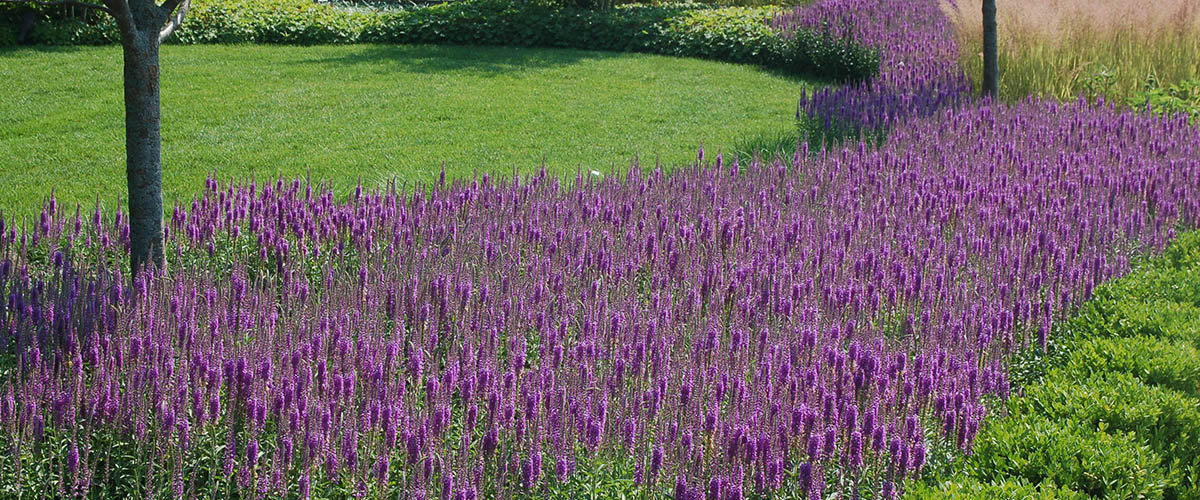
Evaluating Perennials for Chicagoland Gardens
Perennials in Focus is a plant evaluation program that examines new and underused plants for Chicagoland, the third largest metropolitan area in the country. A group of horticultural experts trials and evaluates plants at numerous locations across the region. Results help consumers, public gardens, growers, landscape designers, breeders, and other industry professionals make informed plant choices.
Perennials That Hold Clay Slopes Together
Clay banks can look stable through a dry spell, then slump after a summer storm or a wet winter. Once water finds a bare channel, it carries fine soil downhill, exposes roots and leaves the slope harder to plant. A well-chosen perennial scheme helps slow runoff, bind the upper soil layer and keep the surface covered through changing seasons.
Perennials in Focus evaluates plants across the Chicagoland region, recording traits such as flowering time, height, spread and long-term garden performance. Those observations are useful when comparing plant habits, though Australian gardeners should also consider local rainfall, heat, soil structure, fire exposure and whether a plant behaves responsibly in their area.
| Planting choice | Best use on a clay bank | Main strength | Watch point |
|---|---|---|---|
| Deep-rooted clump perennials | Middle and upper slope | Anchoring soil and enduring dry periods | Need establishment watering |
| Rhizomatous groundcovers | Broad, stable sections | Fast surface coverage and weed suppression | Can become difficult to contain |
| Ornamental grasses | Runoff paths and open banks | Dense fibrous roots and winter structure | Cut back only when conditions allow |
| Moisture-tolerant plants | Lower slope or seepage zone | Coping with periodically wet clay | Poor choice for hot, dry crests |
| Local native perennials | Wildlife-friendly restoration | Suited to regional conditions | Availability varies by nursery |
Match Plants To The Bank
The top, middle and bottom of a slope rarely offer the same growing conditions. The crest may be exposed, dry and windy, while the toe collects runoff and stays damp. Planting the same perennial everywhere often creates gaps, dead patches or plants that collapse under conditions they cannot tolerate.
Use deep-rooted clump-formers through the upper and middle sections, with spreading species placed where they can fill space without escaping into bushland. On a lower bank, moisture-tolerant plants may cope better with heavy clay, provided drainage is not permanently stagnant. In parts of Victoria or New South Wales, a clay cut beside a driveway can alternate between baked-hard and waterlogged within a single season.
Planting density matters as much as plant selection. Smaller perennials are usually installed in staggered groups rather than straight rows, allowing foliage to overlap as it matures. A temporary layer of coarse mulch can reduce raindrop impact while plants establish, but thick mulch should not be allowed to slide downhill or bury crowns.
Reliable Plant Types For Heavy Soil
Ornamental grasses are valuable because their fibrous roots occupy a broad volume of soil. Sterile cultivars of fountain grass, blue fescue, lomandra and selected panic grasses can provide texture while slowing surface water. In Australia, choose species and cultivars suited to the local climate, and avoid planting known environmental weeds near waterways or remnant vegetation. A useful design approach is to combine grasses with flowering perennials, as shown in this guide to winter plant combinations.
Groundcovering geraniums, creeping thyme in suitable dry sites, yarrow and robust sedges can close exposed soil between larger clumps. Daylilies and some hardy salvias may perform well where drainage improves, while perennial rudbeckias, asters and echinaceas can add late-season colour in climates that suit them. On a clay slope near Adelaide, plants that tolerate dry summers will generally need a different treatment from those used on a shaded, rain-fed bank outside Hobart.
For Australian gardens, local native options deserve serious consideration. Dianella, lomandra, native violets, correas and selected grass-like plants can provide habitat and seasonal interest, although their suitability depends on the exact species and provenance. Ask a reputable native nursery for plants matched to local rainfall and frost patterns rather than assuming every Australian native will tolerate compacted clay.
Build A Rooted Cover
Plants cannot repair an actively moving bank by themselves. Before planting, redirect concentrated downpipes and driveway runoff, remove loose debris and address any channel where water is cutting into the soil. On steep or high-risk slopes, a civil engineer, soil consultant or qualified landscape contractor may need to specify drainage, coir logs, erosion-control matting or retaining measures.
Work clay only when it is moist and crumbly. Digging saturated clay smears the soil into dense layers, while working it when bone-dry creates large hard clods. Add organic matter to improve structure where appropriate, but do not create a rich pocket that encourages roots to remain shallow. Plants establish more securely when the whole planting zone drains and holds moisture reasonably evenly.
A grid or contour layout can help distribute water across the bank. Plant crowns should sit level with the surrounding soil, and small basins can capture irrigation during establishment. Water slowly and deeply rather than applying frequent, shallow sprays. Once roots occupy the soil, reduce irrigation gradually so the planting develops resilience to Australian heat and irregular rainfall.
Control Weeds Without Losing Containment
Weeds compete for moisture and leave bare soil when removed abruptly. Dense, well-behaved perennials can reduce that maintenance burden, but vigorous growth needs boundaries. Rhizomatous plants may be useful on a broad, accessible slope and troublesome beside paths, drains or neighbouring bushland. Before buying, check the species against state and local weed lists.
The guide to manageable perennials offers a useful framework for balancing quick coverage with control. In practice, install spreading plants in defined drifts, use edging where practical and leave enough access to divide or thin them. A plant that covers bare clay rapidly can become a maintenance headache if it climbs over stairs or blocks inspection of a drainage channel.
Mulching, hand weeding and seasonal division are easier when the bank is planted in repeating groups rather than a complicated mix of single specimens. Retail nurseries and landscape suppliers across Australia often sell plants in tube stock, forestry tubes or small pots for restoration-style work. Smaller plants can establish well and cost less, but they require closer watering and protection from grass competition.
Plan For Seasons And Safety
Year-round cover is preferable to a bank that is dense in spring and bare by late summer. Combine evergreen or semi-evergreen foliage with plants that flower at different times, then retain sound stems where they help slow rain and protect crowns. Remove collapsed material only when it no longer protects soil or creates a fire hazard.
Fire-prone areas need a separate risk assessment. Around Canberra, the Adelaide Hills or outer Melbourne, avoid allowing dry, fine foliage to build up against buildings, access routes or fences. Keep planting clear of essential inspection points, and follow local bushfire guidance rather than treating erosion control as the only priority.
Observe the bank after heavy rain and record where soil moves, where plants drown and where irrigation misses. Treat plant selection as evidence-based horticulture rather than a casual punt. Trial a few species in small groups before committing to the entire slope, especially when a plant has limited performance information for the local climate.
Choose plants according to the slope’s wet and dry zones, prepare the soil without smearing it, and establish coverage before the next major rain period. Australian gardeners can also compare regional trial data from Perennials in Focus with local nursery advice, council planting lists and observations from nearby gardens. A staged planting of tough, well-contained perennials will protect clay banks more reliably than a rushed collection of attractive plants.
In the Garden
Evaluator gardens are located across the Chicagoland area, representing a range of growing conditions. Visit our retail and wholesale partners to find trialled perennials for your own garden.
Retail & Wholesale: Hinsdale Nurseries (Willowbrook, IL), Mariani Nurseries (Kenosha, WI & Garden Prairie, IL), Northwind Perennials (Burlington, WI), The Growing Place (Aurora, IL).
Wholesale Only: Hinsdale Nurseries (Plano, IL), Intrinsic Perennial Gardens (Hebron, IL).
Our Evaluation Program
The 2017–2020 evaluation cycle included Agastache 'Blue Boa', Allium senescens 'Blue Eddy', Amsonia ciliata var. filifolia 'Georgia Pancake', Astilbe 'Chocolate Shogun', Boltonia astroides 'James Crocket', Brunnera 'Alexander's Great', and Geranium cinereum 'Jolly Jewel Purple'. Completed evaluations include Amsonia 'Blue Ice' (2004–07).
On April 10, 2020, the program published snapshot profiles for Vernonia lettermanii 'Iron Butterfly', Stokesia laevis 'Elf', Stachys officinalis 'Pink Cotton Candy', Lobelia 'Monet Moment', Helleborus 'Winter Thrillers', Geum 'Mai Tai', Geranium soboliferum 'Butterfly Kisses', Gentiana x intermedia 'True Blue', Eurybia divaricata, Asparagus 'Purple Passion', and Agastache 'Bolero'.
Browse the full collection of snapshots organized alphabetically — from A–D, E–H, I–Q, and R–Z — to find detailed performance data on perennials trialled across Chicagoland.