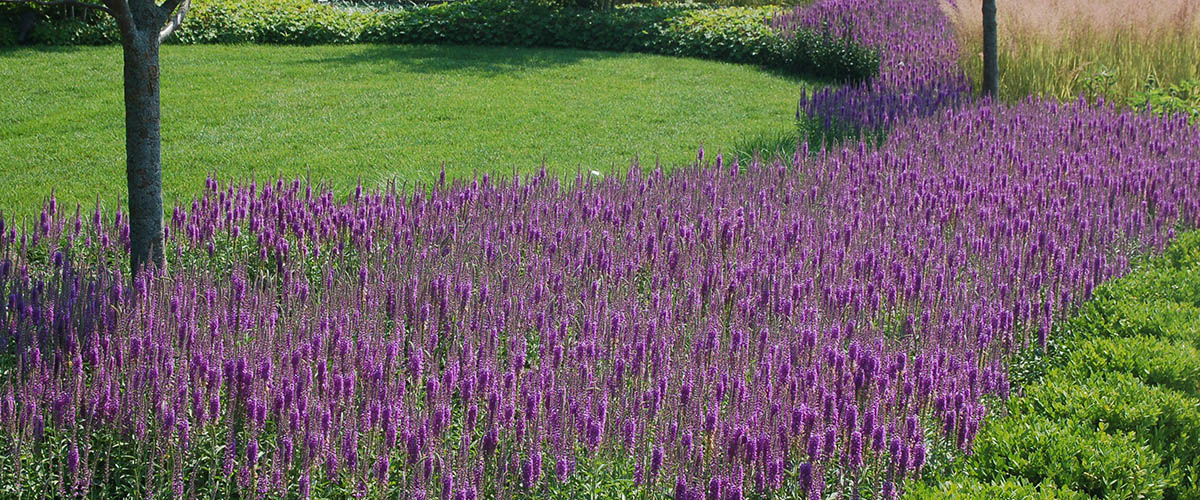
Evaluating Perennials for Chicagoland Gardens
Perennials in Focus is a plant evaluation program that examines new and underused plants for Chicagoland, the third largest metropolitan area in the country. A group of horticultural experts trials and evaluates plants at numerous locations across the region. Results help consumers, public gardens, growers, landscape designers, breeders, and other industry professionals make informed plant choices.
Best Perennials for Slopes and Erosion Control in Illinois
A sloping garden in Illinois has to manage more than beauty. Rainwater can wash away topsoil, winter freeze-thaw cycles can loosen shallow-rooted plants, and hot summer exposures can dry the upper part of a bank quickly. The right perennial planting slows runoff, holds soil with dense roots, and creates a stable ground layer over time.
Successful erosion control rarely depends on a single species. A layered planting of grasses, sedges, flowering perennials, and low-growing ground covers usually performs better than a neat row of identical plants. The strongest choices are adapted to the site’s light, moisture, soil type, and regional climate.
Perennials in Focus evaluates plants across Chicagoland gardens and seasons, providing useful regional information about height, spread, bloom period, and garden performance. Those observations can help gardeners choose plants that are likely to handle Illinois winters and remain attractive after the initial installation period.
Match plants to the slope
Before selecting plants, examine how water moves across the property. A gently sloping bed with average garden soil can support many prairie and sun-loving perennials. A steep, dry bank needs plants that tolerate heat and limited moisture, while a shaded slope beneath mature trees may require woodland species with fibrous roots and spring moisture.
Soil depth matters as well. Construction sites often leave compacted subsoil, fill, or thin layers of topsoil over clay. Loosen compacted areas where practical, remove invasive weeds, and improve the planting zone with organic matter without creating a loose layer that can slide downhill. On very steep grades, biodegradable erosion-control blankets, wattles, or small terraces can protect new plants while roots become established.
Prairie grasses for durable coverage
Prairie grasses are among the most dependable plants for sunny Illinois slopes. Their extensive fibrous root systems help bind soil, while their upright foliage adds structure through much of the year. Prairie dropseed (Sporobolus heterolepis) forms a refined, fountain-shaped clump and works well where drainage is good and competition from taller plants is limited.
Little bluestem (Schizachyrium scoparium) handles dry, sunny conditions and offers blue-green summer foliage followed by copper and bronze tones in fall. It is especially useful on exposed banks where many broad-leaved perennials wilt. Switchgrass (Panicum virgatum) is a stronger vertical accent for larger slopes, with cultivars available in different heights and forms.
These grasses should be planted close enough to knit together as they mature, but not so densely that every plant competes immediately for moisture. Mixing several species can create a more resilient community and reduce the visual impact of occasional plant loss.
Flowering perennials that anchor the planting
Flowering plants add seasonal color and support pollinators, but their role in erosion control depends on dependable foliage and substantial crowns. Purple coneflower (Echinacea purpurea) tolerates sun and average soil, while stiff goldenrod (Solidago rigida) and aromatic aster (Symphyotrichum oblongifolium) extend interest into late summer and fall.
Wild indigo (Baptisia australis) develops a deep root system after establishment and is well suited to sunny, moderately dry slopes. Its blue spring flowers and blue-green foliage provide a strong transition between low ground covers and taller grasses. Black-eyed Susan (Rudbeckia fulgida) offers a longer flowering season and can fill spaces while slower perennials mature.
On a slope, avoid relying on plants that disappear completely after a short bloom period. Combine early, middle, and late-season foliage so the soil remains visually covered from spring through autumn. For additional ideas about plants with proven regional winter tolerance, consult these winter-tested perennials.
| Perennial | Best exposure | Role on a slope | Seasonal value |
|---|---|---|---|
| Prairie dropseed | Full sun, well-drained soil | Dense clumping roots and low-maintenance structure | Fine foliage, seed heads, fall color |
| Little bluestem | Full sun, dry to average soil | Stabilizes exposed, dry banks | Blue foliage and copper fall tones |
| Switchgrass | Full sun, average to moist soil | Taller root mass for broad slopes | Airy flower heads and winter form |
| Wild indigo | Full sun, average soil | Deep-rooted anchor plant | Blue flowers and long-lasting foliage |
| Purple coneflower | Full sun, average soil | Mid-height mass planting | Summer blooms and seedheads |
| Pennsylvania sedge | Part shade to shade | Low ground layer beneath trees | Soft texture and early-season coverage |
Shade-tolerant choices beneath trees
A wooded slope presents different conditions from an open prairie bank. Tree roots compete for water, leaf litter can smother young plants, and summer light may be limited. Pennsylvania sedge (Carex pensylvanica) is a valuable low-growing option for dry or average soils in part shade. It creates a soft, meadow-like carpet when planted in broad drifts.
Wild geranium (Geranium maculatum) is another useful woodland perennial, offering spring flowers and rounded foliage that remains attractive after blooming. Woodland phlox (Phlox divaricata) can provide early color and spreads gradually in conditions with filtered light and consistent moisture. Foamflower (Tiarella cordifolia) suits shadier gardens with richer soil and can help fill the lower layer.
Shade plants usually establish more slowly than aggressive sun perennials. Keep fallen leaves in place when they are not carrying disease, and water new plantings during dry spells. A thin layer of leaf mulch can conserve moisture, but deep mulch should not bury crowns or create a sliding surface.
Planting design for runoff control
Rows running straight downhill can form channels that concentrate water. Instead, arrange plants on the contour, following the slope horizontally where possible. Staggered groups interrupt water movement and create pockets where sediment can settle. Wider planting drifts are generally more effective than isolated specimens spaced far apart.
Use three layers: low plants and sedges near the soil surface, medium flowering perennials in the middle, and grasses or taller species toward the back or upper portion of the slope. This arrangement offers visual depth while distributing root activity through different soil zones. Plants with spreading crowns can occupy open spaces, while clump-forming species provide long-term structure.
Fall cleanup should be selective. Leaving sturdy stems and seedheads through winter protects the soil surface and provides habitat. Cut back flattened or diseased material in late winter, then check for exposed roots, small washouts, and areas where mulch has moved downhill. Repairing those spots early prevents a minor erosion problem from becoming a major one.
Establishment and maintenance in Illinois
Even drought-tolerant perennials require regular moisture during their first growing season. Water deeply and slowly so moisture reaches the root zone instead of running off the surface. On a steep bank, several shorter watering cycles may be more effective than one heavy application. Drip irrigation or soaker hoses can reduce disturbance to the soil.
Weed control is especially important during establishment because weeds compete for water and leave bare soil when removed. Hand-pull carefully, avoiding unnecessary soil disturbance. A shallow layer of shredded leaves or composted mulch can suppress weeds and reduce evaporation, but keep it away from plant crowns.
Expect a slope planting to develop over two or three seasons. Some grasses and deep-rooted perennials spend their first year building roots rather than producing impressive top growth. Once plants knit together, irrigation needs generally decline and the planting becomes more resistant to runoff, summer stress, and winter exposure.
A practical plant palette for different sites
- For a hot, dry, sunny bank, combine little bluestem, prairie dropseed, purple coneflower, aromatic aster, and stiff goldenrod.
- For a larger sunny slope with average moisture, use switchgrass, wild indigo, black-eyed Susan, coneflower, and native asters in repeating drifts.
- For a part-shade slope beneath mature trees, pair Pennsylvania sedge with wild geranium, woodland phlox, and foamflower.
- For a small residential bank, select shorter cultivars and low ground-layer plants so mature growth does not obscure paths, windows, or retaining edges.
- For areas with concentrated runoff, combine perennial planting with contour-based grading, biodegradable erosion-control materials, or small structural features.
The best perennial planting for an Illinois slope is one that fits the site rather than one chosen from a generic list. Start with the existing light and soil conditions, select several species with overlapping root zones, and install enough plants to limit bare ground. Regional trial information can refine those choices and reveal which plants maintain their form, bloom reliably, and return well after Chicagoland winters.
Visit Perennials in Focus to explore region-specific plant evaluations and build a slope planting that is attractive, rooted for stability, and suited to Illinois seasons.
In the Garden
Evaluator gardens are located across the Chicagoland area, representing a range of growing conditions. Visit our retail and wholesale partners to find trialled perennials for your own garden.
Retail & Wholesale: Hinsdale Nurseries (Willowbrook, IL), Mariani Nurseries (Kenosha, WI & Garden Prairie, IL), Northwind Perennials (Burlington, WI), The Growing Place (Aurora, IL).
Wholesale Only: Hinsdale Nurseries (Plano, IL), Intrinsic Perennial Gardens (Hebron, IL).
Our Evaluation Program
The 2017–2020 evaluation cycle included Agastache 'Blue Boa', Allium senescens 'Blue Eddy', Amsonia ciliata var. filifolia 'Georgia Pancake', Astilbe 'Chocolate Shogun', Boltonia astroides 'James Crocket', Brunnera 'Alexander's Great', and Geranium cinereum 'Jolly Jewel Purple'. Completed evaluations include Amsonia 'Blue Ice' (2004–07).
On April 10, 2020, the program published snapshot profiles for Vernonia lettermanii 'Iron Butterfly', Stokesia laevis 'Elf', Stachys officinalis 'Pink Cotton Candy', Lobelia 'Monet Moment', Helleborus 'Winter Thrillers', Geum 'Mai Tai', Geranium soboliferum 'Butterfly Kisses', Gentiana x intermedia 'True Blue', Eurybia divaricata, Asparagus 'Purple Passion', and Agastache 'Bolero'.
Browse the full collection of snapshots organized alphabetically — from A–D, E–H, I–Q, and R–Z — to find detailed performance data on perennials trialled across Chicagoland.