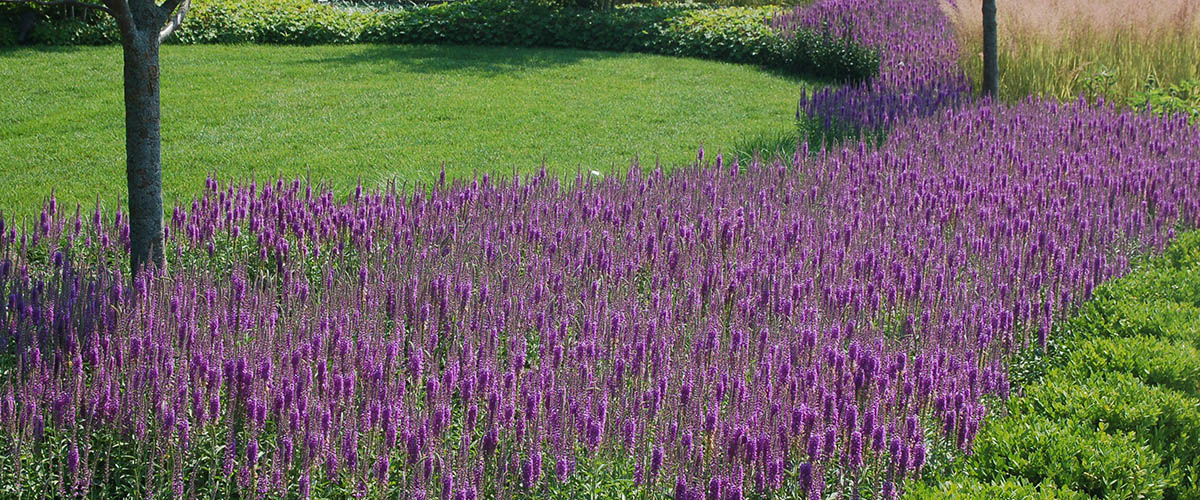
Evaluating Perennials for Chicagoland Gardens
Perennials in Focus is a plant evaluation program that examines new and underused plants for Chicagoland, the third largest metropolitan area in the country. A group of horticultural experts trials and evaluates plants at numerous locations across the region. Results help consumers, public gardens, growers, landscape designers, breeders, and other industry professionals make informed plant choices.
Perennials for Dry, Sunny Slopes with Rapid Drainage in Chicagoland
A steep, sun-baked bank where water races off before plants can drink is one of the hardest spots in any garden. In the Chicagoland region, where winters deliver genuine cold and summers swing into the nineties Fahrenheit, the combination of rapid drainage and reflective heat strips moisture from the soil faster than most roots can replace it. Many reliable perennials elsewhere simply check out after a season or two in these punishing pockets.
For readers gardening in Australia, the conditions feel oddly familiar. Much of the Adelaide Hills, the sandy rises around Perth, the rocky slopes inland from Hobart, and even the well-drained edges of Melbourne's newer subdivisions share that same thirsty, free-draining character. Plants that cope in USDA hardiness zones 5 and 6 around Chicago often transplant their toughness into Australian USDA zone 9 and 10 gardens once they settle in, which is why a US-based trialling program holds real interest for Aussie growers hunting for resilient imports.
Perennials in Focus runs multi-site evaluations across the Chicago region, recording how candidates cope with bloom timing, colour stability, height, and spread across several seasons. The data they publish gives home gardeners, landscapers, and nursery buyers something better than anecdote: replicated evidence from conditions that genuinely challenge plants.
Why slopes punish plants differently
Gravity pulls water downhill, which means a sloping bed holds moisture for a fraction of the time a flat bed does. The soil itself is often thinner over a slope because cultivation and rain wash the topsoil downward, leaving plants to anchor into a lean, gritty substrate. In Chicagoland, where spring melt is followed quickly by hot July afternoons, that lean substrate bakes hard, and any plant without a serious tap root or a sprawling mat habit struggles to survive its first summer.
Wind exposure compounds the problem on exposed banks. Dry winter winds pull moisture from evergreen foliage, and summer breezes accelerate the drying of already parched soil. The reflection from nearby paving, stone walls, or south-facing fences adds radiant heat that pushes leaf temperatures well above the ambient air reading. Plants trialled on flat ground in the same suburb can perform beautifully while their counterparts on the same property's slope collapse, which is why the program treats sloping trial beds as a category of their own.
Low-growing mat formers for exposed banks
For the most exposed upper sections of a free-draining slope, the trials consistently favour plants that hug the soil and root as they creep. Sedum cultivars, particularly the groundcover types S. rupestre and S. spurium selections, knit across the surface and tolerate reflected heat that wilts fussier plants. Their shallow roots suit thin soils, and their succulent foliage stores water against dry spells.
Creeping phlox (Phlox subulata) and the mat-forming dianthus such as Dianthus deltoides handle the same punishing edge, producing sheets of spring colour that earn their keep in a bed that gets little supplementary watering. Where a slope runs up against a shaded wall or the lower portion receives some afternoon shade, gardeners weighing groundcover options for transition zones often find themselves looking at bugleweed and yellow archangel, and the deer resistance comparison clarifies how those two perform when browsing pressure is part of the picture.
Mid-border workhorses for the body of the slope
Once a planting moves away from the absolute hottest lip of the bank, the trial gardens show reliable mid-height performers earning their place. Salvia nemorosa cultivars send up spires of blue-purple flowers from late spring into midsummer and tolerate dry soil once established, though they appreciate a bit more root depth than the mat formers. Nepeta x faassenii sprawls gracefully, its grey-green foliage smelling sharply of mint when brushed, and it reblooms modestly if sheared after the first flush.
Coreopsis verticillata has quietly become one of the standouts in the trial records, flowering for weeks on end without irrigation and forming tidy mounds that don't collapse in heat. Echinacea purpurea and its newer hybrids anchor the middle of the slope with sturdy stems and pollinator-friendly blooms, though they need a season or two to develop the deep roots that let them ride out dry summers. Rudbeckia fulgida var. sullivantii 'Goldsturm' rounds out the group with its late-summer golden display, performing reliably even in thin soil where neighbouring plants have faded.
Staggering bloom times across these mid-border plants keeps the slope colourful from late April through October. The salvias lead off, the coreopsis carries the midsummer weight, and the rudbeckia closes the season with a long golden run that overlaps with autumn on the ornamental grasses.
Deep-rooted anchors for the long haul
Some of the most impressive performers on the program's slopes are species with serious tap roots or rhizomatous spread that lets them reach moisture deeper in the profile. Baptisia australis develops a substantial tap root in its first couple of years and then becomes virtually drought-proof, producing lupine-like blue flower spikes in late spring. Its longevity on the trial slopes is remarkable; plants from the early years of the program are still thriving where shallow-rooted neighbours have come and gone.
Asclepias tuberosa, the butterfly weed, behaves similarly, sending down a deep carrot-like root that powers it through dry summers while its bright orange flowers draw monarch butterflies and a range of native bees. Amsonia hubrichtii offers a softer texture with its willowy foliage and steel-blue spring flowers, earning high marks for autumn colour as well. Readers wanting replicated observations on these and other early-alphabet candidates can find them in the program's snapshots-a-d trial notes, and the ornamental grass Schizachyrium scoparium, little bluestem, completes the picture with vertical structure and a blue-green summer presence that turns coppery in autumn. These species take a year or two to settle but reward patience with decades of low-maintenance performance on slopes where less resolute plants would have given up.
Lessons for the Australian gardener
The clearest message from the trial data is that free-draining slopes reward patience and deep-rooted plants. Australian gardeners working with sandy rises in the Perth Hills, the well-drained banks around Canberra, or the rock-hard alkaline slopes of inner Adelaide will recognise every one of these conditions. Tube-stock sized plants from local suppliers, whether an independent nursery in the Hills or a community garden sale in Melbourne's eastern suburbs, often establish faster in tough Australian summers than larger potted specimens, because their roots hit the ground running rather than circling the potting mix.
It is worth pairing these imported perennials with local knowledge. Where conditions allow, weaving in tough Australian natives like Anigozanthos, Westringia, or Lomandra for similar roles reduces irrigation needs further and supports local fauna. Garden clubs from Brisbane to Hobart run open days and plant swaps where members swap notes on which imported perennials have survived their own punishing banks, and that kind of local intelligence, layered on top of replicated trial data, gives Australian growers a genuinely useful path forward.
Browse the full trialling notes on the Perennials in Focus website before planning your autumn planting, and start a small trial bed of your own this season so you can build your own evidence about what thrives on your particular bank.
In the Garden
Evaluator gardens are located across the Chicagoland area, representing a range of growing conditions. Visit our retail and wholesale partners to find trialled perennials for your own garden.
Retail & Wholesale: Hinsdale Nurseries (Willowbrook, IL), Mariani Nurseries (Kenosha, WI & Garden Prairie, IL), Northwind Perennials (Burlington, WI), The Growing Place (Aurora, IL).
Wholesale Only: Hinsdale Nurseries (Plano, IL), Intrinsic Perennial Gardens (Hebron, IL).
Our Evaluation Program
The 2017–2020 evaluation cycle included Agastache 'Blue Boa', Allium senescens 'Blue Eddy', Amsonia ciliata var. filifolia 'Georgia Pancake', Astilbe 'Chocolate Shogun', Boltonia astroides 'James Crocket', Brunnera 'Alexander's Great', and Geranium cinereum 'Jolly Jewel Purple'. Completed evaluations include Amsonia 'Blue Ice' (2004–07).
On April 10, 2020, the program published snapshot profiles for Vernonia lettermanii 'Iron Butterfly', Stokesia laevis 'Elf', Stachys officinalis 'Pink Cotton Candy', Lobelia 'Monet Moment', Helleborus 'Winter Thrillers', Geum 'Mai Tai', Geranium soboliferum 'Butterfly Kisses', Gentiana x intermedia 'True Blue', Eurybia divaricata, Asparagus 'Purple Passion', and Agastache 'Bolero'.
Browse the full collection of snapshots organized alphabetically — from A–D, E–H, I–Q, and R–Z — to find detailed performance data on perennials trialled across Chicagoland.