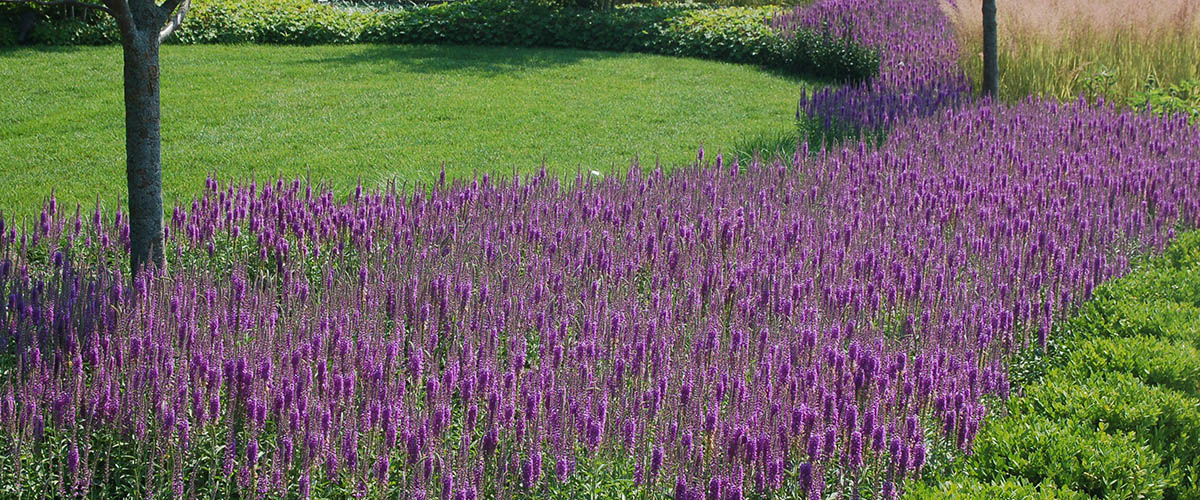
Evaluating Perennials for Chicagoland Gardens
Perennials in Focus is a plant evaluation program that examines new and underused plants for Chicagoland, the third largest metropolitan area in the country. A group of horticultural experts trials and evaluates plants at numerous locations across the region. Results help consumers, public gardens, growers, landscape designers, breeders, and other industry professionals make informed plant choices.
Best Perennials For A Moonlit White Garden In Chicagoland
A moon garden built around white flowers, silvery foliage and pale seedheads can make a Chicagoland landscape feel luminous after sunset. The effect is strongest when plants bloom in succession, repeat similar colours and provide different heights rather than forming a flat bed of white.
Regional performance matters. Winters bring freezing temperatures and snow, while summer can deliver heat, humidity, heavy rain and periods of drought. Plants must also cope with the garden’s soil, exposure and maintenance style, so a beautiful planting plan should begin with dependable perennials rather than colour alone.
For Australian gardeners, the idea translates well to Melbourne courtyards, Sydney terraces and larger suburban blocks, although the seasons run in reverse. A Chicago planting list is not automatically suitable for Brisbane or Perth; use it as a design reference while checking local availability, hardiness and water requirements with an Australian nursery.
| Perennial | Main Season | Approximate Height | Best Moon-Garden Role |
|---|---|---|---|
| White garden phlox | Mid to late summer | 75–100 cm | Fragrant central mass |
| White woodland phlox | Spring | 30–45 cm | Light shade groundcover |
| ‘Honorine Jobert’ Japanese anemone | Late summer to autumn | 90–120 cm | Tall, floating flowers |
| Boltonia asteroides | Late summer to autumn | 120–180 cm | Airy background plant |
| White coneflower | Summer to autumn | 60–100 cm | Wildlife-friendly structure |
| Lamb’s ear | Summer foliage and flowers | 20–45 cm | Silver edging |
| White yarrow | Summer | 45–90 cm | Drought-tolerant filler |
| Ornamental grass | Autumn and winter structure | Variable | Movement and seedheads |
Start With A Silver And White Framework
A successful white border needs foliage that remains attractive before and after flowering. Lamb’s ear, artemisia and ‘Jack Frost’ Siberian bugloss add reflective grey or silver surfaces, helping the garden catch moonlight even when few flowers are open. In partial shade, the patterned leaves of ‘Jack Frost’ can be more reliable visually than a short-lived blossom.
Use white flowers in repeated groups of three or five rather than scattering one plant at a time. White garden phlox can form a fragrant summer anchor, while white yarrow and Shasta daisies create lower, brighter patches. Repetition makes the scheme look intentional from a patio, path or kitchen window.
Choose Plants For Chicagoland Conditions
Chicagoland gardens commonly experience cold winters, spring temperature swings and humid summers. White woodland phlox suits a woodland edge or north-facing border, while white coneflower, yarrow and Boltonia prefer more sun and generally tolerate short dry spells once established. Improve compact clay with compost, but avoid creating an overly rich bed that produces weak, floppy growth.
Salt exposure is important near pavements and driveways, particularly where winter de-icing products are used. Place more sensitive plants away from snow piles and runoff. Good drainage is equally valuable: Japanese anemones appreciate consistent moisture, but their crowns should not sit in stagnant winter water.
Build A Long Blooming Sequence
A moonlit garden should offer changing highlights from spring through autumn. Begin with white woodland phlox, white-flowered bleeding heart and white peonies in late spring. Baptisia alba adds a strong upright shape in early summer, followed by white catmint, yarrow, coneflower and garden phlox.
Late-season plants keep the composition alive when many borders fade. ‘Honorine Jobert’ Japanese anemone produces pale flowers on tall stems, while Boltonia forms a cloud of small white daisies. White-flowered asters and ornamental grasses extend the display into autumn, and their dried seedheads can remain attractive through winter.
For a planting calendar that coordinates colour and succession, use this continuous bloom checklist alongside local trial observations. It helps prevent the common problem of a spectacular June display followed by an empty bed in August.
Use Fragrance And Evening Texture
Colour alone does not create a convincing night garden. White garden phlox is valuable because its fragrance becomes more noticeable in the evening, especially near seating. Nicotiana is often grown as an annual in Chicagoland, but it can be tucked between dependable perennials for extra dusk fragrance and tall, tubular flowers.
Texture should vary as much as colour. Combine rounded peony leaves, narrow grass blades, woolly lamb’s ear and upright anemone stems. Plants with open flower forms can look delicate under low light, while dense double flowers provide stronger pale masses from a distance.
Australian readers may recognise this design approach from alfresco entertaining, where a garden is viewed after dinner rather than only during daylight. In Melbourne or Hobart, a sheltered white border can echo that atmosphere, while gardeners in Adelaide or Perth should prioritise plants that tolerate hotter, drier summers.
Match Plants To Light And Scale
Full sun is the best position for yarrow, coneflower, Boltonia, white phlox and most ornamental grasses. Aim for at least six hours of direct light, with morning sun particularly useful in areas where evening humidity encourages foliar disease. Taller plants belong at the back of a border or beside a fence, not directly in front of windows or paths.
For dappled shade, use white woodland phlox, ‘Jack Frost’ Siberian bugloss, white astilbe and variegated foliage. Avoid filling deep shade with sun-loving daisies; they may stretch, flower poorly and become vulnerable to collapse. In a small courtyard, repeat just two or three key plants rather than trying to represent every season.
Plant height should support the view. A low silver edge can lead into mid-height daisies, with Japanese anemone or Boltonia behind them. This layered arrangement works in a suburban Chicagoland lot and can be adapted to Australian garden centres, where compact cultivars are often easier to find for balconies and narrow beds.
Plan For Maintenance And Wildlife
White flowers can show weather damage quickly, especially after heavy rain. Remove spent phlox and daisies when a tidy appearance is important, but leave selected coneflower and grass seedheads for birds and winter structure. Cutting everything down immediately in autumn removes habitat and makes the border look bare for several months.
Divide crowded perennials in spring or early autumn, water new plants deeply during their first growing season and apply mulch without covering crowns. Monitor powdery mildew on garden phlox by providing air movement and avoiding overhead irrigation. Deer may browse hostas and some flowering plants, so use aromatic foliage such as yarrow, catmint and lamb’s ear around more vulnerable specimens.
Availability varies between regions and seasons. In Australia, Bunnings and independent nurseries may stock familiar white perennials, while specialist mail-order growers can offer unusual cultivars; always check whether a plant is suitable for local heat, frost and water restrictions. Australian native plants with pale flowers can also be woven into the same visual scheme, particularly where a purely North American plant palette would require excessive irrigation.
A moonlit border becomes most persuasive when its pale flowers are supported by sound structure, fragrance and seasonal rhythm. Select plants proven for your Chicagoland conditions, group them generously and place the brightest foliage where it can be seen from windows, paths and outdoor seating. Browse regional perennial evaluations, make a shortlist for your site and create a planting that remains luminous from the first spring flowers through the final autumn seedheads.
In the Garden
Evaluator gardens are located across the Chicagoland area, representing a range of growing conditions. Visit our retail and wholesale partners to find trialled perennials for your own garden.
Retail & Wholesale: Hinsdale Nurseries (Willowbrook, IL), Mariani Nurseries (Kenosha, WI & Garden Prairie, IL), Northwind Perennials (Burlington, WI), The Growing Place (Aurora, IL).
Wholesale Only: Hinsdale Nurseries (Plano, IL), Intrinsic Perennial Gardens (Hebron, IL).
Our Evaluation Program
The 2017–2020 evaluation cycle included Agastache 'Blue Boa', Allium senescens 'Blue Eddy', Amsonia ciliata var. filifolia 'Georgia Pancake', Astilbe 'Chocolate Shogun', Boltonia astroides 'James Crocket', Brunnera 'Alexander's Great', and Geranium cinereum 'Jolly Jewel Purple'. Completed evaluations include Amsonia 'Blue Ice' (2004–07).
On April 10, 2020, the program published snapshot profiles for Vernonia lettermanii 'Iron Butterfly', Stokesia laevis 'Elf', Stachys officinalis 'Pink Cotton Candy', Lobelia 'Monet Moment', Helleborus 'Winter Thrillers', Geum 'Mai Tai', Geranium soboliferum 'Butterfly Kisses', Gentiana x intermedia 'True Blue', Eurybia divaricata, Asparagus 'Purple Passion', and Agastache 'Bolero'.
Browse the full collection of snapshots organized alphabetically — from A–D, E–H, I–Q, and R–Z — to find detailed performance data on perennials trialled across Chicagoland.