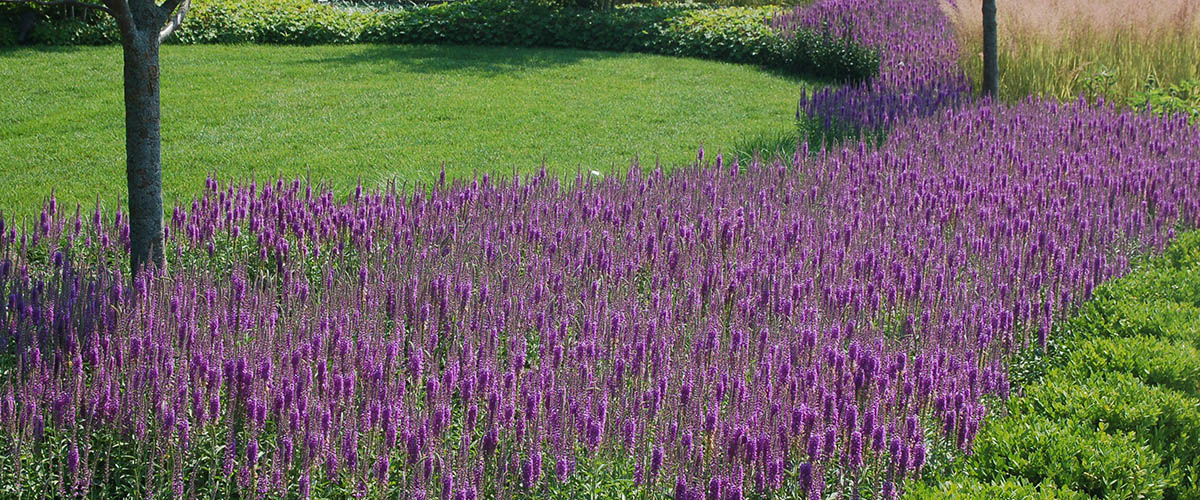
Evaluating Perennials for Chicagoland Gardens
Perennials in Focus is a plant evaluation program that examines new and underused plants for Chicagoland, the third largest metropolitan area in the country. A group of horticultural experts trials and evaluates plants at numerous locations across the region. Results help consumers, public gardens, growers, landscape designers, breeders, and other industry professionals make informed plant choices.
Best perennial vines for screening chain-link fences in Northern Illinois
A chain-link fence solves a practical boundary problem, but its open structure can leave a yard feeling exposed. Perennial vines soften the metal, add habitat, and create a greener screen that changes with the seasons. In Northern Illinois, the best choices must tolerate winter cold, humid summers, variable soils, and the wind that moves freely through a fence line.
The ideal plant depends on the kind of coverage you want. Some vines form a dense leafy wall, while others offer flowers, fall color, or winter interest without completely hiding the fence. Growth habit matters just as much as hardiness: a self-clinging vine behaves differently from one that needs twine, wire, or a trellis.
Regional performance is especially valuable when choosing less familiar perennials. The regional trial findings from Perennials in Focus can help gardeners compare plants based on observed bloom time, mature size, and seasonal behavior rather than relying only on catalog descriptions.
What makes a vine suitable for a fence
A chain-link fence provides a useful framework, but it is not equally strong in every section. Lightweight vines can climb through the mesh with little assistance, whereas woody climbers may eventually add substantial weight and leverage. Before planting, inspect posts, gates, and fasteners, especially along older fences.
Look for perennial vines with reliable hardiness in roughly USDA Zones 5a to 6b, depending on the garden’s exact location. Northern Illinois sites can vary widely: an exposed suburban lot may be colder and windier than a protected urban garden. A vine that recovers quickly after winter damage is often more useful than one that grows rapidly but struggles after severe cold.
Strong choices for leafy screening
Virginia creeper (Parthenocissus quinquefolia) is one of the most dependable options for a full green screen. It grows vigorously, tolerates sun or part shade, and develops vivid red to burgundy foliage in autumn. Its tendrils can grip chain link effectively, though the plant may extend beyond the intended fence area and needs regular pruning.
Trumpet honeysuckle (Lonicera sempervirens) offers a more restrained habit and brings tubular flowers in shades of red, orange, or coral. It is a valuable choice for hummingbirds and performs best in sun with consistently drained soil. Unlike invasive bush honeysuckles, this native vine is a garden-worthy selection, although it usually needs ties or a supporting framework as it climbs.
Climbing hydrangea (Hydrangea anomala subsp. petiolaris) can create a handsome, long-term screen in part shade. Its white flower clusters and cinnamon-colored peeling stems add ornamental value, but establishment is slow. It uses aerial rootlets to attach to solid surfaces, so it may need help getting started on open chain link. Mature plants can become heavy and should be kept on sound fencing or given a separate support.
Flowering vines for a lighter screen
Clematis provides the broadest range of flower colors and bloom periods. Large-flowered hybrids can produce dramatic blossoms, while viticella, integrifolia, and other tougher groups often offer better garden resilience. Their slender stems weave through chain link, but they need a trellis, netting, or horizontal wire near the base because they cannot climb bare metal efficiently on their own.
Choose clematis according to pruning group and site conditions. Many prefer their roots cool and shaded while the upper growth receives sun. A low layer of mulch or nearby perennials can protect the root zone, but mulch should remain away from the crown. Clematis is usually better for seasonal color and partial screening than for an instant privacy wall.
Hops (Humulus lupulus) can cover a fence rapidly each summer and are especially useful when a gardener wants a temporary leafy screen. The stems die back to the ground in winter, so the fence becomes open again in the cold season. Hops require sturdy support and strong pruning, and their vigorous growth can overwhelm smaller plants. Select ornamental or female plants carefully if cones, scent, or reseeding are concerns.
| Vine | Light | Seasonal value | Screening speed | Main consideration |
|---|---|---|---|---|
| Virginia creeper | Sun to part shade | Dense foliage and red fall color | Fast | Needs firm pruning boundaries |
| Trumpet honeysuckle | Sun to part shade | Flowers, pollinators, leafy cover | Moderate | Benefits from ties or wires |
| Climbing hydrangea | Part shade to shade | White flowers and winter stems | Slow to establish | Can become heavy |
| Clematis | Sun with cool roots | Long or dramatic flowering | Moderate | Needs support and pruning knowledge |
| Hops | Sun to part shade | Fast summer foliage | Very fast | Dies back in winter |
| Native passionflower | Sun | Flowers and wildlife value | Moderate | Less dependable in exposed sites |
Native and wildlife-friendly alternatives
Native passionflower (Passiflora incarnata) is a distinctive option for a sheltered, sunny fence line. Its intricate flowers support pollinators, and its foliage may serve as a host plant for the gulf fritillary butterfly where that species occurs. The vine can die back in winter and return from the roots, so it is best used where summer screening matters more than year-round coverage.
Virginia creeper and trumpet honeysuckle are generally easier choices for a durable Northern Illinois screen. They offer stronger winter reliability and a more predictable structure. Plant diversity can improve the fence planting: one flowering vine may be combined with a shrub, ornamental grass, or evergreen rather than forcing a single vine to provide all the privacy.
Avoid invasive vines that can escape into nearby woodland or naturalized areas. English ivy is poorly suited to the region’s winter conditions and can become a management problem in sheltered locations. Oriental bittersweet and vigorous non-native honeysuckles should also be excluded from residential screening plans.
Planting and training along chain link
Prepare a planting strip at least 18 to 24 inches wide where possible. Remove competing turf, loosen compacted soil, and add organic matter only when the existing soil is poor. Most vines establish more reliably when watered deeply during the first two growing seasons, especially beside pavement, foundations, or dry gravel.
Set plants several inches to a foot away from the fence so their roots have room to develop and maintenance access remains possible. Guide young stems through the mesh or attach them loosely with soft ties. For clematis and honeysuckle, add vertical twine, galvanized wire, or a narrow trellis panel to create more climbing routes.
Spacing should reflect mature spread rather than the size of the nursery container. A vigorous Virginia creeper may need one plant for a broad section, while slower climbing hydrangea may be spaced more closely if the budget and site allow. Keep vines away from gates, utility equipment, and fence corners where growth can interfere with operation.
Managing growth through the seasons
Pruning keeps a living fence screen attractive and prevents vines from pulling on posts. Remove stems that reach beyond the property line, gather around gate hardware, or droop onto walkways. Virginia creeper and hops can be cut back firmly when needed, while clematis should be pruned according to its flowering wood and cultivar group.
Monitor the lower fence for bare areas. Vines often climb quickly at the top while leaving gaps near the soil, particularly where rabbits browse or lawn competition is strong. A row of shade-tolerant perennials, shrubs, or mulch can disguise the base without crowding the vine’s crown.
Inspect the planting after snow, ice, and strong summer storms. Replace broken ties, redirect stems, and remove damaged wood before it becomes tangled. Fertilize conservatively; excessive nitrogen can produce soft, leafy growth with fewer flowers and greater pruning demands.
A practical planting combination
For a sunny fence where year-round structure is not essential, pair Virginia creeper with trumpet honeysuckle. The creeper supplies dense foliage and autumn color, while the honeysuckle contributes flowers and a more refined texture. Give each plant its own section or guide them on separate wires so the faster grower does not smother the flowering vine.
For part shade, climbing hydrangea can anchor the design, with a compatible ground layer beneath it to cover the slow-establishing base. In a sunny location where summer coverage is the priority, hops can be used as a seasonal component alongside a permanent shrub or small tree. This layered approach provides privacy while reducing dependence on one aggressive climber.
When selecting plants, prioritize documented regional performance, mature dimensions, and maintenance requirements. A slightly slower vine that survives winter and stays within bounds will usually create a better fence screen than a fast-growing plant that requires constant correction.
Recommendations for a durable fence screen
- Choose Virginia creeper for rapid, full foliage and strong autumn color.
- Use trumpet honeysuckle when flowers and hummingbird activity are priorities.
- Select climbing hydrangea for a slower, elegant screen in protected part shade.
- Add clematis for flowers, but provide fine supports and learn its pruning group.
- Reserve hops or passionflower for sites where seasonal dieback is acceptable.
A successful planting begins with a sound fence, suitable support, and realistic expectations about establishment time. Match the vine to the site’s light, soil moisture, exposure, and desired privacy level, then give it regular training during the first few seasons.
Use regional plant evaluations to refine the choice before purchasing, and record how the vine performs through winter, bloom season, and late summer. With the right perennial and thoughtful maintenance, a chain-link boundary can become a productive garden edge with flowers, foliage, wildlife value, and lasting character.
In the Garden
Evaluator gardens are located across the Chicagoland area, representing a range of growing conditions. Visit our retail and wholesale partners to find trialled perennials for your own garden.
Retail & Wholesale: Hinsdale Nurseries (Willowbrook, IL), Mariani Nurseries (Kenosha, WI & Garden Prairie, IL), Northwind Perennials (Burlington, WI), The Growing Place (Aurora, IL).
Wholesale Only: Hinsdale Nurseries (Plano, IL), Intrinsic Perennial Gardens (Hebron, IL).
Our Evaluation Program
The 2017–2020 evaluation cycle included Agastache 'Blue Boa', Allium senescens 'Blue Eddy', Amsonia ciliata var. filifolia 'Georgia Pancake', Astilbe 'Chocolate Shogun', Boltonia astroides 'James Crocket', Brunnera 'Alexander's Great', and Geranium cinereum 'Jolly Jewel Purple'. Completed evaluations include Amsonia 'Blue Ice' (2004–07).
On April 10, 2020, the program published snapshot profiles for Vernonia lettermanii 'Iron Butterfly', Stokesia laevis 'Elf', Stachys officinalis 'Pink Cotton Candy', Lobelia 'Monet Moment', Helleborus 'Winter Thrillers', Geum 'Mai Tai', Geranium soboliferum 'Butterfly Kisses', Gentiana x intermedia 'True Blue', Eurybia divaricata, Asparagus 'Purple Passion', and Agastache 'Bolero'.
Browse the full collection of snapshots organized alphabetically — from A–D, E–H, I–Q, and R–Z — to find detailed performance data on perennials trialled across Chicagoland.