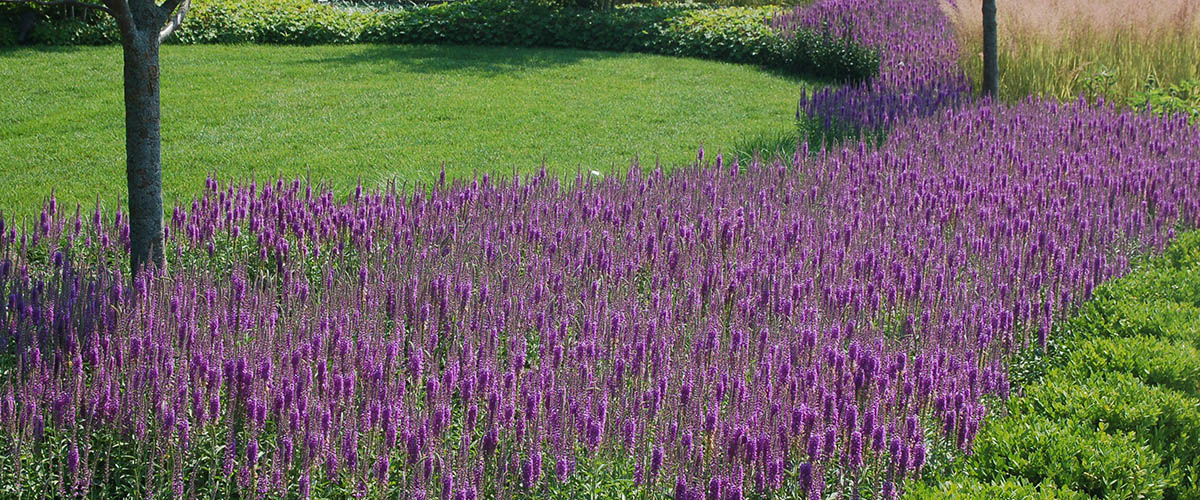
Evaluating Perennials for Chicagoland Gardens
Perennials in Focus is a plant evaluation program that examines new and underused plants for Chicagoland, the third largest metropolitan area in the country. A group of horticultural experts trials and evaluates plants at numerous locations across the region. Results help consumers, public gardens, growers, landscape designers, breeders, and other industry professionals make informed plant choices.
Best Perennial Companions For Allium Giganteum In A Mixed Border
Allium giganteum brings a strong architectural accent to a sunny border. Its tall, globe-shaped flower heads rise above narrow foliage, creating a clear focal point in late spring and early summer. The bulbs are dependable in well-drained soil, resistant to browsing, and especially effective when planted in generous groups rather than as isolated specimens.
Its brief period of peak display creates the main design challenge. The strappy leaves often yellow and decline before the flower stems disappear, leaving open space at the plant’s base. The best companion plants extend seasonal interest, soften the fading foliage, and provide a balanced combination of height, texture, and color.
In the Chicagoland region, successful combinations must also tolerate cold winters, humid summers, variable spring weather, and occasional periods of drought. Regional observations from perennial trials can help gardeners compare plants under conditions that are more relevant than generic catalog descriptions.
Why Giant Allium Needs Thoughtful Neighbors
Allium giganteum generally reaches about three to four feet in bloom, although conditions and cultivar can affect its final height. The flower heads are usually purple or violet, and their round form contrasts beautifully with softer, more branched perennials. Because the stems are relatively narrow, they do not occupy much visual space until the flowers open.
The foliage emerges early, then gradually loses its best appearance as flowering approaches. Low and medium-height companions are therefore valuable around the clumps. Plants with dense leaves can disguise the decline without competing aggressively with the bulbs, while airy perennials allow the allium stems to remain visible.
A sunny position with sharply draining soil is essential. Avoid pairing the bulbs with plants that require consistently wet conditions unless the bed has been carefully amended and drainage remains reliable through winter. Good air circulation also reduces the risk of foliar problems in crowded plantings.
Build Height In Several Layers
A convincing mixed border usually combines plants at the front, middle, and rear of the planting. Low mounds of catmint, hardy geranium, or creeping ground covers can frame the allium without hiding its stems. Their spreading foliage also helps cover bare soil as the bulb leaves fade.
Medium-height companions such as Salvia nemorosa, Penstemon, Baptisia, and yarrow provide a second layer. Their upright or branching forms echo the allium’s vertical movement while introducing different flower shapes. Blue, rose, white, and soft yellow flowers can either reinforce the violet color or create a controlled contrast.
For a back layer, consider ornamental grasses, Amsonia, Baptisia, or early-season shrubs kept at a suitable scale. The goal is not to surround every bulb with tall plants, but to create enough foliage behind and beside the alliums that the border still looks composed after the globes have passed.
Reliable Partners For Color And Texture
Nepeta is one of the most useful companions for giant allium. Its gray-green foliage thrives in sun, its lavender-blue flowers repeat after trimming, and its loose habit softens the formal shape of the allium globes. Cut it back after the first flush to encourage fresh foliage and a later display.
Hardy geraniums offer a different texture. Geranium sanguineum forms a low mound and can flower near the allium season, while taller selections of Geranium pratense or related species provide more height. Their divided leaves remain attractive after bloom and help disguise yellowing bulb foliage.
Salvia nemorosa is especially effective in a high-contrast scheme. Its vertical flower spikes rise near the allium’s rounded heads, creating a pairing that is both orderly and pollinator-friendly. Repeated trimming can produce a second flush, although the timing will vary with cultivar, soil moisture, and summer heat.
The following combinations suit many sunny, well-drained borders in northern Illinois. Bloom timing is approximate because weather, cultivar, and garden exposure can shift the display by several weeks.
| Companion plant | Border role | Typical timing | Why it works with giant allium |
|---|---|---|---|
| Nepeta ‘Walker’s Low’ | Front or middle layer | Late spring into summer | Blue flowers and gray foliage soften fading leaves |
| Salvia nemorosa | Middle layer | Late spring and repeat bloom | Vertical spikes contrast with round flower heads |
| Geranium sanguineum | Front layer | Late spring to summer | Low foliage hides bulb bases and spreads gently |
| Baptisia australis | Middle or back layer | Late spring to early summer | Blue flowers and substantial foliage extend structure |
| Amsonia tabernaemontana | Middle layer | Late spring; strong fall color | Fine texture supports the border after flowering |
| Achillea | Middle layer | Summer | Flat flower clusters contrast with allium spheres |
| Echinacea | Middle or back layer | Summer into fall | Carries color forward after the bulbs finish |
| Sesleria or a compact ornamental grass | Front or middle layer | Foliage from spring onward | Adds movement and lasting texture without heavy shade |
Extend Interest Beyond The Allium Display
The most effective planting does not rely on every companion blooming at the same moment. Early perennials can support the allium during its rise, while summer bloomers take over once the flower heads dry. Echinacea, yarrow, coreopsis, and selected ornamental grasses are useful for this succession.
Allium seed heads can remain attractive after the flowers fade, particularly in a naturalistic or prairie-inspired border. Leave them standing if they contribute shape and winter interest, or remove them when they begin to look worn. Nearby plants with persistent foliage will make either choice easier.
Color repetition can make a mixed border feel intentional. Violet alliums may be echoed by catmint, salvia, or blue baptisia, while pale yellow yarrow and white feverfew-like flowers provide brightness. Warm-toned echinacea cultivars can shift the border toward a more dramatic summer palette without overwhelming the spring display.
Match Plants To Chicagoland Conditions
Cold hardiness is only part of perennial performance in the Chicago area. A plant may survive winter yet struggle in heavy clay, wet spring soil, or a site with reflected heat. Before choosing companions, assess drainage, sun exposure, irrigation patterns, and the amount of competition from nearby trees and shrubs.
Plants that perform well in one local garden may behave differently in another. The regional plant snapshots provide a useful way to investigate characteristics such as mature height, spread, flowering period, and seasonal appearance when narrowing a planting palette.
Allow enough room for mature width rather than filling every gap at installation. Overcrowded companions can conceal the allium too completely, reduce air movement, and require frequent division. A slightly open arrangement often fills in more gracefully over two or three seasons.
Planting And Maintenance Details
Plant Allium giganteum bulbs in fall, usually at a depth of roughly three times the bulb’s height, with the pointed end upward. Space groups closely enough to read as a visual unit, but avoid creating a dense pocket where winter moisture can collect. A sunny location with lean to moderately fertile soil generally produces sturdier stems than rich, overly lush conditions.
Place low companions near the front and sides of the bulbs rather than directly over the planting holes. Perennials that expand slowly are easier to manage during the first years. If a companion becomes too dense, divide it in spring or early fall and use the extra plants to repeat the composition elsewhere in the border.
After flowering, allow allium foliage to yellow naturally so the bulb can store energy for the following year. Avoid braiding or tying the leaves, which can restrict light and air. As the foliage declines, let surrounding perennials move forward visually; this seasonal handoff is central to a successful mixed planting.
A Practical Planting Palette
- Combine three to seven allium bulbs in a group instead of scattering single bulbs through the border.
- Use catmint, hardy geranium, or a low ornamental grass to cover fading foliage at ground level.
- Add salvia, baptisia, or Amsonia for a middle layer with contrasting flower shapes.
- Follow the spring display with echinacea, yarrow, or grasses that remain attractive through summer.
- Favor plants with similar sun and drainage requirements, and leave room for mature spread.
Choose companions that provide a sequence rather than a single moment of bloom. Start with one repeated combination, observe how it handles Chicagoland’s seasons, and expand the most successful pairing through the border. Explore regional perennial evaluations, then plant your own allium grouping with companions that keep the bed colorful, layered, and useful long after the purple globes have faded.
In the Garden
Evaluator gardens are located across the Chicagoland area, representing a range of growing conditions. Visit our retail and wholesale partners to find trialled perennials for your own garden.
Retail & Wholesale: Hinsdale Nurseries (Willowbrook, IL), Mariani Nurseries (Kenosha, WI & Garden Prairie, IL), Northwind Perennials (Burlington, WI), The Growing Place (Aurora, IL).
Wholesale Only: Hinsdale Nurseries (Plano, IL), Intrinsic Perennial Gardens (Hebron, IL).
Our Evaluation Program
The 2017–2020 evaluation cycle included Agastache 'Blue Boa', Allium senescens 'Blue Eddy', Amsonia ciliata var. filifolia 'Georgia Pancake', Astilbe 'Chocolate Shogun', Boltonia astroides 'James Crocket', Brunnera 'Alexander's Great', and Geranium cinereum 'Jolly Jewel Purple'. Completed evaluations include Amsonia 'Blue Ice' (2004–07).
On April 10, 2020, the program published snapshot profiles for Vernonia lettermanii 'Iron Butterfly', Stokesia laevis 'Elf', Stachys officinalis 'Pink Cotton Candy', Lobelia 'Monet Moment', Helleborus 'Winter Thrillers', Geum 'Mai Tai', Geranium soboliferum 'Butterfly Kisses', Gentiana x intermedia 'True Blue', Eurybia divaricata, Asparagus 'Purple Passion', and Agastache 'Bolero'.
Browse the full collection of snapshots organized alphabetically — from A–D, E–H, I–Q, and R–Z — to find detailed performance data on perennials trialled across Chicagoland.