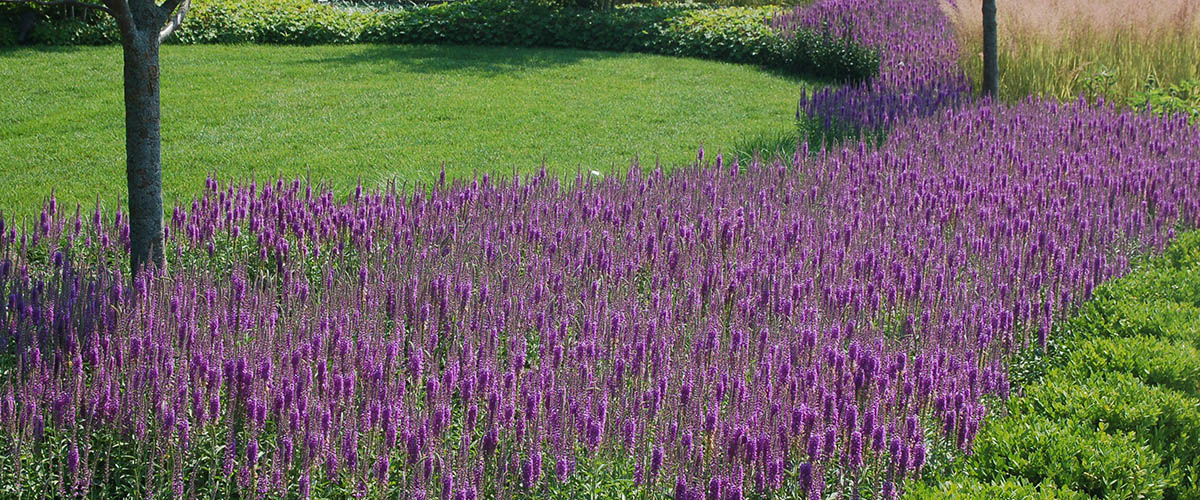
Evaluating Perennials for Chicagoland Gardens
Perennials in Focus is a plant evaluation program that examines new and underused plants for Chicagoland, the third largest metropolitan area in the country. A group of horticultural experts trials and evaluates plants at numerous locations across the region. Results help consumers, public gardens, growers, landscape designers, breeders, and other industry professionals make informed plant choices.
Reliable Geranium Maculatum Selections For Tree-Rooted Masses
A broad drift of Geranium maculatum can turn the difficult ground beneath deciduous trees into a calm, seasonal planting. In spring, the foliage forms a fresh green carpet and open flowers rise above it; by early summer, many plants retreat into dormancy, leaving room for later woodland companions. The effect is informal, generous and far more natural than a regimented row of shrubs.
For Australian gardeners, the main qualification is climate. These North American wild geraniums perform best where winters are cool and summers are not relentlessly hot and dry. The Chicagoland evaluations are especially useful because they examine plants across several gardens and seasons, rather than judging a selection from a single nursery bench. Use those regional observations as a guide, then match the plant to local shade, rainfall and soil conditions.
Why Wild Geranium Suits Deciduous Trees
Geranium maculatum is a clump-forming perennial that emerges early enough to take advantage of spring light before a tree canopy closes. Its divided leaves create a textural ground layer, while flowers in soft pink, rose or white attract attention without looking overly formal. Mature plants commonly reach about 45–75 centimetres high and spread to a similar width, depending on soil and moisture.
The plant also has a useful rhythm for mass planting. It looks substantial during the main spring display, tolerates a degree of dry shade once established and usually becomes less prominent as summer progresses. That seasonal retreat is an advantage beneath deciduous trees, where bulbs, ferns and late-emerging perennials can occupy the space afterwards.
This is not a plant for compacted lawn soil or the baked strip beside a north-facing brick wall. In Melbourne’s cooler suburbs or Canberra gardens with reliable winter chill, it has a better chance of following its natural cycle than in tropical Queensland. In warmer areas, use it only where the root zone stays cool and receives supplementary moisture.
Strong Selections For Broad Drifts
‘Bevan’s Variety’ is a dependable choice when the aim is a classic, floriferous woodland effect. It produces pink to rose flowers above mounded foliage and works well when planted in repeated groups. Its appeal lies in balance: the plant has enough presence for a large bed without becoming visually heavy.
‘Album’ offers the cleanest colour contrast, with white flowers set against green foliage. In a large planting, pale blooms can brighten deep shade and remain visible beneath broad canopies. White flowers may look particularly effective in an Australian garden where evening entertaining and low winter sun make lighter colours valuable.
‘Elizabeth Ann’ is noted for its bronze-toned foliage, giving it a stronger foliage role than a plain green form. The colour is most useful in spring, before the canopy becomes dense. It can provide a sophisticated understorey beside silver birches, clipped hedges or dark-barked trees, although excessive shade may reduce the intensity of the foliage.
Compact And Dramatic Options
‘Espresso’ is among the most recognisable selections because of its chocolate-bronze leaves and pale pink flowers. It is a good candidate for a designed mass under trees where foliage contrast matters as much as bloom. Plant it in generous blocks rather than scattering individual specimens, since repeated dark foliage creates a clearer visual statement.
‘Chatto’ is another selection valued for darker foliage and a refined habit. It suits gardeners who want a woodland planting with more structure and less visual softness. The colour can vary with light, soil and seasonal conditions, so assess it over a full growing season before expecting the same depth of tone shown in catalogue photographs.
For public gardens, botanic collections and larger residential landscapes, it is sensible to combine one dependable green-leaved form with one darker selection. The green form carries the mass and the darker form supplies punctuation. This approach also reduces the risk of a single cultivar looking disappointing if a particular site proves too hot, too dry or too shaded.
Matching Plants To Australian Conditions
A deciduous canopy does not automatically create moist shade. Established trees can remove large amounts of water from the soil, especially during dry Australian summers. Prepare the planting area with compost or well-rotted organic matter, but avoid piling soil against trunks or damaging major surface roots. A thick organic mulch will moderate temperature and reduce evaporation, though it should be kept clear of the trunk flare.
In Adelaide or inland New South Wales, irrigation may be needed through the first two summers and during prolonged autumn dryness. In Sydney, drainage and humidity deserve equal attention; crowded foliage in poorly ventilated soil can decline after wet periods. Gardeners in Tasmania and the cooler parts of Victoria may find the plant easier to establish, particularly under trees that provide summer shade without creating severe root competition.
Do not treat the plant as a permanent evergreen carpet. Mark its position while it is dormant, and underplant the retreating foliage with species that emerge later. Hellebores, woodland iris, Polygonatum, brunnera and selected ferns can extend the display, provided their water needs and winter performance are compatible.
Building A Mass Planting That Looks Natural
For a continuous drift, plant on roughly 40–60 centimetre centres, tightening the spacing where rapid coverage is important and widening it where budget or access is limited. A group of at least seven plants usually reads as a deliberate colony; larger beds benefit from irregular edges and repeated clusters rather than a rigid grid.
Prepare the whole bed before planting instead of improving only individual holes. This encourages roots to move laterally and makes later irrigation more even. Water deeply after planting, then check soil moisture below the mulch rather than relying on its surface appearance. Once established, the plants should tolerate moderate dry shade, but flowering and foliage quality will suffer if the root zone repeatedly becomes bone dry.
In Australian retail nurseries, availability can be uneven because named forms are often stocked in small numbers or brought in through specialist perennial growers. Confirm the cultivar before buying, particularly when a dark-leaved selection is central to the design. The programme’s trial history also demonstrates why multi-season evaluation matters: plant habit, flowering and persistence can change considerably after establishment.
Interpreting Chicagoland Results For Your Garden
A strong result in Chicagoland indicates useful qualities such as winter hardiness, reliable emergence, flowering performance and garden durability. It does not guarantee identical behaviour in Australia. The region has cold winters and warm summers, while many Australian gardens experience milder winters, intense sunlight, irregular rainfall or a longer period of heat stress.
Use the evaluation information to shortlist plants, then trial small groups locally before committing to hundreds. Record when foliage appears, how long flowers last, whether plants flop, and how quickly they recover after dry weather. This practical observation is especially important for landscape contractors and councils, where replacing an underperforming groundcover is expensive.
| Selection | Main Feature | Best Mass-Planting Use | Australian Site Notes |
|---|---|---|---|
| ‘Bevan’s Variety’ | Pink to rose flowers, green foliage | Reliable broad woodland drifts | Best in cool, moisture-retentive shade |
| ‘Album’ | White flowers | Brightening deep shade | Needs protection from severe heat and drought |
| ‘Elizabeth Ann’ | Bronze-toned foliage | Refined foliage contrast | Colour is stronger with filtered light |
| ‘Espresso’ | Chocolate-bronze foliage, pale flowers | Contemporary or high-contrast masses | Provide summer moisture in warmer districts |
| ‘Chatto’ | Dark foliage and neat habit | Structured understorey planting | Trial first where summers are hot or humid |
Choose ‘Bevan’s Variety’ for a generous green carpet, ‘Album’ for light, or ‘Espresso’ and ‘Elizabeth Ann’ when foliage contrast is the priority. Start with a properly prepared trial bed, monitor it through an Australian summer and expand only after the plants have proved their value. That measured approach produces a more reliable tree-understorey planting and gives growers, designers and home gardeners evidence suited to their own patch of ground.
In the Garden
Evaluator gardens are located across the Chicagoland area, representing a range of growing conditions. Visit our retail and wholesale partners to find trialled perennials for your own garden.
Retail & Wholesale: Hinsdale Nurseries (Willowbrook, IL), Mariani Nurseries (Kenosha, WI & Garden Prairie, IL), Northwind Perennials (Burlington, WI), The Growing Place (Aurora, IL).
Wholesale Only: Hinsdale Nurseries (Plano, IL), Intrinsic Perennial Gardens (Hebron, IL).
Our Evaluation Program
The 2017–2020 evaluation cycle included Agastache 'Blue Boa', Allium senescens 'Blue Eddy', Amsonia ciliata var. filifolia 'Georgia Pancake', Astilbe 'Chocolate Shogun', Boltonia astroides 'James Crocket', Brunnera 'Alexander's Great', and Geranium cinereum 'Jolly Jewel Purple'. Completed evaluations include Amsonia 'Blue Ice' (2004–07).
On April 10, 2020, the program published snapshot profiles for Vernonia lettermanii 'Iron Butterfly', Stokesia laevis 'Elf', Stachys officinalis 'Pink Cotton Candy', Lobelia 'Monet Moment', Helleborus 'Winter Thrillers', Geum 'Mai Tai', Geranium soboliferum 'Butterfly Kisses', Gentiana x intermedia 'True Blue', Eurybia divaricata, Asparagus 'Purple Passion', and Agastache 'Bolero'.
Browse the full collection of snapshots organized alphabetically — from A–D, E–H, I–Q, and R–Z — to find detailed performance data on perennials trialled across Chicagoland.