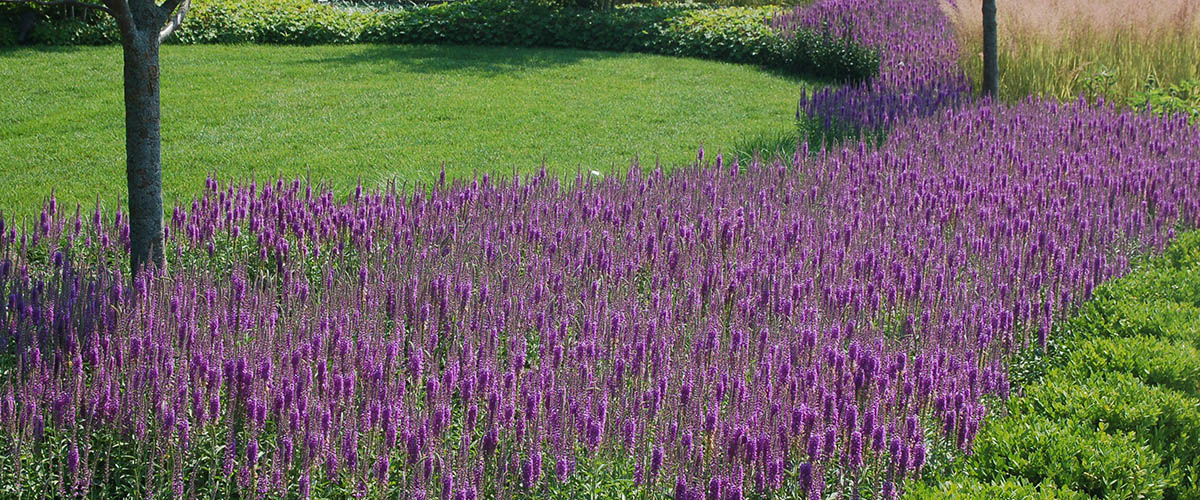
Evaluating Perennials for Chicagoland Gardens
Perennials in Focus is a plant evaluation program that examines new and underused plants for Chicagoland, the third largest metropolitan area in the country. A group of horticultural experts trials and evaluates plants at numerous locations across the region. Results help consumers, public gardens, growers, landscape designers, breeders, and other industry professionals make informed plant choices.
Best Aconitum Carmichaelii Cultivars for Late Summer Vertical Accent
Aconitum carmichaelii brings a rare combination to the perennial border: tall, architectural stems and intensely coloured flowers when many summer plants are beginning to fade. Its hooded blooms rise above divided foliage, creating a strong vertical accent without the broad footprint of a shrub or the visual weight of a large ornamental grass.
For Australian gardeners, timing needs a seasonal adjustment. In southern and cool inland districts, the flowering period usually falls from late summer into autumn, often from February to April. The best results come in gardens with reliable moisture, cool root conditions and some protection from harsh afternoon sun.
Why aconite earns a place in the border
Aconite, also called monkshood, forms an upright clump that commonly reaches 1.2–1.5 metres when established. The flower stems are particularly useful at the back of a mixed border, where they can lift the eye above hostas, ferns, brunnera, Japanese anemones and low-growing heucheras. Deep blue is the dominant colour, although some selections offer white-edged or softer violet flowers.
The plant’s late-season presence is valuable in places such as Melbourne, Hobart, Canberra and the cooler parts of the Blue Mountains. It can carry a garden through the point when spring perennials have finished and many summer-flowering plants are losing momentum. In a Melbourne backyard with dappled light, or a Canberra garden with a well-watered east-facing border, aconite can provide a strong final layer of height.
Flowering stems may need support in exposed positions, particularly after heavy rain or strong southerly weather. A discreet plant ring installed in spring is usually more attractive than tying stems after they have flopped. Cut flowers can last well in a vase, but wear gloves whenever handling the plant.
Cultivars with useful colour and structure
‘Arendsii’ remains one of the most dependable choices for a classic late-season display. It produces rich blue flowers on sturdy, upright stems and works well where a clear vertical line is needed. It is an excellent partner for silver foliage, pale grasses and white-flowered woodland perennials.
‘Bicolor’ adds contrast through blue and white flowers, making it easier to integrate into a softer planting scheme. The two-tone effect is especially effective against dark green foliage and in partly shaded areas where single-coloured blue flowers may recede. It suits a cottage-style border or a cool-toned Australian garden with foxgloves, astrantias and Japanese forest grass.
‘Spark’s Variety’ is widely valued for its intense blue flowers and good height. It can create a stronger visual statement than paler selections, especially when planted in groups of three or five. The cultivar is often associated with Aconitum henryi rather than pure A. carmichaelii, so check the botanical label when buying; its performance and habit still make it relevant to a late-summer aconite planting.
‘Cloudy’ and ‘Kelmscott’ are worth considering when a gardener wants something less predictable than standard deep blue. Stock and naming can vary between specialist nurseries, so ask for details of mature height, flower colour and parentage. This is particularly important in Australia, where imported perennial lines may be listed under different names or appear only through collector nurseries.
Matching the plant to an Australian garden
Aconitum carmichaelii prefers fertile, moisture-retentive soil that drains freely. It dislikes a dry root run, yet constantly waterlogged ground can lead to weak growth and root problems. Improve sandy soil with compost and well-rotted organic matter, while heavy clay benefits from raised planting, gypsum where appropriate and careful drainage.
In Sydney’s cooler, shaded suburbs, the plant may perform well with morning sun and afternoon protection, although hot, humid spells can shorten the display. Brisbane and tropical districts are generally more difficult because winter conditions are mild and summer heat can be intense. In those areas, aconite is best treated as a specialist plant for a cool, sheltered microclimate rather than a dependable border perennial.
Gardeners in Adelaide and Perth should focus on autumn planting, deep organic mulch and consistent irrigation through warm weather. Avoid placing it beside paving, reflective walls or north-west-facing fences, where radiant heat can scorch foliage. A drip line or soaker hose is more effective than frequent light sprinkling, particularly under Australian water restrictions.
Planting, care and safe handling
Plant dormant crowns or container-grown specimens in autumn or early spring, spacing them around 45–60 centimetres apart according to the cultivar’s expected spread. Give each plant enough room for air movement, while positioning it behind shorter companions that will conceal the lower stems as the season progresses.
Keep the soil evenly moist during establishment and renew the mulch each spring, leaving a small gap around the crown. Remove spent flower stems if seed production is unwanted, then cut the plant to ground level after the foliage has yellowed. A balanced slow-release fertiliser in spring is usually sufficient; excessive nitrogen can produce soft, leafy growth that needs more support.
Every part of aconite is poisonous if eaten, and sap can irritate the skin. Wear gloves when planting, dividing or cutting stems, wash tools afterwards and label the plant clearly. It is not a sensible choice beside a children’s play area, an accessible herb garden or a paddock where livestock browse. Keep cut stems and fallen plant material away from pets and poultry.
Using trial evidence when choosing plants
Regional trial information is useful because a catalogue photograph cannot show whether a cultivar stands upright after rain, flowers at a useful time or maintains good foliage through a long season. Perennials in Focus evaluates plants across multiple gardens and seasons, recording practical traits such as height, spread, bloom period and flower colour. Its trial approach provides helpful context for reading plant-performance information rather than treating a single nursery description as a guarantee.
Aconite should be assessed by habit as well as flower colour. A slightly shorter cultivar may be the better choice for a windy coastal garden, while a tall selection can be ideal behind a Melbourne mixed border. The same principle applies to other shade perennials; comparisons such as heuchera cold tolerance show why foliage retention and seasonal resilience matter alongside appearance.
| Cultivar | Flower impression | Approximate height | Best use |
|---|---|---|---|
| ‘Arendsii’ | Rich blue | 1.2–1.5 m | Strong back-of-border accent |
| ‘Bicolor’ | Blue and white | 1.0–1.4 m | Mixed or cottage-style planting |
| ‘Spark’s Variety’ | Intense deep blue | 1.2–1.5 m | Bold group planting |
| ‘Cloudy’ | Pale blue to blue-white tones | About 1.0–1.3 m | Softer woodland combinations |
| ‘Kelmscott’ | Usually softer violet-blue tones | About 1.0–1.4 m | Collector or specialist borders |
Availability changes from season to season, so Australian buyers should check specialist perennial nurseries, local plant fairs and reputable online growers rather than relying on a single retail chain. Ask whether a plant is true to name, whether it was grown in a cool district and how tall it performs in that nursery’s conditions. In the Australian market, a well-grown local division can establish more reliably than a stressed imported liner.
Choose a site with filtered light, rich soil and dependable moisture, then select the cultivar that fits the scale of the border. With careful placement and safe handling, Aconitum carmichaelii can give a cool-climate Australian garden a memorable lift precisely when late-season colour begins to thin.
In the Garden
Evaluator gardens are located across the Chicagoland area, representing a range of growing conditions. Visit our retail and wholesale partners to find trialled perennials for your own garden.
Retail & Wholesale: Hinsdale Nurseries (Willowbrook, IL), Mariani Nurseries (Kenosha, WI & Garden Prairie, IL), Northwind Perennials (Burlington, WI), The Growing Place (Aurora, IL).
Wholesale Only: Hinsdale Nurseries (Plano, IL), Intrinsic Perennial Gardens (Hebron, IL).
Our Evaluation Program
The 2017–2020 evaluation cycle included Agastache 'Blue Boa', Allium senescens 'Blue Eddy', Amsonia ciliata var. filifolia 'Georgia Pancake', Astilbe 'Chocolate Shogun', Boltonia astroides 'James Crocket', Brunnera 'Alexander's Great', and Geranium cinereum 'Jolly Jewel Purple'. Completed evaluations include Amsonia 'Blue Ice' (2004–07).
On April 10, 2020, the program published snapshot profiles for Vernonia lettermanii 'Iron Butterfly', Stokesia laevis 'Elf', Stachys officinalis 'Pink Cotton Candy', Lobelia 'Monet Moment', Helleborus 'Winter Thrillers', Geum 'Mai Tai', Geranium soboliferum 'Butterfly Kisses', Gentiana x intermedia 'True Blue', Eurybia divaricata, Asparagus 'Purple Passion', and Agastache 'Bolero'.
Browse the full collection of snapshots organized alphabetically — from A–D, E–H, I–Q, and R–Z — to find detailed performance data on perennials trialled across Chicagoland.