Evaluating Perennials for Chicagoland Gardens
Perennials in Focus is a plant evaluation program that examines new and underused plants for Chicagoland, the third largest metropolitan area in the country. A group of horticultural experts trials and evaluates plants at numerous locations across the region. Results help consumers, public gardens, growers, landscape designers, breeders, and other industry professionals make informed plant choices.
Heat stress in Penstemon barbatus reflective microclimates
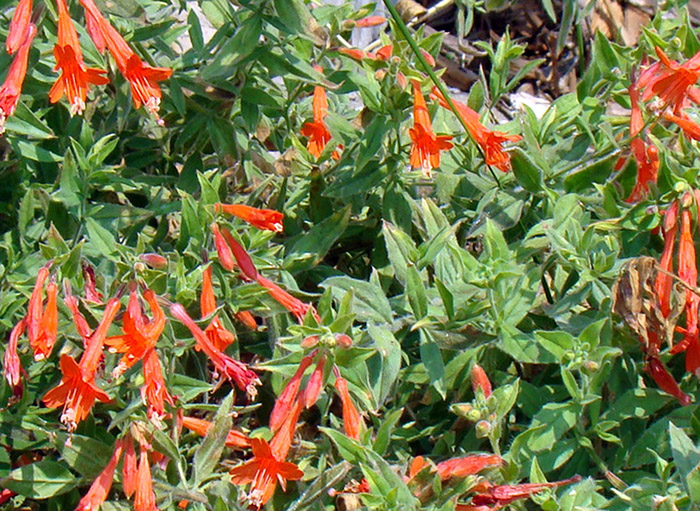
Penstemon barbatus, commonly called beardtongue, is a clump-forming perennial valued for upright stems of tubular flowers and a long flowering season. Australian gardeners use it in sunny borders, pollinator gardens and naturalistic plantings, where it adds vertical form and strong colour. Its ornamental appeal is clear; its tolerance of reflected heat is less certain.
Reflected sunlight can make a narrow garden bed behave like a much warmer site, particularly beside pale masonry, stone or paving. Assessing the heat stress response of Penstemon barbatus in reflective microclimates therefore requires more than noting whether the plant survived. Flowering duration, flower size, stem height, spread, leaf condition and water demand all reveal how the plant is coping.
Reflected heat creates distinct growing conditions
Chicagoland trials place selected perennials across gardens that differ in soil, exposure and maintenance. The trial mission explains how collaboration among public gardens, growers and horticultural professionals turns observations from several sites into region-specific guidance. Reflective microclimates are especially useful test conditions because they extend the growing season into the hottest part of a site without relying on a glasshouse.
Radiant heat and air temperature are related but not identical. A pale wall can warm foliage and the soil immediately beside it, increase evaporation and raise the heat load around the crown even when a thermometer records the same air temperature as an open bed. Orientation also matters: a south-facing wall is a familiar Chicago hotspot, while a north-facing wall often receives stronger year-round reflection in much of Australia.
Building a useful heat stress trial
A sound comparison needs several plants of the same size and age, replicated across positions rather than represented by one specimen in each treatment. Random placement reduces bias from shade, soil variation and irrigation. Researchers should record establishment, irrigation, soil moisture and any pest or disease pressure, since missing water or an early aphid problem can easily be mistaken for thermal injury.
Measurements should separate visible stress from underlying strain. Canopy or leaf temperature, substrate moisture and early-morning water status provide useful context, while bloom date, flower colour, height and spread capture ornamental performance. Plants should be checked during a hot spell and again after relief, because severe midday wilting can disappear overnight without indicating that the root zone was comfortable.
Australian trials should repeat the core method rather than copy Chicago irrigation schedules. January and February can bring intense radiation in Adelaide or Perth, a sudden “heat dump” in Melbourne, and humid nights around Sydney or Brisbane. Local soil temperature, rainfall and evaporation must determine the watering treatment, and the reversed seasons must be reflected in the calendar.
Signs of stress and plant performance
The first signals are often subtle. Shortened internodes, reduced stem extension, drooping leaves during the warmer part of the day and lower flower density can precede obvious scorch. In a reflective pocket, irrigation demand may rise while bloom duration falls; in a moderately stressed plant, flowering may arrive earlier but with fewer open flowers. These responses should be recorded rather than reduced to a single survival score.
| Microclimate | Main heat effect | Signs to record | Useful response |
|---|---|---|---|
| Open, free-draining soil | Lower radiant load and steadier root-zone moisture | Normal height, steady spread, longer flowering | Use as the local reference position |
| Beside a pale masonry wall | Higher leaf and soil temperature with rapid drying | Leaf scorch, shortened stems, fewer flowers | Increase moisture checks and maintain airflow |
| Along light-coloured paving | Strong reflected radiation around the lower canopy | Warm roots, midday wilt, flower fading | Add mulch and separate plants from the hard edge |
| Container on paving | Small root volume and high evaporative demand | Frequent drying, rapid wilting, reduced bloom | Shelter or move the container during peak heat |
A plant that maintains open flowers, stable height and active growth under the reflective treatment shows stronger heat resilience than one that merely persists. Flower colour should also be judged under clear midday sun and softer morning light, as petals can look intense in one condition and washed out in another. Photographs taken at the same time and angle make seasonal comparisons far more useful than isolated descriptions.
Interpreting Chicagoland results for Australia
Chicagoland findings are a strong regional dataset, but they are not a direct forecast for Australia. The two regions share hot summers, reflective urban surfaces and periods of drought stress, yet rainfall patterns, humidity, soil types and winter conditions differ. A result from an Illinois trial should therefore identify mechanisms and relative rankings, then be checked in Australian soil and climate before a plant is sold as locally proven.
The practical value is the ability to distinguish heat tolerance from general vigour. Penstemon barbatus may perform well in a sunny, sharply drained site yet lose flowers beside a hot wall. The same plant can establish readily after winter rain in Melbourne, then face a different challenge during a dry northerly summer. Local gardeners often describe that sudden Melbourne rise as a “heat dump”, while people in Adelaide speak of the whole place “baking”; both phrases point to rapid, site-specific heat load.
Australian retail markets also reward evidence that is more precise than labels such as “full sun” or “drought hardy”. Garden centres, independent nurseries and online plant suppliers need information on regional establishment, peak flowering, mature spread and failure conditions. Public garden results can help retailers explain why a healthy plant in a pot may still struggle in a reflective courtyard. Regional trials should also note pollinator activity, since flowers that remain open and accessible are more useful than a stressed display with little insect traffic.
Choose the right plant for the right place
Before buying, check the mature height and spread against the space, then ask whether a wall or paved edge will trap heat around the crown. For Penstemon barbatus, select a sunny position with excellent drainage, keep competing plants from restricting airflow, and inspect it during the hottest part of a clear day. Where reflected heat is unavoidable, use a container that can be moved or choose a trial site with some afternoon protection.
Trial several plants rather than relying on one dramatic result. Record the first flowering date, peak bloom, flower colour, height, spread, leaf condition and watering frequency from spring through summer. Gardeners, growers and public gardens can compare those observations with local heat records and soil moisture, then report failures as carefully as successes. Buy from a specialist perennial nursery, use the recorded information to match the species to the microclimate, and inspect the plant again after the next hot spell.
In the Garden
Evaluator gardens are located across the Chicagoland area, representing a range of growing conditions. Visit our retail and wholesale partners to find trialled perennials for your own garden.
Retail & Wholesale: Hinsdale Nurseries (Willowbrook, IL), Mariani Nurseries (Kenosha, WI & Garden Prairie, IL), Northwind Perennials (Burlington, WI), The Growing Place (Aurora, IL).
Wholesale Only: Hinsdale Nurseries (Plano, IL), Intrinsic Perennial Gardens (Hebron, IL).
Our Evaluation Program
The 2017–2020 evaluation cycle included Agastache 'Blue Boa', Allium senescens 'Blue Eddy', Amsonia ciliata var. filifolia 'Georgia Pancake', Astilbe 'Chocolate Shogun', Boltonia astroides 'James Crocket', Brunnera 'Alexander's Great', and Geranium cinereum 'Jolly Jewel Purple'. Completed evaluations include Amsonia 'Blue Ice' (2004–07).
On April 10, 2020, the program published snapshot profiles for Vernonia lettermanii 'Iron Butterfly', Stokesia laevis 'Elf', Stachys officinalis 'Pink Cotton Candy', Lobelia 'Monet Moment', Helleborus 'Winter Thrillers', Geum 'Mai Tai', Geranium soboliferum 'Butterfly Kisses', Gentiana x intermedia 'True Blue', Eurybia divaricata, Asparagus 'Purple Passion', and Agastache 'Bolero'.
Browse the full collection of snapshots organized alphabetically — from A–D, E–H, I–Q, and R–Z — to find detailed performance data on perennials trialled across Chicagoland.