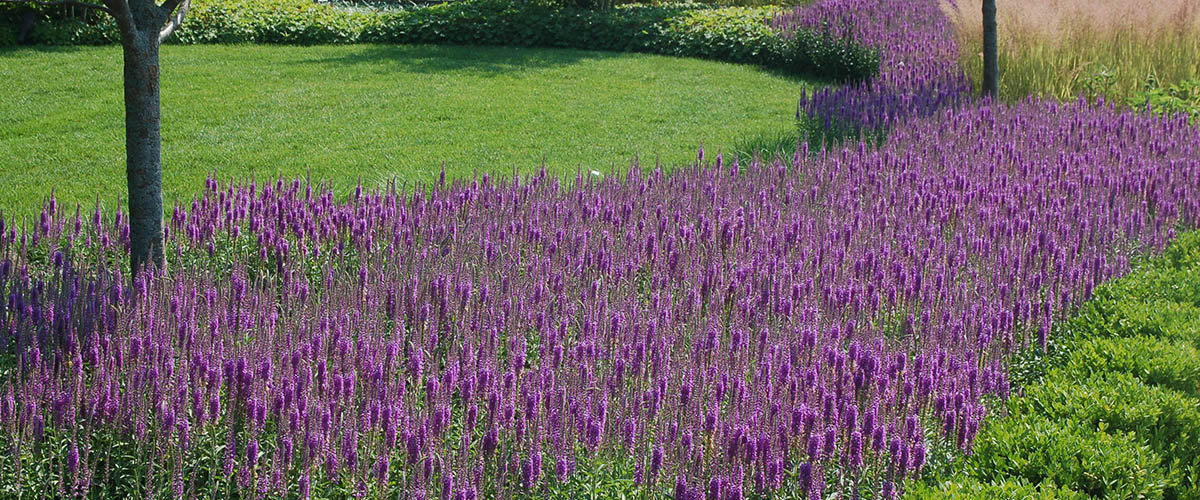
Evaluating Perennials for Chicagoland Gardens
Perennials in Focus is a plant evaluation program that examines new and underused plants for Chicagoland, the third largest metropolitan area in the country. A group of horticultural experts trials and evaluates plants at numerous locations across the region. Results help consumers, public gardens, growers, landscape designers, breeders, and other industry professionals make informed plant choices.
Yucca filamentosa hardiness in northern Illinois winters
Yucca filamentosa, commonly called Adam’s needle, is valued for its architectural evergreen foliage, creamy-white flowers and ability to tolerate heat, drought and poor soils. Yet its reputation for toughness can obscure the conditions that determine whether it survives a northern Illinois winter with a healthy crown and resumes normal growth in spring.
Winter hardiness involves more than the lowest recorded temperature. Chicagoland’s alternating freezes, thaws, saturated soil, snow and ice can challenge a plant differently from simple cold. Perennials in Focus trials across gardens and seasons provide regional evidence that helps gardeners interpret both winter survival and later performance.
What northern Illinois actually tests
Chicago and nearby northern Illinois generally fall within USDA hardiness zones 5b to 6a, although local minimum temperatures vary considerably. Exposure, snow cover and urban warmth create a patchwork of microclimates. The same yucca may face different stress in a western suburb, a northern garden and a site beside Lake Michigan.
Cold tolerance alone does not predict performance. Waterlogged clay can damage roots and the crown even when temperatures remain within the plant’s normal hardiness range. Wind-driven ice, repeated freeze-thaw cycles and poorly drained soil during spring thaw are equally important factors.
| Assessment factor | Well-drained, established plant | Cold, wet or exposed site | Interpretation |
|---|---|---|---|
| Winter crown | Remains firm and continues growth | Rot, weakening or delayed recovery | Drainage is as important as cold tolerance |
| Foliage | Retains green or bronze leaves | Tip burn, broken blades or dieback | Cosmetic damage may not indicate plant death |
| Spring growth | Produces vigorous new leaves | Sparse growth from a compromised crown | Check the crown rather than old foliage alone |
| Flowering | Develops a strong flower stalk | Delayed or reduced flowering | Recovery may take more than one season |
Reading winter survival correctly
A newly planted yucca may struggle through its first winter because roots have not yet spread or acclimated. Established specimens normally have a stronger chance of surviving, particularly when planted in spring and allowed to develop roots before autumn. Dividing or moving an established plant late in the season can reset that advantage.
Leaf browning does not always equal mortality. Yucca filamentosa is evergreen in suitable conditions, but frozen foliage may turn bronze or collapse while the protected crown remains alive. Scrape gently near the base or inspect for firm new growth before removing a plant that appears damaged.
Snow often protects soil and roots from the coldest temperatures, but it can also remain heavy and wet around the crown. Repeated thawing followed by refreezing is particularly troublesome in compacted soil. The plant’s survival rating should therefore reflect crown condition, spring recovery and the ability to resume growth, not merely whether some leaves remained.
What multi-site trials can reveal
A single garden cannot represent every northern Illinois site. Frost pockets, reflected heat, prevailing wind, soil type and snow management all influence results. Collaborative evaluation across several gardens helps distinguish consistent species traits from unusually favourable conditions in one location.
Perennials in Focus makes this evidence accessible through its regional trial snapshots, where observations can be compared across locations and growing seasons. The program records practical characteristics such as bloom period, flower colour, height and spread alongside winter performance.
Useful records include the original planting date, irrigation during establishment, soil drainage and the extent of spring dieback. They also show whether a plant flowered normally after difficult weather. A specimen that survives but produces weak growth for two years is less valuable than one that recovers strongly and maintains its expected habit.
Site preparation that protects the crown
Start by improving drainage rather than adding heavy enrichment. Sandy loam enriched with organic matter is generally safer than a poorly drained planting hole made richer but still surrounded by clay. A slightly raised mound, sloping site or drainage correction can prevent winter water from collecting around the crown.
Planting after the soil has warmed in late spring gives roots a full growing season before freezing weather. Water regularly during establishment, but allow the surface to begin drying between irrigations. Once established, the plant tolerates extended dry periods, although sudden drought after years of wet conditions can still cause stress.
Keep mulch away from the crown and avoid piling wet leaves against the base. Moderate fertility is sufficient; rich feeding encourages lush, softer growth that may be less resilient. Remove dead leaves carefully, retain healthy foliage and cut spent flower stalks near the base after they have finished. Keep new offsets under control where spreading is undesirable, as established rhizomes can expand beyond the original planting area.
Translating the findings for Australia
Melbourne’s cool, wet winters and regular frosts provide the closest useful stress comparison for northern Illinois, although local clay soils still require attention. Adelaide combines hot, dry summers with cool, wet winters, so a successful plant needs both summer irrigation and excellent winter drainage. In Sydney, mild, humid winters and occasional frost in inland or exposed pockets make cold damage less predictable.
Many Australian gardeners make weekend trips to nurseries or large home-improvement stores, where Yucca filamentosa may be sold in a container under broad labels such as “full sun” or “drought tolerant.” Those descriptions offer useful starting points, but they rarely explain winter hardiness, mature spread or regional differences. Container-grown plants also experience different root and moisture conditions from specimens planted directly in garden soil.
Northern Illinois evidence should therefore be treated as a performance baseline rather than a direct planting recommendation for Australia. Match the plant’s cold and drainage requirements to your local rainfall pattern, then monitor the crown, new growth and flowering during the first two years. Its ability to withstand a Chicago winter does not guarantee tolerance of tropical humidity, prolonged summer rain or intense reflected heat.
Buying and importing under Australian rules
The Australian nursery market offers established yuccas as feature plants, but labels can vary widely. Look for a healthy specimen with a firm crown, firmly attached leaves and no softness at the base. Ask the grower about its mature dimensions and whether it was propagated from seed, offsets or a named selection, since Yucca filamentosa can vary in habit and flower form.
Under the Commonwealth’s Biosecurity Act 2015, imported plants, seeds and other biological material may be subject to strict conditions. Anyone considering an overseas purchase should check the Biosecurity Import Conditions system, BICON, before ordering and obtain any permit, treatment or inspection required. Soil, pests and plant pathogens can make poorly documented imports particularly risky.
State environmental weed laws and local council by-laws may also affect where a plant can be grown, particularly on verges or near waterways. Requirements differ between jurisdictions, so check the relevant state agency and council before planting or importing. Buying from an Australian nursery with traceable stock avoids unnecessary regulatory uncertainty and supports a more responsible local market.
A confident decision for your garden
Yucca filamentosa is generally a dependable choice for northern Illinois when the crown stays well drained and the plant is established before winter. Regional trials support judging it on recovery and long-term performance rather than on a single night’s minimum temperature or the condition of its old leaves.
For an Australian garden, use the same evidence alongside local climate and soil information. Compare your site’s winter wetness, summer moisture and frost pattern, allow for mature spread, and select a reputable nursery that can document the plant’s identity and history.
Check the regional trial records, choose a healthy Yucca filamentosa, plant it in free-draining soil and record its first winter. That approach turns northern Illinois observations into a sound, site-specific decision for your garden.
In the Garden
Evaluator gardens are located across the Chicagoland area, representing a range of growing conditions. Visit our retail and wholesale partners to find trialled perennials for your own garden.
Retail & Wholesale: Hinsdale Nurseries (Willowbrook, IL), Mariani Nurseries (Kenosha, WI & Garden Prairie, IL), Northwind Perennials (Burlington, WI), The Growing Place (Aurora, IL).
Wholesale Only: Hinsdale Nurseries (Plano, IL), Intrinsic Perennial Gardens (Hebron, IL).
Our Evaluation Program
The 2017–2020 evaluation cycle included Agastache 'Blue Boa', Allium senescens 'Blue Eddy', Amsonia ciliata var. filifolia 'Georgia Pancake', Astilbe 'Chocolate Shogun', Boltonia astroides 'James Crocket', Brunnera 'Alexander's Great', and Geranium cinereum 'Jolly Jewel Purple'. Completed evaluations include Amsonia 'Blue Ice' (2004–07).
On April 10, 2020, the program published snapshot profiles for Vernonia lettermanii 'Iron Butterfly', Stokesia laevis 'Elf', Stachys officinalis 'Pink Cotton Candy', Lobelia 'Monet Moment', Helleborus 'Winter Thrillers', Geum 'Mai Tai', Geranium soboliferum 'Butterfly Kisses', Gentiana x intermedia 'True Blue', Eurybia divaricata, Asparagus 'Purple Passion', and Agastache 'Bolero'.
Browse the full collection of snapshots organized alphabetically — from A–D, E–H, I–Q, and R–Z — to find detailed performance data on perennials trialled across Chicagoland.