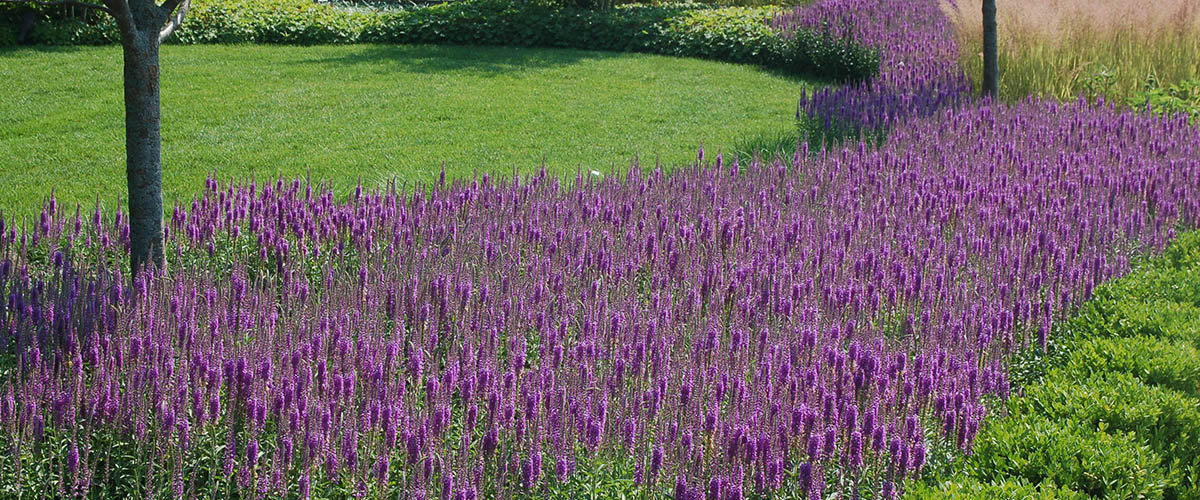
Evaluating Perennials for Chicagoland Gardens
Perennials in Focus is a plant evaluation program that examines new and underused plants for Chicagoland, the third largest metropolitan area in the country. A group of horticultural experts trials and evaluates plants at numerous locations across the region. Results help consumers, public gardens, growers, landscape designers, breeders, and other industry professionals make informed plant choices.
Lupinus perennis establishment across acidic and alkaline soils
Lupinus perennis, or sundial lupine, is a North American perennial with blue flowers and a deep taproot. It is easily confused in Australian nurseries with annual lupin hybrids and agricultural species such as Lupinus angustifolius. Assessing the establishment success of Lupinus perennis in acidic versus alkaline soils therefore starts with checking the botanical name and seed provenance. Learn more about Snapshots E H.
Establishment means more than temporary emergence. It covers root and leaf development, rhizobial nodulation, and survival through the first demanding season. Perennials in Focus evaluates plants across Chicagoland gardens and seasons, providing a useful regional baseline that must be translated carefully for Australian soil, climate and nursery conditions. Learn more about In The Garden.
Southern Hemisphere timing changes the trial calendar. Autumn sowing in Melbourne can give seedlings cool, moist soil before summer, while humid summers and heavy rain in Sydney increase damping-off risk. Adelaide gardens often contain alkaline clay, whereas Perth's sandy ground drains freely but may also be alkaline. Such contrasts can outweigh a small pH difference.
The Australian retail market mainly sells familiar annual lupin hybrids, leaving true L. perennis as a specialist exotic. Gardeners usually encounter it through garden centres or online nurseries, while councils use selected plants in public displays. Accurate labels matter because buyers may expect a long-flowering bedding plant rather than a short-lived perennial that needs excellent drainage.
Why soil pH changes establishment
Sundial lupine evolved mainly in open sites of eastern and central North America, where acidic to neutral soils are common. Soil pH affects nutrient availability: iron becomes less available as pH rises, phosphorus can be restricted at both extremes, and rhizobial nodulation may weaken when conditions are unsuitable.
The practical comparison is conditional rather than absolute:
| Feature | Acidic soil, about pH 5.0–6.5 | Alkaline soil, about pH 7.5–8.5 |
|---|---|---|
| Root-zone chemistry | Phosphorus and biological activity may be favourable; iron can still be limited | Available phosphorus and iron may fall; bicarbonate can limit uptake |
| Rhizobial nodulation | Usually compatible with mildly acidic to neutral conditions | May be weaker, especially in hot, dry or compacted soil |
| Main establishment risk | Aluminium or manganese toxicity below roughly pH 5 | Salt accumulation and poor drainage can compound alkaline stress |
| Expected performance | More consistent in a sunny, well-drained bed | Possible, but often slower and less uniform without modification |
Texture and drainage can magnify these effects. An acidic sandy site may still fail through winter saturation, while a well-structured alkaline loam may establish successfully. Published trial snapshots are most useful when pH is reported alongside soil class, moisture and weather rather than treated as a stand-alone result.
What counts as establishment success
A useful scorecard should separate emergence, early rooting, vegetative stability and persistence. Record germination percentage and date, then measure surviving plants at fixed intervals. Note leaf colour, root length where practical, nodulation, insect damage and the causes of losses.
Seedlings and container-grown plants need separate cohorts. Direct sowing tests establishment under local soil and rainfall, while transplants test nursery production and garden performance. Counting only plants that reach saleable size can hide losses from damping-off, root disturbance or failure through summer.
Extension beyond the first year is decisive. In Australia, document survival through the hottest period, winter dormancy and renewed spring growth, followed by flowering. Height, spread, bloom period and flower colour can then be compared with establishment data rather than substituted for it.
Designing a fair soil comparison
A credible comparison should use one seed lot, consistent planting depth, spacing and watering across randomised plots. Test the original soil first, because pH labels on bags are broad and council maps rarely describe a garden bed. Replicate each treatment, with untreated soil as the control.
Adjust pH gradually and document the method. Elemental sulphur lowers pH over months, while garden lime raises it; neither should be applied by guesswork. Retain the same organic matter, mulch and fertiliser in every treatment, and retest each bed after amendments settle.
Run the work in more than one setting. Trials in a sunny Melbourne courtyard, a free-draining Perth bed and a heavier Adelaide plot would show whether pH interacts with heat, rainfall and soil structure. Shield young plants from severe wind and drying, and record every irrigation or replant that could affect results.
Acidic soil advantages and limits
In a mildly acidic bed, phosphorus and biological activity may support steady root growth, while rhizobial nodulation can provide useful nitrogen. This advantage is strongest when the root zone is moist but well aerated.
Acidity is not automatically beneficial. Below roughly pH 5, aluminium and manganese can become toxic, while phosphorus can bind tightly to iron and aluminium oxides. Heavy additions of acidic compost or sulphur can overshoot the target, harming fine roots even when a surface test reads acidic.
For gardeners in wetter parts of Melbourne or Sydney, drainage may be the larger concern. Raised beds, generous spacing and careful irrigation can matter more than a modest pH change. Sundial lupine needs strong light and should not occupy a damp corner merely because the soil test is favourable.
Alkaline soil constraints and workarounds
Alkaline soil presents a different pattern. Bicarbonate and higher pH can reduce iron and manganese uptake, producing pale new leaves while older foliage stays green. Phosphorus may be less available, compacted or dry soil can restrict roots, and nodulation may become less reliable.
Amend alkaline clay with suitable organic matter and use a raised bed of well-drained, low-alkalinity mix. Where lowering pH is justified by a test, apply elemental sulphur slowly and seek local advice on the rate. Avoid repeated heavy liming, which can correct one season and worsen the next.
Adelaide offers a useful local context: alkaline clay can retain winter water and become hard during summer. Perth's sandy profiles drain freely but can require frequent irrigation, with salts concentrating around pots. In either city, a container or carefully built bed gives more control than a small pocket of unchanged native soil.
Reading regional findings for Australia
Regional results are most useful when growing conditions stay visible. The Perennials in Focus garden examples can show how the same perennial responds in different exposures and soils. For an Australian comparison, record sun exposure, wind, irrigation frequency, and pH and texture at root depth, not just a pot label.
Chicagoland's cold winters and variable summer rainfall provide a useful stress test, but they do not replicate Melbourne's winter, Adelaide's summer or Sydney's humidity. Treat overseas flowering dates as relative stages rather than calendar dates. Pair survival scores with weather records so drought, heat or cold is not credited to soil treatment.
A local network could place one seed lot in home gardens, public beds and specialist nursery trials. Public gardens can contribute controlled observations, while household plots reveal realistic failures. Retailers can then offer accurate provenance and an honest description of expected habit, rather than marketing every seedling as an easy exotic perennial.
Making a measured planting choice
Check the full botanical name before purchase, especially through an Australian garden centre or online nursery. L. perennis should not be presented as native to Australia or confused with annual bedding lupins. Buyers can use store feedback to report unclear labelling, missing provenance or plants that failed despite accurate care instructions.
Imported seed and plants must comply with Australian biosecurity requirements under the Biosecurity Act 2015, including conditions set by the Department of Agriculture, Fisheries and Forestry. Use reputable suppliers and keep imported material separate until its status is clear. Garden clubs and councils can share source information without moving potentially infested soil between sites.
Start with a soil test, choose a sunny, sharply drained position, and plant a small matched group in the best available bed. Record emergence, root and leaf condition, summer survival and the following spring's flowering, then compare those results with untreated soil. This evidence gives Australian gardeners a dependable basis for deciding where sundial lupine belongs.
In the Garden
Evaluator gardens are located across the Chicagoland area, representing a range of growing conditions. Visit our retail and wholesale partners to find trialled perennials for your own garden.
Retail & Wholesale: Hinsdale Nurseries (Willowbrook, IL), Mariani Nurseries (Kenosha, WI & Garden Prairie, IL), Northwind Perennials (Burlington, WI), The Growing Place (Aurora, IL).
Wholesale Only: Hinsdale Nurseries (Plano, IL), Intrinsic Perennial Gardens (Hebron, IL).
Our Evaluation Program
The 2017–2020 evaluation cycle included Agastache 'Blue Boa', Allium senescens 'Blue Eddy', Amsonia ciliata var. filifolia 'Georgia Pancake', Astilbe 'Chocolate Shogun', Boltonia astroides 'James Crocket', Brunnera 'Alexander's Great', and Geranium cinereum 'Jolly Jewel Purple'. Completed evaluations include Amsonia 'Blue Ice' (2004–07).
On April 10, 2020, the program published snapshot profiles for Vernonia lettermanii 'Iron Butterfly', Stokesia laevis 'Elf', Stachys officinalis 'Pink Cotton Candy', Lobelia 'Monet Moment', Helleborus 'Winter Thrillers', Geum 'Mai Tai', Geranium soboliferum 'Butterfly Kisses', Gentiana x intermedia 'True Blue', Eurybia divaricata, Asparagus 'Purple Passion', and Agastache 'Bolero'.
Browse the full collection of snapshots organized alphabetically — from A–D, E–H, I–Q, and R–Z — to find detailed performance data on perennials trialled across Chicagoland.